
speech
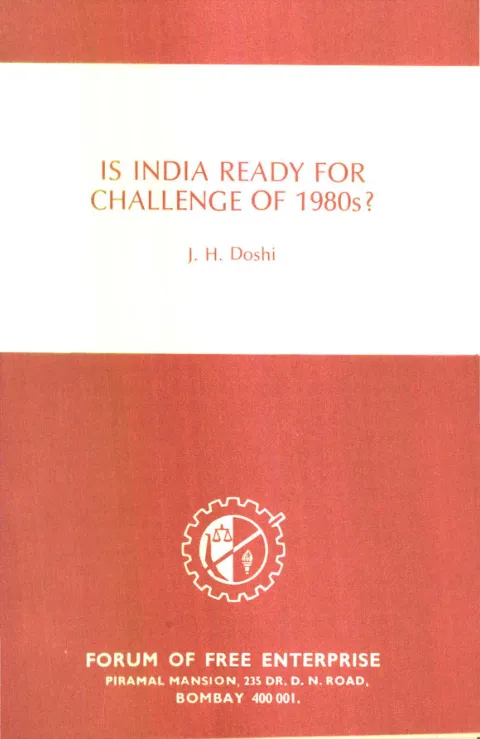
Is India Ready for Challenge of 1980s?
By J. H. Doshi
Published by M. R. PAI for the Forum of Free Enterprise 235, Dr. Dadabhai Naoroji Road, Bombay-400 001, and printed at TATA PRESS Ltd., 414, Veer Savarkar Marg, Prabhadevi, Bombay 400 025. · Bombay · 1979
13 pages
Summary
J. H. Doshi delivered this Presidential address at the 23rd Annual General Meeting of the Forum of Free Enterprise in Bombay on 13 November 1979, and the Forum published it as a pamphlet a few days later. Doshi frames India at the close of the 1970s as ‘a giant in chains’ — chains, he insists, that the country has deliberately forged for itself through bureaucratic controls, statist planning and an entrenched political dogma he names ‘Synthetic Socialism’. The address reads as a stock-taking exercise: 28 years after planned economic development was initiated, foodgrain output has barely doubled while millions remain too poor to buy grain from the very buffer stocks that are rotting in unscientific storage; unemployment registrations have shot up from 34 lakhs in 1969 to 136 lakhs in 1979; foreign debt has climbed from Rs. 32 crores in 1951 to over Rs. 7,000 crores; and inflation, running at roughly 17 per cent above the previous year, has by his count been a fixture of Indian life for a quarter-century.
Against this gloom, Doshi sets a counter-archive of what citizens have done despite the state — the leap in gem, jewellery and diamond exports from Rs. 10 crores in 1965-66 to Rs. 700 crores; the Rs. 200 crores a year remitted by semi-literate workers in the Middle East; the women who built a multi-crore ‘Pappad’ industry on a few hundred rupees of capital. The lesson he draws is that India’s economic potential is sleeping under the weight of permits, licences, credit squeezes, power cuts, nationalised industries that blame one another, and a Government ‘machinery’ that he says has become ‘an engine of corruption and oppression’. Public-sector expansion, in his telling, has both starved primary public functions (drinking water, primary education, village roads, public health) and crowded out productive private enterprise.
Doshi closes by widening the lens to the coming decade: population pressure, stagflation, energy shortages, an adverse trade balance and the looming collapse of the foreign-exchange surplus once oil import costs are fully felt. He warns the country may slide back to the conditions of the late 1950s and early 1960s unless Government, business and economists co-operate — as, he argues, they have in Japan, South Korea, Taiwan and Singapore — and unless ‘vigorous public opinion’ compels the political class to abandon dogma. The pamphlet ends not with a programme but with a question: ‘Can we make this happen?’, and reminds readers that the Forum of Free Enterprise has been making this case for 23 years.
Key points
-
Frames India circa 1979 as a self-shackled giant whose chains are ‘carefully designed and forged’ by its own policy choices.
-
Treats the buffer stock of nearly 20 million tonnes of foodgrains rotting alongside millions without purchasing power as the paradigmatic Indian paradox.
-
Marshals data on debt (Rs. 32 crores in 1951 to over Rs. 7,000 crores in 1979), unemployment (34 lakhs to 136 lakhs registered between 1969 and 1979) and inflation (~17% YoY, a 25-year continuum) to argue the planning model has failed on its own terms.
-
Celebrates the unplanned successes — gems/jewellery/diamond exports, Middle East remittances, the women’s Pappad industry — as evidence of a ‘sleeping economic giant’ that officialdom obstructs.
-
Indicts the public sector for crowding out primary state functions (water, primary education, roads, health) while running bread-making, soft drinks and bus transport at a loss.
-
Names the underlying ideology ‘Synthetic Socialism’ — statism plus hypocrisy — and identifies ceilings on executive pay, bans on company donations to parties, and the resulting industrialist arm-twisting as symptoms of the double standard.
-
Warns the 1980s will bring population pressure, stagflation, energy shortages and adverse trade balances that could push India back to its late-1950s / early-1960s condition unless policy changes.
-
Argues that only sustained education of public opinion, of the kind the Forum of Free Enterprise has carried on for 23 years, can compel politicians to abandon dogma.
Metadata and summary are AI-extracted from the source PDF and reviewed for editorial accuracy. The original work is available via the Read PDF tab above (where present); paragraph-level citation inside the PDF is deferred to a future engagement.
People in this work
Related across the archive
 Primary workRural Development is Key to Welfare of the Masses
 Primary workThe Chinese Economic Experiment: Lessons for India
 Primary workFood Shortage and High Prices
 ExcerptA Viable Agriculture Policy for Sustained Growth
 ThePrintCapitalism isn’t responsible for mass unemployment. Look at Japan, Singapore: BS Iyer