speech · memorial lecture
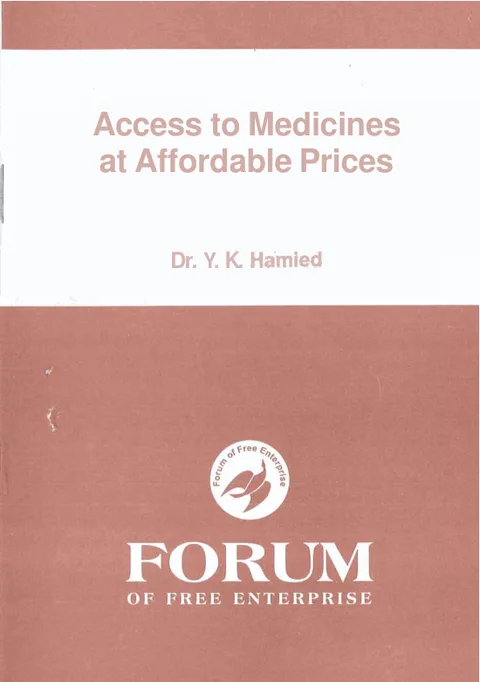
Access to Medicines at Affordable Prices
Published by S. S. Bhandare for the Forum of Free Enterprise, Peninsula House, 2nd Floor, 235, Dr. D. N. Road, Mumbai 400001, and Printed by S. V. Limaye at India Printing Works, India Printing House, 42 G. D. Ambekar Marg, Wadala, Mumbai 400 031. · Mumbai · 2014
9 pages
No. 25 in Bhogilal Leherchand Memorial Lecture
Summary
Dr. Y. K. Hamied, Chairman of Cipla Ltd., uses his 25th Bhogilal Leherchand Memorial Lecture (delivered 12 November 2013 in Mumbai under the auspices of the Forum of Free Enterprise) to argue that access to affordable, life-saving medicines is a fundamental human right that India’s patent regime ought to protect. He divides the world into a Rich global North of 600 million and a Developing global South of 3 billion, observing that one-third of humanity — and roughly half of Asia and Africa — lacks access to even basic medicines. Against this backdrop he indicts both multinational drug companies that have aggressively blocked low-cost AIDS drugs to Africa, and the Indian government, whose 2005 Indian Patent Bill (incorporating product patents and section 3(d) loopholes) he says has stalled the affordability gains that the 1970 Patent Act, which patented only the process and not the product, had previously secured.
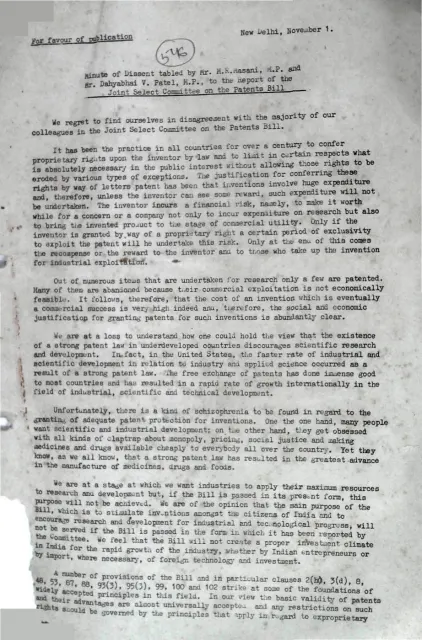
Hamied walks the reader through the legal mechanics: the distinction between patents and compulsory licensing (CL), the GATT-era pressures that forced India to accept TRIPS in 1995, the 10-year transition that ended in January 2005, the introduction of EMR and the mail-box system for 6,000–7,000 backdated patents, the 2001 DOHA declaration that 149 countries unanimously adopted (and the USA later tried to gut), and the I. K. Gujral Parliamentary Committee’s 1993 verdict that the process-patent regime should be maintained and a 20-year term should not be conceded. He insists that compulsory licensing — better named ‘Obligatory or Essential Drug Licensing’ — is fully TRIPS-compliant when used pragmatically to break monopoly pricing on essential medicines.
The lecture closes on a credo: vision, imagination and enthusiasm are the qualities India’s pharmaceutical industry must marshal to remain the ‘Pharmacy Center of the world’, expanding R&D capacity and matching the technological parity of the developed world without sacrificing its mission of affordability. Hamied quotes a 1981 WHO statement attributed to Indira Gandhi — that medical discoveries should be free of patents and free of profiteering on life or death — and frames Cipla’s work, including its free Palliative Care Centre in Pune, as a working demonstration that corporate capability can serve moral obligation. A foreword by Minoo R. Shroff, President of the Forum of Free Enterprise, situates the lecture alongside the documentary ‘Fire In The Blood’ as evidence of how vision and daring can be wielded by private enterprise to alleviate suffering.
Key points
-
Frames access to affordable medicines as a fundamental, universal human right, with one-third of the world’s population (50% in Asia and Africa) lacking access to even basic medicines.
-
Defends the 1970 Indian Patent Act’s process-only patent regime as the engine that made Indian generics globally competitive, and faults the 2005 Indian Patent Bill (excepting section 3(d)) for restoring product monopolies that price drugs out of reach.
-
Argues that compulsory licensing is a legally recognised, TRIPS-compliant tool to overcome access barriers when a patented drug is unavailable or unaffordable, and proposes renaming it ‘Obligatory or Essential Drug Licensing’ to reflect its public-health logic.
-
Recounts India’s reluctant acceptance of GATT/WTO/TRIPS under US pressure (1989 onward), the 1995 grant of a 10-year transition, and the December 2000 introduction of EMR and a mail-box system for 6,000–7,000 backdated patents — describing the backdating itself as ‘beyond all rational thinking’.
-
Cites the disease burden in India — 110 million mentally ill, 80 million cardiac, 60 million diabetic, 60 million asthmatic, 50 million hepatitis cases, 1 in 3 Indians with latent TB — and projects 1.65 billion population by 2050 with 800 million still without sanitation and 500 million without electricity, to argue for a ‘need-based patent regime’.
-
Highlights the 2001 DOHA declaration (149 countries) and the USA’s 2003 attempt to dilute it (vetoed 148-to-1 in a Doha ratification meeting, leaving the declaration unratified), as evidence that powerful states resist a public-health reading of TRIPS.
-
Calls on the Indian pharmaceutical industry to expand R&D, achieve technological parity with the developed world, and remain self-reliant — invoking vision, imagination and enthusiasm as the three values that must guide future progress.
-
Closes with a 1981 WHO statement attributed to Indira Gandhi — that medical discoveries should be free of patents and free of profiteering on life or death — as the moral horizon for India’s pharma policy.
Metadata and summary are AI-extracted from the source PDF and reviewed for editorial accuracy. The original work is available via the Read PDF tab above (where present); paragraph-level citation inside the PDF is deferred to a future engagement.