speech
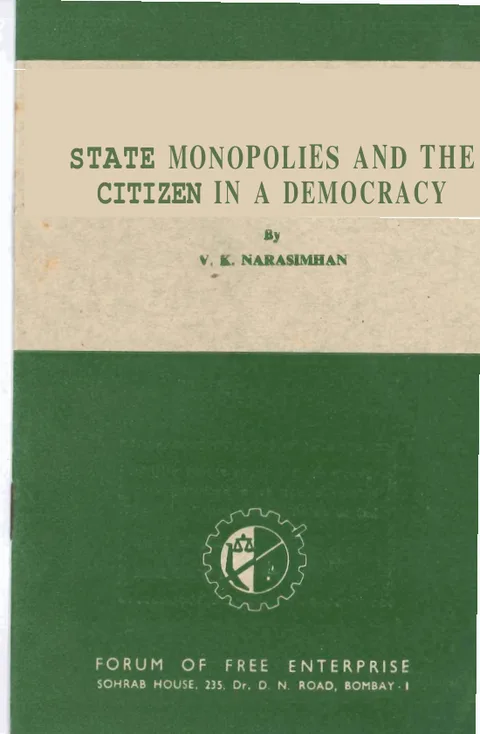
STATE MONOPOLIES AND THE CITIZEN IN A DEMOCRACY
Published by M. R. Pai for the Forum of Free Enterprise, 235, Dr. Dadabhai Naoroji Road, Bombay 1, and Printed by Michael Andrades at the Bombay Chronicle Press, Horniman Circle, Bombay-I. · Bombay · 1959
12 pages
STATE MONOPOLIES AND THE CITIZEN IN A DEMOCRACY
By V. K. NARASIMHAN
Summary
V. K. Narasimhan, then Assistant Editor of The Hindu, uses this 1959 Forum of Free Enterprise booklet — based on a lecture he delivered in Bombay on 22 May 1959 — to ask a constitutional and democratic-theory question: how far is the creation and maintenance of State monopolies in goods and services compatible with the right of citizens in a democracy to operate similar enterprises? The trigger, he says, was the 1956 nationalisation of life insurance by ordinance, where a working private industry was absorbed into a state monopoly without organised protest. Behind that silence Narasimhan locates a deeper failure: democratic-minded public men did not register the danger of the First Amendment of 1951, which inserted a sweeping clause into Article 19(6) allowing the State to operate any trade, business, industry or service to the partial or complete exclusion of citizens, with no equivalent constitutional safeguard.
The core of the booklet is a close reading of the 1951 amendment’s drafting history. Narasimhan traces it back to the Allahabad High Court judgment in the U.P. Motor Vehicles Act case, which held that the State could not entirely exclude private operators from an industry under the original Article 19(6); the Constitution (First Amendment) Bill was widened in response. He shows how only a handful of members — Pandit Hridayanath Kunzru, Shyam Nandan Sahaya, Prof. K. T. Shah, Dr. S. P. Mookerjee — pressed for safeguards (compensation for displaced citizens, prior enquiry before any State monopoly is created, non-discrimination between public and private enterprise, review by the President), and how each amendment was negatived. He highlights an official-record anomaly: the Lok Sabha proceedings show Sahaya’s compensation amendment as ‘adopted’ when in fact it had been ‘negatived’ — a misprint never corrected in subsequent editions.
From there Narasimhan moves to the political economy of State monopoly. Using the LIC takeover and State trading in foodgrains (notably the Gauhati correspondent’s account of the disruption of the Nowgong district rice-milling industry in Assam) as case studies, he argues that the absence of competition in a single-buyer/single-seller State system produces bureaucratic indifference, destroys consumer choice, removes the spur to efficiency, and substitutes monopoly procurement for competitive trade — sometimes catastrophically for the small producer. He notes that the British Labour Party itself, once an advocate of nationalisation, was turning toward ‘controlling’ rather than nationalising well-managed firms.
The booklet ends with six prescriptive conclusions: the democratic citizen must enjoy the amplest freedom to pursue any lawful economic activity; the constitutional space in which the State may set up monopolies must be precisely narrowed; no State monopoly should be created without prior enquiry into the existing private sector and a fair hearing for those engaged in it; outside a narrow field of public utilities, no enterprise on sound lines should be displaced by a State monopoly; full compensation must be paid when displacement does occur; and an impartial, quasi-judicial review body — analogous to the Tariff Commission or the British Monopolies Commission — should oversee State monopolistic enterprises and hear complaints.
Key points
-
Narasimhan’s central question is whether the State’s creation of monopolies in goods and services is compatible with the equal right of citizens in a democracy to operate similar enterprises.
-
He treats the unprotested 1956 nationalisation of life insurance by ordinance as evidence that the political class failed to absorb the constitutional implications of the First Amendment of 1951.
-
He reads the 1951 amendment to Article 19(6) — empowering the State to operate any ‘trade, business, industry or service’ to the partial or complete exclusion of citizens — as an ‘astonishing’ constitutional shift toward economic regimentation.
-
The booklet narrates the U.P. Motor Vehicles / Allahabad High Court backstory and shows how amendments by Hridayanath Kunzru, Shyam Nandan Sahaya, K. T. Shah and S. P. Mookerjee — each of which would have added safeguards (compensation, non-discrimination, prior enquiry, President’s review) — were all negatived.
-
Narasimhan flags an uncorrected misprint in the official Lok Sabha proceedings that records Sahaya’s compensation amendment as ‘adopted’ when in fact it was ‘negatived’.
-
He uses the LIC takeover and State trading in foodgrains in Assam (Nowgong district rice mills, citing the Gauhati correspondent of The Statesman) to argue that State monopoly destroys competition, consumer choice, and the small producer.
-
He notes the British Labour Party’s drift away from blanket nationalisation toward ‘control’ of well-managed private firms.
-
His six closing recommendations include constitutional narrowing of the State-monopoly clause, prior enquiry before any new State monopoly, compensation for displaced enterprises, and an impartial quasi-judicial review body modelled on the Tariff Commission or the Monopolies Commission in England.
Generated by the v1.5 extraction pipeline. Awaiting editorial review.
Metadata and summary are AI-extracted from the source PDF and reviewed for editorial accuracy. The original work is available via the Read PDF tab above (where present); paragraph-level citation inside the PDF is deferred to a future engagement.