speech · memorial lecture
Social and Economic Significance of Insurance in Modern Economic Life
Published by THE A. D. SHROFF MEMORIAL TRUST, 235, Dr. D. N. Road, Bombay-1. · Bombay · 1970
31 pages
Part of A. D. Shroff Memorial Lecture
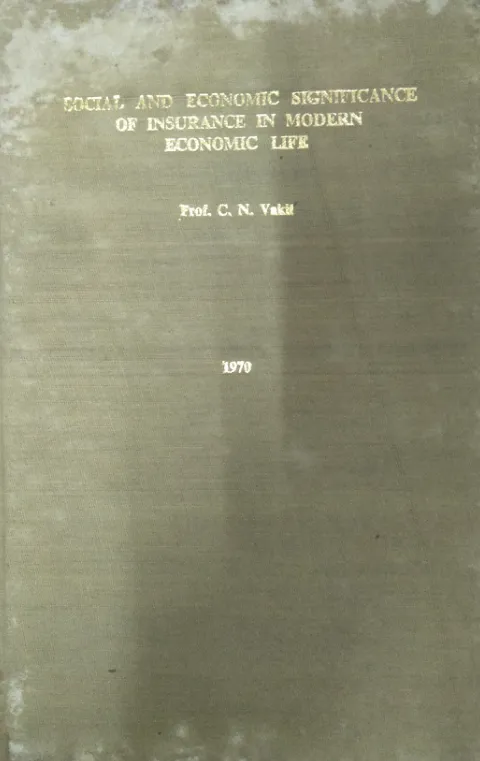
Social and Economic Significance of Insurance in Modern Economic Life
By Prof. C. N. Vakil
Summary
Prof. C. N. Vakil delivers the third A. D. Shroff Memorial Lecture (25 March 1970) on the place of insurance in a modern, risk-laden economy. He opens with a panoramic claim about modern economic life — that the scale, speed and interdependence of production, transport and international trade have multiplied the range of personal and property risks. Insurance, he argues, is the institutional device by which these risks are shifted, and without it the gigantic enterprises of the modern world and the international trade that stimulates them would be impossible. He carefully separates Life Insurance, a long-term contract that also mobilises household savings into a large investible pool, from General Insurance, a short-term, reinsurance-driven business whose accumulated funds are necessarily modest.
From this exposition Vakil pivots to a critique of how the Indian state has applied Socialism to the insurance sector. He concedes that the goals attached to the word — equality of opportunity, removal of inequality, better distribution — are largely shared across parties, but warns that the chosen instrument, nationalisation, has gone unexamined. Public sector undertakings, he observes, run continuing losses borne by the taxpayer; large private firms are discouraged from growing, against the elementary principle of economies of scale; and the public sector, though nominally accountable to Parliament, is in practice controlled by a ruling majority that protects its decisions from scrutiny. He coins the phrase “the luxury of Socialism at the cost of the tax-payer” to describe this arrangement.
Applying the same lens to the LIC, Vakil notes that the Corporation now commands roughly Rs. 1,260 crores of policy-holders’ savings and has become a major financing agency. He calls for a fresh review of whether nationalisation has actually advanced Life Insurance compared with what the old private companies might have achieved, and presents tables showing that LIC investments are overwhelmingly directed into Central and State Government securities and public sector enterprises (about 81.7 per cent), with only 17.8 per cent reaching the private sector. He concedes the legitimacy of objectives such as housing finance, regional balance and aid to backward states, but insists that without convincing evidence of public good — measured against the interests of policy-holders — the socialist credentials of such a measure cannot be taken for granted.
Key points
-
Modern industry, international trade and personal life all generate risks (death, accident, fire, shipwreck, storm) that only insurance can pool and shift, making it foundational to economic stability and freedom.
-
Vakil distinguishes Life Insurance — a long-term, savings-mobilising contract — from General Insurance, a one-year, reinsurance-dependent business that cannot accumulate large funds.
-
He treats the nationalisation of Life Insurance as a settled fact but presses the question of whether progress under the LIC has surpassed what private companies might have achieved.
-
He critiques the Fourth Plan and the policy climate for assigning the public sector a dominant position while diverting household savings into loss-making state undertakings whose burden falls on the taxpayer.
-
He warns that hostility to large private industrial units violates the elementary principle of economies of scale and discourages proven industrialists from expanding output.
-
He attacks asymmetric regulation: stringent Company Law over the private sector but only post-mortem parliamentary accountability for the public sector.
-
On LIC funds of about Rs. 1,260 crores, he shows that roughly 81.7 per cent of investments flow into the public sector (Central and State securities, PSUs, cooperatives) and only 17.8 per cent into the private sector.
-
He concludes that nationalisation cannot claim socialist legitimacy unless it produces convincing, demonstrable benefit for policy-holders and the common man.
Generated by the v1.5 extraction pipeline. Awaiting editorial review.
Metadata and summary are AI-extracted from the source PDF and reviewed for editorial accuracy. The original work is available via the Read PDF tab above (where present); paragraph-level citation inside the PDF is deferred to a future engagement.