essay
Role of Free Enterprise
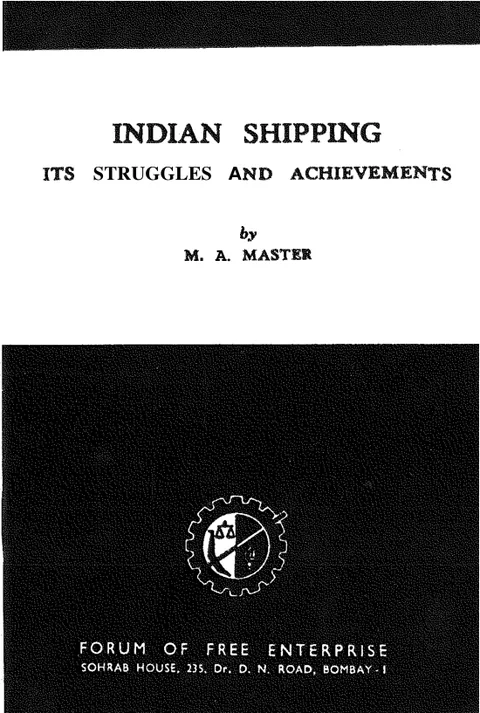
Indian Shipping
By SN Haji
THE FORUM OF FREE ENTERPRISE, "Sohrab House", 235, Dr. Dadabhai Naoroji Road, BOMBAY 1. · Bombay · 1956
4 pages
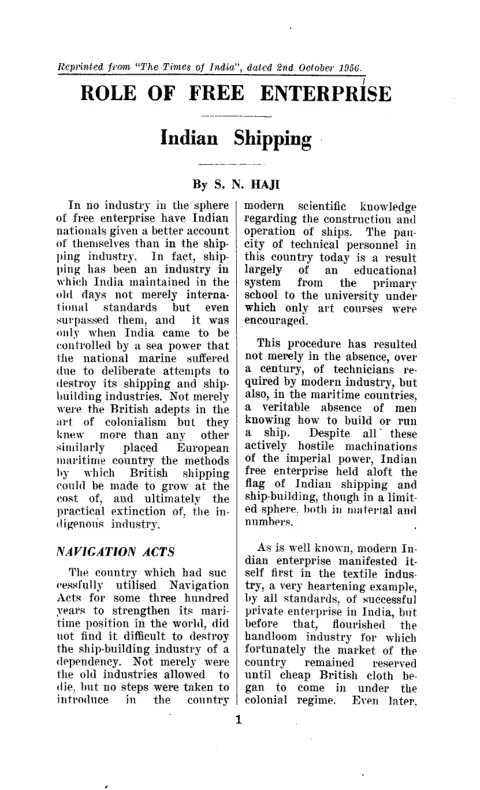
Role of Free Enterprise
By S. N. HAJI
Summary
S. N. Haji’s short article, reprinted from The Times of India of 2 October 1956 and reissued by the Forum of Free Enterprise, builds a historical case for Indian private enterprise by walking through the survival and revival of the country’s modern shipping industry. He argues that shipping is the field in which Indian nationals have given the best account of themselves under free enterprise, despite the deliberate hostility of British policy: Navigation Acts that strangled the older Indian sail and ship-building traditions, a controlling British bureaucracy in the post-sail era, and a foreign-owned coastal fleet propped up by an imperial government.
The central narrative is the founding of the Scindia Steam Navigation Company in 1919, which Haji presents as the economic counterpart of the political independence movement. He recounts the practical obstacles confronting its sponsors — Narottam Morarjee, Walchand Hirachand, Lallubhai Samaldas and Kilachand Devchand — including the absence of shipyards, trained crews, marine engineers and repair facilities, and the readiness of the principal British rival to absorb Scindia by buying out its shareholders, an offer the company rejected outright. He then catalogues the rate war and rebate practices used by entrenched British lines to choke off Indian competitors, listing five small Indian companies on the east and west coasts that perished before Scindia’s tenacity, backed by the patriotic action of the wider Indian public, broke the British coastal monopoly.
Haji closes by tallying what Indian private enterprise has done since the end of the Second World War: new tanker, tramp and liner services in the Persian Gulf and U.K./Continent trades, companies such as the India Steamship of Calcutta, the Bharat Line of Saurashtra and the Great Eastern of Bombay, and the lifting of fleet tonnage from a wartime low of 75,000 gross tons to 500,000 with another 100,000 on order — a figure he highlights as already meeting the First Five-Year Plan’s shipping target. The piece thus reads simultaneously as economic history, as nationalist memory, and as a pointed Forum of Free Enterprise tract demonstrating that the Plan’s own targets are being met by private capital rather than the state.
Key points
-
Frames Indian shipping as the strongest historical proof that Indian nationals can succeed under free enterprise.
-
Argues that the decline of pre-modern Indian shipping was the result of deliberate British policy — Navigation Acts, denial of steam and iron, and the British bureaucracy’s refusal to let an Indian modern marine arise.
-
Treats the 1919 founding of the Scindia Steam Navigation Company, with Rs. 4.5 crores of paid-up capital, as the economic counterpart of the Indian political independence movement.
-
Names Narottam Morarjee, Walchand Hirachand, Lallubhai Samaldas and Kilachand Devchand as the sponsors of Scindia and recounts the absence of shipyards, repair shops and trained Indian marine personnel they had to overcome.
-
Describes how the principal British rival tried to absorb Scindia by buying out shareholders and, when refused, mounted a sustained rate war and rebate system that destroyed five smaller Indian coastal lines.
-
Reports post-1945 expansion of Indian shipping into tanker, tramp and liner trades, listing India Steamship of Calcutta, Bharat Line of Saurashtra and Great Eastern of Bombay among new entrants.
-
Quantifies the recovery: fleet tonnage raised from a World War II low of 75,000 gross tons to 500,000, with 100,000 more on order — meeting the First Five-Year Plan target through private effort.
-
Carries an implicit polemical message — appropriate to a Forum of Free Enterprise pamphlet in 1956 — that planning targets are being delivered by private capital, not state monopoly.
Generated by the v1.5 extraction pipeline. Awaiting editorial review.
Metadata and summary are AI-extracted from the source PDF and reviewed for editorial accuracy. The original work is available via the Read PDF tab above (where present); paragraph-level citation inside the PDF is deferred to a future engagement.