speech
REFLECTIONS ON THE CHANGING SCENARIO OF THE INDIAN STOCK MARKETS
Published by THE A. D. SHROFF MEMORIAL TRUST, "Piramal Mansion", 235, Dr. D. N. Road, BOMBAY 400001. Published by M. R. Pai on behalf of The A. D. Shroff Memorial Trust, 235, Dr. Dadabhai Naoroji Road, Bombay 400001, and Printed by S. V. Limaye at the India Printing Works, India Printing House, 42, G. D. Ambekar Marg, Wadala, Bombay 400031. · Bombay · 1995
45 pages
Part of A. D. Shroff Memorial Lecture
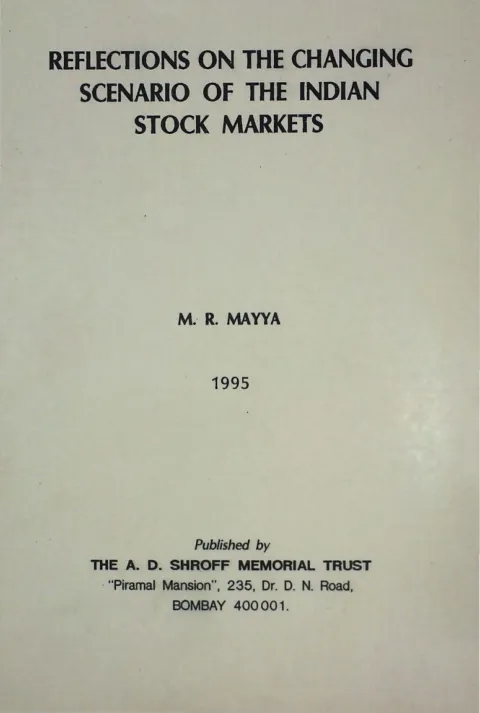
REFLECTIONS ON THE CHANGING SCENARIO OF THE INDIAN STOCK MARKETS
By M. R. MAYYA
Summary
Delivered as the 1994 A. D. Shroff Memorial Lecture under the auspices of the A. D. Shroff Memorial Trust and printed as a booklet in 1995, M. R. Mayya’s address surveys the transformation of the Indian stock market since the liberalisation impulse of November 1984 and especially since June 1991. Writing as the recently retired Executive Director of the Bombay Stock Exchange, Mayya frames the half-century preceding 1991 as a self-inflicted detour: a ‘trauma of restrictions and constraints to growth’ that the nation eventually realised was not the proper path for progress. Liberalisation, he argues, has produced a primary-market expansion of roughly 250 times since the seventies, taken Indian listed-company count past that of the United States, and lifted the investor base to over 40 million.
Having celebrated the quantitative explosion, Mayya devotes the bulk of the rendered pages to the qualitative reforms still owed to investors. He calls for space currently occupied by public-sector tenants in stock-exchange buildings to be vacated on commercial terms; for accelerated computerisation, telecom and postal upgrades; for the absorption of sub-brokers into the regulated fold; for genuine corporatisation of broking firms (with one-time capital-gains relief to ease conversion); and for a clearer entry path for financial-institution members so that a ‘level playing ground’ is restored. On governance, he accepts the 50:50 elected-broker/non-broker board ratio but insists that the real prize is improved director quality, and proposes that the executive director of each exchange be appointed by a standing committee rather than left hostage to the political pulls of the governing board.
The later pages take up SEBI’s new regulatory edifice — the 1992 Act, the Stock Brokers, Merchant Bankers, Underwriters, Insider Trading and Mutual Fund regulations, and the repeal of the Capital Issues (Control) Act, 1947. Mayya credits SEBI’s disclosure code, credit-rating mandate and ‘Stockinvest’ instrument while warning that free pricing has been misused by issuers and merchant bankers, and that the persistent ‘grey market’ for unlisted scrip — three decades old and counting — must either be declared illegal or formally regulated. He closes the rendered portion by criticising two recent policy moves as adverse to small investors: the September 1993 dilution of the minimum public offer from 60 per cent to 25 per cent of issued capital, and the raising of the minimum application size from 100 to 500 shares, proposing 40 per cent and 300 shares respectively as the more defensible figures.
Key points
-
Mayya frames pre-1991 economic policy as a fifty-year ‘trauma of restrictions and constraints’ that the nation only belatedly recognised as misguided.
-
Primary-market raisings climbed from an average of Rs. 900 million annually in the seventies to Rs. 224.80 billion in 1993-94 — a 250x rise equal to 12.8 per cent of gross domestic savings.
-
India’s roughly 7,500 listed companies in 1994 surpassed the United States’ 7,250, while the investor population reached over 40 million, second only to the U.S.A.
-
Infrastructure remains the choke point: public-sector institutions occupy exchange space, computerisation has stalled ‘partly to block transparency’, and telecom/postal facilities lag.
-
Corporatisation of broking firms is necessary for perpetuity and professionalism; Mayya appeals for a one-time capital-gains exemption to unblock conversions.
-
Sub-brokers — a uniquely Indian class — must be brought into a regulated arbitration framework or phased out over a ten-year horizon.
-
The 50:50 broker/non-broker governing-board ratio is settled, but director quality matters more; executive directors should be appointed by an independent standing committee to insulate them from board pressure.
-
SEBI’s post-1992 regulatory architecture has improved disclosures but free pricing is being misused, and the three-decade-old ‘grey market’ for unlisted scrip must either be banned or formally regulated.
Generated by the v1.5 extraction pipeline. Awaiting editorial review.
Metadata and summary are AI-extracted from the source PDF and reviewed for editorial accuracy. The original work is available via the Read PDF tab above (where present); paragraph-level citation inside the PDF is deferred to a future engagement.