pamphlet · collected works
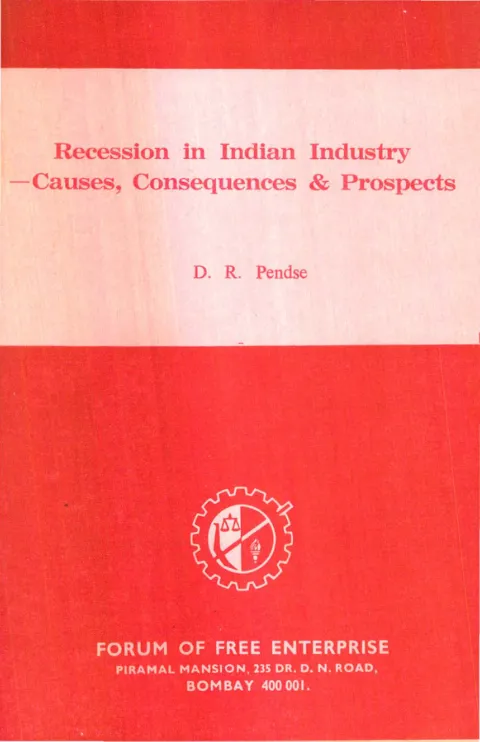
Recession in Indian Industry — Causes, Consequences & Prospects
By D. R. Pendse
Published by M. R. PAI for the Forum of Free Enterprise, "Piramal Mansion", 235 Dr. Dadabhai Naoroji Road, Bombay-1, and printed by B. D. Nadirshaw at Bombay Chronicle Press, Sayed Abdulla Brelvi Road, Fort, Bombay-1. · Bombay · 1975
16 pages
Recession in Indian Industry — Causes, Consequences & Prospects
By D. R. Pendse
Summary
D. R. Pendse, then Economic Adviser to a business house, reprints in this Forum of Free Enterprise booklet two Indian Express columns from late October and early November 1975 that together diagnose, weigh, and forecast the recession then engulfing Indian industry. The first essay, “Causes and Consequences,” notes that the debate over whether recessionary tendencies exist is finally over: textiles, cars, steel, air-conditioners, consumer durables, basic engineering goods and even high-priority lines such as fertilisers and tractors are all in trouble. Pendse identifies five interlocking causes — inadequate consumer purchasing power, overlicensing that built capacity vastly out of step with demand (television sets licensed at over three lakh against output of 74,000; dry cells licensed at 1,521 million against 635 million produced), sharp price escalations following decontrols and tax hikes, the crackdown on black money that hit luxury-oriented and service industries, and imbalances in plan performance, especially the Fourth Plan’s 49 per cent shortfall in power generation that starved downstream industries of demand.
Pendse refuses to treat the recession as wholly malign. He casts it as a “purgative” that weeds out inefficient firms, makes scarce inputs more manageable, and chokes the generation of black money — but he weighs against this the waste of idle capacity in a country still at or below the poverty line, the chilling of new entrepreneurs, and above all the employment set-back, which feeds back into shrinking purchasing power and deepens the slump. He concludes that the debit-versus-credit ledger is best left open rather than litigated.
The second essay, “Is the Recession on the way out?”, takes up four recurring puzzles: why demand has not picked up despite near-price-stability, whether excise relief would help, why corporate results for 1974 and 1974-75 look strong in a recession-hit economy, and when the recession will end. Pendse argues that price stability without rising incomes only freezes demand at depressed levels; that selective tax relief is justified only where a recent jack-up in duties caused the demand to taper; that good corporate profits often reflect efficient managements coping through exports, diversification and product-mix changes, plus the lag of balance-sheets, controlled output prices, and paper profits in a depreciated currency. On prospects he is cautiously hopeful: sustained net bank credit to Government (Rs. 997 crores between end-March and end-September 1975 against Rs. 588 crores the previous year), an additional Rs. 700–800 crores in rural hands from a good kharif crop without inflationary risk, and stepped-up but selective public-sector outlay on agriculture and energy should arrest the recession in several industries, though with widely varying time-lags.
The booklet opens with an A. D. Shroff epigraph defending free enterprise as coeval with man, closes with a Eugene Black quotation urging acceptance of private enterprise “not as a necessary evil, but as an affirmative good,” and bears the Forum’s standard disclaimer that the views are the author’s own.
Key points
-
Pendse declares the verbal debate over the existence of recession effectively closed by late 1975 — textiles, cars, steel, air-conditioners, consumer durables, engineering goods and even high-priority lines like fertilisers and tractors are all affected, with power and mining equipment as rare exceptions.
-
Five causes are itemised: inadequate consumer purchasing power, overlicensing that gives capacity wildly in excess of demand, sharp price escalations after decontrols and tax hikes, the black-money crackdown that hit luxury and service industries, and imbalances in plan performance (notably the Fourth Plan’s 49 per cent shortfall in power generation).
-
The booklet treats recession with two-handed honesty: a “purgative” that disciplines inefficient firms, eases scarcities, and shrinks black-money circulation, but at the cost of idle capacity, deterred entrepreneurs, and — most damaging — set-back to employment creation that feeds back into still weaker demand.
-
On price stability, Pendse insists that flat prices without rising incomes only freezes consumption patterns set during the inflation peak; genuine recovery requires either falling prices that release surplus purchasing power or rising money emoluments and employment.
-
On tax reliefs, he urges a selective approach: only where a recent jack-up in excise (e.g., the supplementary 1974 budget) demonstrably caused demand to taper does tax relief have strong counter-recessionary force; he warns against the drift from specific to ad valorem duties, which gives Government a vested interest in high prices.
-
Strong 1974 and 1974-75 corporate results are not, he argues, evidence against recession: vanishing black-market premia, shortened queues and stock accumulation are the first symptoms; balance-sheets lag, controlled prices mask declines, and “encouraging” profits are often paper profits in a depreciated currency.
-
Three macro-factors give cautious grounds for relief by the turn of 1975-76: a near-doubling of net bank credit to Government year-on-year, Rs. 700–800 crores of new rural purchasing power from a good kharif crop, and selective public-sector step-up in agriculture and energy, with a larger kharif and bigger foreign-assistance receipts dampening the inflation risk of higher outlay.
-
Throughout, Pendse positions the analysis within Forum of Free Enterprise’s house frame — bracketed by the Shroff and Eugene Black epigraphs — while keeping his own diagnosis empirically detailed and policy-pragmatic rather than ideological.
Generated by the v1.5 extraction pipeline. Awaiting editorial review.
Metadata and summary are AI-extracted from the source PDF and reviewed for editorial accuracy. The original work is available via the Read PDF tab above (where present); paragraph-level citation inside the PDF is deferred to a future engagement.