speech
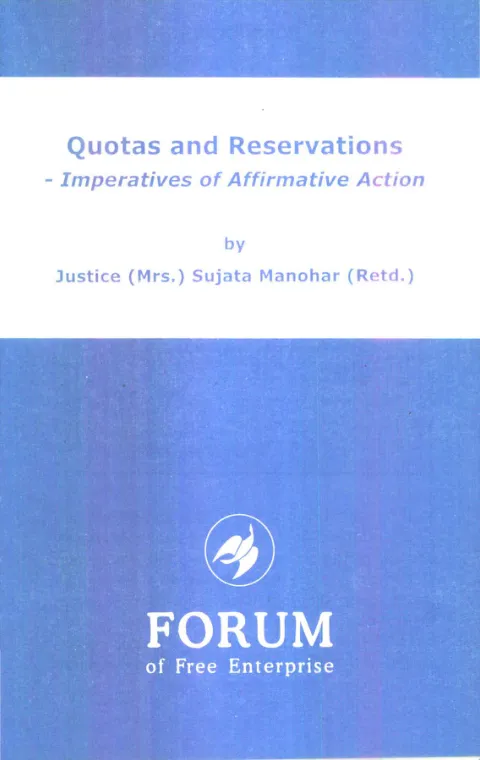
Quotas and Reservations
Imperatives of Affirmative Action
By Justice (Mrs.) Sujata Manohar (Retd.)
Forum of Free Enterprise · Mumbai · 2006
24 pages
Quotas and Reservations
By Justice (Mrs.) Sujata Manohar (Retd.)
Summary
Quotas and Reservations — Imperatives of Affirmative Action is the printed text of a lecture delivered by Justice (Mrs.) Sujata Manohar (Retd.), a former Chief Justice of the Bombay and Kerala High Courts and Supreme Court judge, at the Annual Day of the Leslie Sawhny Endowment programme on 16th May 2006. The pamphlet was published by the Forum of Free Enterprise in Mumbai and opens with an Introduction signed by Minoo R. Shroff, President of the Forum, who frames the address as an incisive analysis of the country’s reservations regime and laments that politicians who divide the nation on the basis of religion and caste ‘scar a country forever’.
Manohar reads the Indian reservations regime against its constitutional intent. Recalling Martin Luther King, Rabindranath Tagore’s Geetanjali, and Ambedkar’s Constituent Assembly warning that ‘castes are anti national’, she argues that Articles 14, 15, 16 and 335 were designed to build a non-discriminatory and fraternal order; the special provisions for women, children, Scheduled Castes and Scheduled Tribes were conceived as short-term, reverse-discrimination measures pending empowerment. The Constituent Assembly’s choice of reservations over US-style affirmative action, she contends, was a ‘flawed perception’ — born of a lack of confidence that prejudice could be overcome by structural support rather than by quota.
The core indictment is empirical and institutional. After sixty years no Scheduled Caste or Scheduled Tribe has been removed from the backward list; quotas have only expanded; no inbuilt programme of gradual reduction exists; and reliable data on the reduction of backwardness is missing from public discourse. Manohar walks through the Supreme Court’s reasoning in Indra Sawhney v. Union of India and Preeti Srivastava v. State of Madhya Pradesh (she sat on the latter bench), the 50 per cent ceiling, the extension of reservation to promotions, and the running controversies of 2006 — the proposed 27 per cent OBC quota and its extension to IITs, IIMs and the private sector. She argues that quotas have lent themselves to misuse, killed incentive to excel, created a ‘vested interest in backwardness’, and generated divisive forces stronger than those at independence.
The remedy she urges is a massive shift of weight from reservation to affirmative action: economic policy that empowers the backward, fee-regulation and need-based aid in schools and colleges, special effort by both public and private sector to broaden recruitment, and a sustained programme to retain Scheduled Caste children in school (citing a 76 per cent pre-Class X dropout rate). She points to the South African Employment Equity Act — non-quota, duty-based, covering women and other discriminated groups — as a model worth studying, and closes the rendered section on the need for civil society, NGOs, the private sector and government to build schools and colleges that ‘generate excellence’ rather than parcel out shrinking opportunities by caste.
Key points
-
Forum of Free Enterprise pamphlet (Mumbai, 2006) reproducing Justice Sujata Manohar’s address at the Leslie Sawhny Endowment Annual Day on 16 May 2006, prefaced by an Introduction signed by Minoo R. Shroff (FFE President).
-
Reads reservations against the constitutional design of Articles 14, 15, 16 and 335: special provisions were intended as short-term reverse discrimination to make the weak able to compete, not as permanent entitlements.
-
Argues that opting for reservations instead of US-style affirmative action was a ‘flawed perception’, driven by lack of confidence that social prejudice could be overcome by structural means.
-
Empirical indictment: in sixty years no Scheduled Caste or Scheduled Tribe has been removed from the backward list, reservations have only expanded, and there is no inbuilt mechanism for gradual reduction.
-
Walks through Supreme Court jurisprudence — Indra Sawhney v. Union of India (50% ceiling, promotions) and Preeti Srivastava v. State of M.P. (on which she sat) — and the live 2006 controversies over the 27% OBC quota and its extension to IITs, IIMs and the private sector.
-
Identifies a ‘vested interest in backwardness’ and warns that divisive forces unleashed by misused reservations are now stronger than those that existed at independence.
-
Programmatic recommendations centre on massive affirmative action: basic education quality, fee regulation, need-based aid, retention of Scheduled Caste children in school (76% pre-Class X dropout), and a duty on private and public sector employers to broaden recruitment.
-
Holds up South Africa’s Employment Equity Act — duty-based, non-quota, covering women and a wide range of discriminated groups — as a model India should study.
Generated by the v1.5 extraction pipeline. Awaiting editorial review.
Metadata and summary are AI-extracted from the source PDF and reviewed for editorial accuracy. The original work is available via the Read PDF tab above (where present); paragraph-level citation inside the PDF is deferred to a future engagement.