edited volume · proceedings
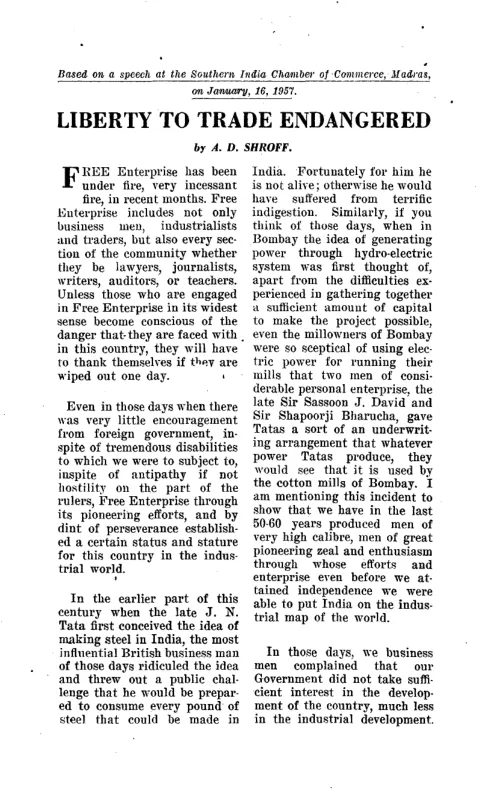
Private Enterprise and Politics
By A. D. Shroff
Forum of Free Enterprise, "Sohrab House", 235 Dr. D. N. Road, Bombay-1. Published by M. R. Pai for the Forum of Free Enterprise, 235, Dr. Dadabhai Naoroji Road. Bombay 1, and Printed by Michael Andrades at the Bombay Chronicle Press, Horniman Circle, Bombay-1. 8/June/1962. · Bombay · 1962
11 pages
Private Enterprise and Politics
Summary
This 14-page booklet collects four addresses delivered at a symposium organised by the Forum of Free Enterprise in Bombay on 23 January 1962, prompted by debate during the February 1962 General Elections over the place of private enterprise in Indian politics. A. D. Shroff, President of the Forum, presided and opened by urging businessmen to shed their ‘moral cowardice’ and engage politics directly. He is joined by industrialist Lalchand Hirachand (President, Maharashtra Chamber of Commerce), journalist Frank Moraes (Editor-in-Chief, Indian Express), and educationist Dr. A. R. Wadia, M.P. (Director, Tata School of Social Sciences, Bombay). Across the four talks the contributors converge on a shared thesis: that the post-Independence expansion of state activity has made political abstention impossible for private industry, that the public-sector model is producing waste and unfair competition rather than virtue, and that defending free enterprise is inseparable from defending democracy itself.
Key points
-
The booklet collects four addresses from a 23 January 1962 Forum of Free Enterprise symposium in Bombay, held amid General Election debate over private enterprise’s place in politics.
-
A. D. Shroff, presiding, urges businessmen to shed their moral cowardice and recalls the Indian Merchants’ Chamber’s political activism during the freedom struggle.
-
Shroff warns that automatic deference to the ruling party is the method of Fascist Mussolini, and binds the cause of business to the survival of democracy itself.
-
Lalchand Hirachand cites the State Trading Corporation’s cement profiteering, flagged by Parliament’s Estimates Committee, to argue that public enterprises hold no monopoly on virtue over private ones.
-
Hirachand argues profit-making, once dismissed as anti-social, is now widely recognised as absolutely essential for the development of Indian industry and trade.
-
Frank Moraes contends government’s primary function is to secure law, order and economic and social justice rather than to substitute itself for private initiative.
-
Moraes argues India is a developing, not underdeveloped, country that now needs the stimulus of private enterprise, faulting the Five-Year Plans for producing a wasteful, top-heavy state apparatus.
-
Moraes criticises Indian and Asian historians for instinctively equating industrialisation with capitalism and colonialism, calling it a case of confused and arrested thinking.
-
Dr. A. R. Wadia, M.P., Director of the Tata School of Social Sciences, closes the symposium by arguing that private enterprise should take an active interest in politics.
Essays
BUSINESS MEN MUST PICK UP COURAGE
By A. D. Shroff
A. D. Shroff, presiding President of the Forum of Free Enterprise, opens with an anecdote crowning the politician as the oldest profession because ‘he was the one who creates chaos’, then argues that under the expanded post-Independence state, business can no longer stand aside from politics. Where pre-Independence businessmen complained that government took too little interest in them, the modern complaint is the opposite. He recalls the political activism of the Indian Merchants’ Chamber during the freedom struggle and laments that today’s businessmen are too timid to oppose the ruling party publicly — a ‘trend of thinking’ he warns ‘was an idea propounded by Fascist Mussolini’. He closes by binding the cause of business to the cause of democratic survival itself.
- Frames the booklet’s central concern: the vast post-Independence increase in state power makes political engagement compulsory for business.
- Contrasts pre-Independence businessman activism (Indian Merchants’ Chamber boycott resolutions) with present-day political timidity.
- Diagnoses Indian businessmen with ‘moral cowardice’ that the Forum of Free Enterprise (founded 1956) was set up to cure.
- Warns that automatic deference to the ruling party is the totalitarian method of Fascist Mussolini.
- Asserts the indivisibility of free enterprise and democracy.
PRIVATE ENTERPRISE SHOULD IMPART REALISM TO ECONOMIC POLICIES
By LALCHAND HIRACHAND
Lalchand Hirachand, speaking as President of the Maharashtra Chamber of Commerce, argues that as economic activity has become ‘dominant in everyday life’, the Government’s deepening interest in business has made economic policy a political question — and businessmen who keep aloof do so at their peril. He insists that businessmen must publicly advise the Government on industrial development, the Five-Year Plans, and the Public Sector vs. Private Sector controversy, citing the State Trading Corporation’s profiteering on cement (as flagged by Parliament’s Estimates Committee) as proof that public enterprises hold no monopoly on virtue. Profit-making, once dismissed as anti-social, is now widely recognised as ‘absolutely essential for the development of industry and trade’; the time has come for private enterprise to defend itself through the press and the platform as well as through legislatures.
- As economic life becomes the dominant axis of politics, business cannot abdicate the political conversation.
- Calls for private enterprise to ‘realise its useful role in political matters’ rather than being scapegoated.
- Cites the State Trading Corporation’s cement profiteering (per Parliament’s Estimates Committee) to refute the moral case for the Public Sector.
- Notes the elite reversal that has rehabilitated profit-making as legitimate and necessary.
- Insists that ideological self-defence must reach the public through press and platform, not only through legislatures.
PRIVATE ENTERPRISE SHOULD HAVE AN IMPORTANT PLACE IN OUR DEMOCRACY
By FRANK MORAES
Frank Moraes, Editor-in-Chief of the Indian Express, opens with the witticism that ‘there are only two ways of getting on in this world, either by one’s own industry or by the stupidity of others’ — and warns that some governments would happily profit from the latter. He rejects the romantic claim of pure freedom anywhere (neither in China and Russia, nor in the United States, where rich governments spend heavily on nuclear and atomic experiments) and argues that the proper test is comparative: a government’s primary function is to ensure law, order, and economic and social justice, not to substitute itself for private initiative. India, he contends, is no longer ‘underdeveloped’ but a ‘developing country’ that ‘needs more the stimuli of private enterprise’; the Five-Year Plans have produced a ‘top-heavy mass of personnel, with a great deal of wastefulness’ that legislatures struggle to bring to account. He closes by criticising Indian and Asian historians for instinctively equating industrialisation with capitalism and colonialism — a ‘case of confused and arrested thinking’ that still distorts India’s economic life a century after the Industrial Revolution reached its shores.
- Rejects the binary of ‘unadulterated freedom’ vs. classless society; insists on degree, not kind.
- Government’s primary function is law, order, and economic and social justice, not direct economic command.
- India is a developing, not underdeveloped, country and now needs private-enterprise stimulus.
- Five-Year Plans have produced wasteful, oversized state structures resistant to legislative oversight.
- Indian and Asian historians have wrongly conflated industrialisation with capitalism and colonialism, freezing Indian economic thought.
PRIVATE ENTERPRISE SHOULD TAKE INTEREST IN POLITICS
By DR. A. R. WADIA, M.P.
Dr. A. R. Wadia, M.P., Director of the Tata School of Social Sciences, opens by inverting the proverb that ‘government governs the best which governs the least’ — under modern socialism the dictum no longer holds. He argues that the capitalists of the 18th and 19th centuries in England and America ‘were not as enlightened as the capitalists of today’: had they been ‘a little just to the claims of the labourers’, socialism might never have arisen. Today even nominally non-socialist nations — the U.S.A., England, West Germany, France — are ‘socialistic in that they do realise the importance of looking to the benefits and well-being of labourers’ and tax heavily to fund welfare states. He notes that India has wavered between embracing and disavowing socialism, citing contradictory statements ‘even from the Prime Minister’, and argues that allowing private enterprise to exist ‘almost by sufferance’ is not enough — it must be actively encouraged because it brings expert management, the competitive impetus of profit, and the example of ‘a genius like Jamshedji Tata’. The failure of Public Sector undertakings, he says, is largely because they are run by people without ‘the special management expertise needed for success in business’.
- Inverts the classical proverb: in the welfare-state era, minimal government is no longer the accepted standard.
- Argues that capitalists themselves invited socialism by failing to share gains with labour; today’s welfare states are partly capitalist corrections of that failure.
- India’s policy ambivalence on socialism (illustrated by inconsistent prime-ministerial statements) is itself a reason for private enterprise to speak up.
- Public Sector failures trace to placing administrators without business management expertise in commercial roles.
- Honours Jamshedji Tata as the type of entrepreneurial genius that government action could not have produced.
Generated by the v1.5 extraction pipeline. Awaiting editorial review.
Metadata and summary are AI-extracted from the source PDF and reviewed for editorial accuracy. The original work is available via the Read PDF tab above (where present); paragraph-level citation inside the PDF is deferred to a future engagement.