essay
Planning Machinery Should Be Placed Above Politics
Published by M. R. PAI for Forum of Free Enterprise, "Sohrab House", 235 Dr. Dadabhai Naoroji Road, Bombay 1, and printed by B. G. DHAWALE at KARNATAK PRINTING PRESS, Chira Bazar, Bombay 2 · Bombay · 1962
2 pages
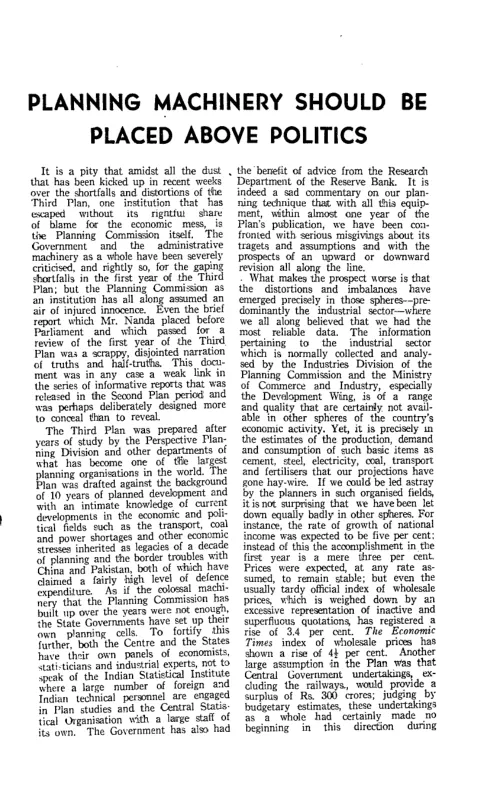
Planning Machinery Should Be Placed Above Politics
Summary
This short Forum of Free Enterprise pamphlet reproduces an unsigned editorial from The Economic Times of 6 September 1962. The editorial complains that, amid the storm of public criticism over the shortfalls of the Third Five-Year Plan, the one institution that has so far escaped its share of blame — the Planning Commission itself — is the very body whose work is at fault. Even Planning Minister Nanda’s own report to Parliament on the first year of the Plan, the editorial notes, was a ‘scrappy, disjointed narration of truths and half-truths’.
The core charge is technical and political. Despite a vast planning apparatus — the Perspective Planning Division, central and state planning cells, panels of economists and statisticians, the Indian Statistical Institute, the Central Statistical Organisation, and the Reserve Bank’s Research Department — the Plan’s projections in cement, steel, electricity, coal, transport and fertilisers have ‘gone hay-wire’ within a year of publication. National income grew at three per cent against the assumed five; wholesale prices, far from staying stable, rose 3.4 per cent on the official index and 4½ per cent on the Economic Times index; Central Government undertakings have made no progress towards their promised Rs. 300-crore surplus; and exports of Rs. 656 crores in year one fall well short of the Rs. 740-crore annual average required. Foreign-exchange needs were under-estimated and even the invisibles balance has turned adverse.
The editorial’s argument turns from data to structure. The fashionable apparatus of ‘model building’, ‘econometric models’, ‘input-output analysis’ and ‘flow-of-funds analysis’ has not prevented basic structural variables from drifting away from the pre-determined estimates. The Planning Commission cannot plead a lack of power — it has ‘functioned in several fields as a super-Cabinet’. Its peculiar composition — its top membership being only a concentrated version of the Central Cabinet itself — places planning in India even above governmental censure, so that development targets become ‘a mere echo of political whims and compromise’ and economic estimates are sometimes ‘carefully worked backwards’ from pre-determined conclusions.
The remedy proposed is institutional autonomy: planning will improve only when the planners work in a freer atmosphere, with a personality of their own, free from the vagaries of political exigency, and in a setting where planning and administrative authorities can freely and fearlessly exchange criticism. Otherwise, the editorial concludes, Indian development will continue to be ‘the unfortunate essay in misdirected energy and money that it is today’.
Key points
-
The Planning Commission has uniquely escaped blame for the Third Plan’s shortfalls, even as the Government and administrative machinery have been heavily criticised.
-
Even Planning Minister Nanda’s first-year report to Parliament was characterised by the editorial as a scrappy, disjointed narration of truths and half-truths.
-
Despite a vast planning apparatus and Reserve Bank research support, projections for cement, steel, electricity, coal, transport and fertilisers have gone hay-wire within a year of the Plan’s publication.
-
National income grew only three per cent against a five per cent target; wholesale prices rose 3.4 per cent (official) and 4½ per cent (Economic Times index); Central Government undertakings made no progress toward their Rs. 300-crore surplus.
-
Exports of Rs. 656 crores in the first year fall short of the Rs. 740-crore annual average required, and foreign-exchange needs were under-estimated while invisibles turned adverse.
-
Imported techniques — model building, econometric models, input-output analysis, flow-of-funds analysis — have not prevented basic structural drift from pre-determined estimates.
-
Structural diagnosis: the Planning Commission’s top membership is a concentrated version of the Central Cabinet, so planning sits above governmental censure and targets become an echo of political whims and compromise.
-
Reform demands institutional autonomy — planners with a personality of their own, free from political exigency, with frank mutual criticism between planning and administrative authorities.
Generated by the v1.5 extraction pipeline. Awaiting editorial review.
Metadata and summary are AI-extracted from the source PDF and reviewed for editorial accuracy. The original work is available via the Read PDF tab above (where present); paragraph-level citation inside the PDF is deferred to a future engagement.