speech
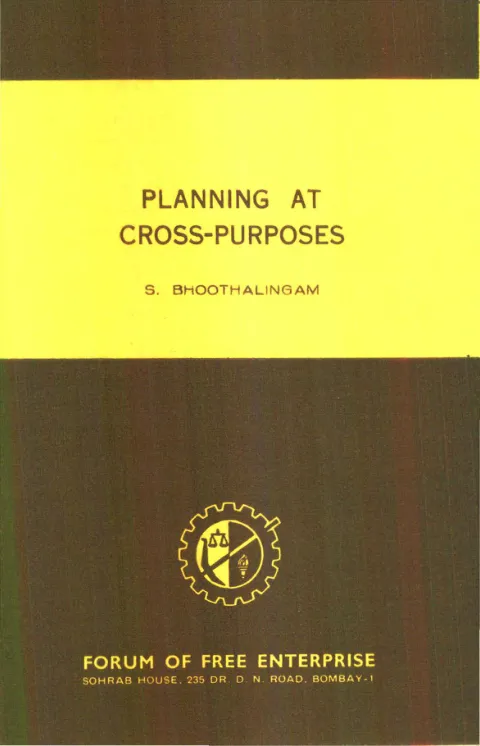
PLANNING AT CROSS-PURPOSES
Published by M. R. Pai for the Forum of Free Enterprise, "Sohrab House", 235 Dr. Dadabhai Naoroji Road, Bombay-1, and printed by H. NARAYAN RAO at H. R. MOHAN & CO. (PRESS), 9-B, Cawasjee Patel Street, Bombay-1. · Bombay · 1970
20 pages
Part of A. D. Shroff Memorial Lecture
PLANNING AT CROSS-PURPOSES
By S. BHOOTHALINGAM
Summary
Delivered as the Fifth A. D. Shroff Memorial Lecture in Delhi on 27 October 1970 and published by the Forum of Free Enterprise in December 1970, S. Bhoothalingam’s pamphlet diagnoses what he calls ‘planning at cross-purposes’ — the chronic failure of Indian planning to harmonise its ends with its means. Writing as Director-General of the National Council of Applied Economic Research and a former senior official, he opens with the empirical embarrassment of the Fourth Plan: a near-final draft surfacing months after launch, railway traffic falling instead of growing by the projected 3.6 per cent, industrial production lagging, fertiliser consumption stagnant, and Plan schemes that ‘cost much more, take longer to complete, and when completed take even longer to yield their results.’
From that audit Bhoothalingam moves to a structural argument. Indian planning, properly understood, is neither as comprehensive as its detractors fear nor as total as its devotees pretend — it is ‘nothing more than public investment in certain sectors and the management of economic activities springing therefrom.’ The real choice, he insists, ‘is not between planning and no planning, but only between different kinds of planning or between good planning and bad planning.’ What has gone wrong is the divorce of Plan from non-Plan: resources painfully mobilised for Plan investment are diverted to ordinary government expenditure, while the Planning Commission is kept off the non-Plan sector that quietly consumes the country’s growth.
The diagnostic core of the lecture is a sustained attack on the confusion of means with ends. Mobilisation of resources, exchange controls, import controls and Company Law administration have, he argues, ‘become truly autonomous and self-contained’ — means promoted into objectives in themselves. Corrective regulation breeds vested interests: ‘When you cannot do something yourself you are tempted, if you have the power, to stop anyone else from doing it except by your grace and permission.’ His prescription is radical recasting rather than abolition: controls should be general in character, work through economic forces rather than against them (‘one should use controls as the sailor uses the winds’), and free up the intellectual effort now ‘wasted in a perpetual game of hide and seek in a dark and ever-growing jungle.’
Bhoothalingam closes by gathering the threads into a liberal frame consistent with the Forum’s outlook: the basic objective of planning is ‘the development of human personality in a free society through economic growth and social justice’, requiring comprehensive planning at the highest level but means that ‘facilitate and not hinder the display of constructive energy and initiative.’ Without that clarity and steadfastness, he warns, ‘planning will continue to be at cross-purposes.‘
Key points
-
Frames the Fourth Plan’s troubles — late drafts, falling railway traffic, sluggish industrial output, stagnant fertiliser consumption — as symptoms of a deeper, recurring crisis in Indian planning rather than a passing aberration.
-
Redefines Indian planning as narrower than commonly claimed: ‘nothing more than public investment in certain sectors’ plus indirect management of the rest of the economy, not the encyclopaedic enterprise the Plan documents suggest.
-
Rejects the dichotomy between planning and no planning, recasting the real choice as one between good and bad planning consistent with democratic government.
-
Identifies confusion of ends and means as the central malaise — resource mobilisation, exchange control, import control and Company Law administration have become ends in themselves and ‘sacred cows’.
-
Attacks the institutional divorce of Plan from non-Plan expenditure, arguing the non-Plan sector — schools, hospitals, ongoing services — exercises prior claim on resources and falsifies Plan arithmetic.
-
Argues that the Planning Commission should be one organ of the Central Government, not a separate authority kept off non-Plan activity; planning and implementation must not be divorced.
-
Calls for radical reform of import controls and detailed industrial regulation: controls should be general, work through economic forces (‘as the sailor uses the winds’), and not require discretion exercised by a large number of functionaries.
-
Locates the lecture’s normative core in the freedom of choice as the wellspring of initiative and enterprise, and in growth-with-social-justice pursued through means that do not stifle private effort.
Generated by the v1.5 extraction pipeline. Awaiting editorial review.
Metadata and summary are AI-extracted from the source PDF and reviewed for editorial accuracy. The original work is available via the Read PDF tab above (where present); paragraph-level citation inside the PDF is deferred to a future engagement.