speech · memorial lecture
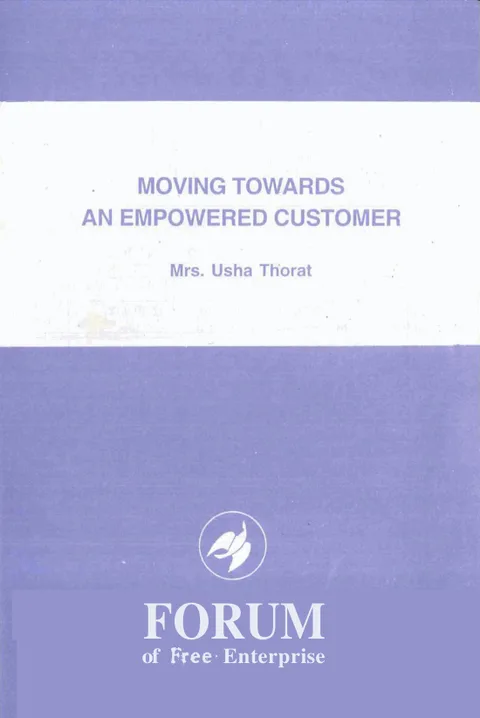
MOVING TOWARDS AN EMPOWERED CUSTOMER
By Usha Thorat
Published by S. S. Bhandare for the Forum of Free Enterprise, Peninsula House, 2nd Floor, 235, Dr. D. N Road, Mumbai 400001, and Printed by S. V. Lirnaye at India Printing Works, India Printing House, 42 G. D. Arnbekar Marg, Wadala, Mumbai 400 031 · Mumbai · 2007
15 pages
Summary
Delivered on 27 June 2007 at the 3rd M. R. Pai Memorial Award Function in Mumbai and published the following August by the Forum of Free Enterprise, this address by Mrs. Usha Thorat, then Deputy Governor of the Reserve Bank of India, argues that ‘customer empowerment’ in Indian banking is a two-sided project — institutional design by regulators on one side, an alert and assertive citizenry on the other. Thorat opens with a tribute to M. R. Pai, the consumer activist whose campaigns from the 1970s onward — for the right to nominate, the right to retrieve fraudulently withdrawn money, the right to access a locker before drill-opening, the right to redress for negligent storage — are framed as the moral premise of the talk: ‘Unless a citizen knows his rights and is willing to fight to assert them, he has no reason to complain.’
The speech is structured in three parts. The international section surveys the regulatory architecture for fair customer treatment across the United Kingdom (Office of Fair Trading, Financial Services Authority, Financial Ombudsman Service, Banking Code Standards Board), the European Commission (Treaty-level consumer protection and the ‘internal market’ rules on unfair contract terms, mis-selling, and guarantees), and the United States (Federal Reserve, FDIC, OCC, Office of Thrift Supervision, plus credit-union and FTC overlays). Thorat reads this comparative material as evidence that financial regulation everywhere now rests on two distinct pillars — prudential supervision of institutions, and conduct-of-business protection for customers — and that India must build out the second pillar in parallel with the first.
The Indian section catalogues the RBI’s recent moves: the Tarapore Committee’s May 2004 report on disenfranchisement of the depositor; the revised Banking Ombudsman Scheme of 2006 (RBI-funded, scope expanded to credit-card complaints, sales-agent deficiencies, and code non-adherence); the autonomous self-regulatory Banking Codes and Standards Board of India set up in July 2006, with sixty-seven of eighty-four scheduled commercial banks signed up; the new Customer Service Department at the RBI; comprehensive Credit Card Guidelines (November 2005); a Fair Practices Code for Lenders (2003); a Working Group report (August 2006) on the reasonableness of bank charges across twenty-seven basic banking services; IBA Model Policies on cheque collection, grievance redressal, compensation and security repossession; and the restoration of passbooks and cheque drop-box acknowledgements after evidence that banks were unilaterally curtailing them. Thorat notes that of roughly 44,000 complaints handled in 2006, about 48 per cent were resolved through mutual settlement and 34 per cent were rejected as outside scope or without cause.
The third part is a numbered checklist of nineteen practical tips for ordinary customers — read your Code of Bank’s Commitment to Customers, understand ‘average monthly/quarterly balance’, use ‘no-frills’ accounts, watch ATM and credit-card transactions, protect PINs and CVVs, study Most Important Terms and Conditions, escalate first to the bank’s internal grievance officer and only then to the Banking Ombudsman, and approach the Appellate Authority if dissatisfied. The booklet closes with a biographical tribute to M. R. Pai — gold medalist at the University of Madras, biographer of Nani Palkhivala, Secretary and later Vice-President of the Forum of Free Enterprise from 1956 — and prints A. D. Shroff’s epigraph that ‘Free Enterprise was born with man and shall survive as long as man survives,’ alongside Eugene Black’s exhortation that private enterprise be accepted ‘not as a necessary evil, but as an affirmative good.‘
Key points
-
Speech delivered on 27 June 2007 by Mrs. Usha Thorat, Deputy Governor of the Reserve Bank of India, at the 3rd M. R. Pai Memorial Award Function in Mumbai, sponsored by Punjab and Maharashtra Cooperative Bank.
-
Frames financial-sector regulation as two distinct pillars — prudential supervision of institutions and conduct-of-business protection of customers — and argues India is now consciously building out the second pillar.
-
Surveys international institutional architecture for fair treatment of bank customers: UK (OFT, FSA, FOS, BCSB), European Commission (Treaty-level consumer protection), and US (Federal Reserve, FDIC, OCC, OTS, FTC, National Credit Union Administration).
-
Catalogues RBI initiatives — Tarapore Committee (May 2004), revised Banking Ombudsman Scheme (2006), Banking Codes and Standards Board of India (July 2006), Customer Service Department, Credit Card Guidelines (November 2005), Fair Practices Code for Lenders (2003), and the Working Group on reasonableness of bank charges (August 2006).
-
Reports complaint volumetrics: about 44,000 complaints handled in 2006, of which roughly 48% were resolved through mutual settlement, 34% rejected for cause, and awards passed in 88 cases.
-
Documents IBA Model Policies on Collection of Cheques/Instruments, Grievance Redressal, Compensation, and Collection of Dues and Repossession of Security as benchmarks for individual bank policies.
-
Closes with a checklist of nineteen practical tips for customers — covering codes of commitment, no-frills accounts, ATM/credit-card vigilance, MITC awareness, internal grievance officers, and escalation paths through the Banking Ombudsman and Appellate Authority.
-
Pays tribute to M. R. Pai (1922–2003), Forum of Free Enterprise Secretary and biographer of Nani Palkhivala, whose maxim — that a citizen must know his rights and be willing to fight to assert them — sets the polemical frame of the talk.
Metadata and summary are AI-extracted from the source PDF and reviewed for editorial accuracy. The original work is available via the Read PDF tab above (where present); paragraph-level citation inside the PDF is deferred to a future engagement.