speech
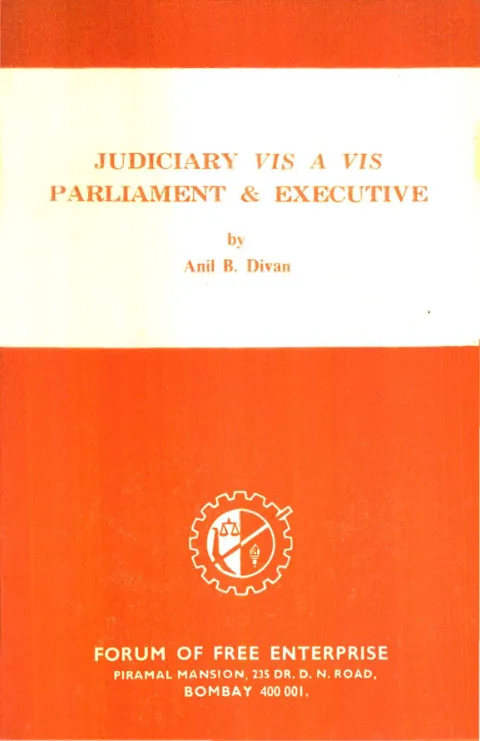
Judiciary Vis a Vis Parliament & Executive
FORUM OF FREE ENTERPRISE PIRAMAL MANSION, 235 DR. D. N. ROAD, BOMBAY 400 001. · Bombay · 1981
26 pages
Summary
Anil B. Divan’s 1981 keynote address to the Bar Council of India Trust, published as a booklet by the Forum of Free Enterprise, traces the genealogy of judicial independence from Stuart England through colonial India to the first three decades of the Indian Supreme Court. Divan opens with the dictionary sense of ‘vis-a-vis’ as two parties facing each other, and asks whether the Court’s recurrent confrontations with Parliament and the Executive — most recently the new Government’s mass transfers of High Court judges and Chief Justices — could harden into ‘eyeball to eyeball’ confrontation. He grounds the answer in history: Sir Edward Coke’s defiance of James I at Westminster Hall in 1608, the Act of Settlement (1701) securing judges’ tenure during good behaviour, the colonial-era stand of Sir Peter Grant in Bombay (1829), and Sir Morris Gwyer’s wartime striking down of Rule 26 of the Defence of India Rules.
The address then walks through the Constituent Assembly’s intent — quoting Nehru, Ambedkar and B. N. Rau on the need for judges free from party bias — and the inaugural sitting of the Supreme Court on 28 January 1950, where Chief Justice Kania set the standard that the Court ‘should be quite untouchable by the legislature and the executive authority’. Divan uses this benchmark to audit each decade. The 1950s emerge as ‘the era of the conservatives’, with foundational losses on personal liberty (the Gopalan judgment killed ‘due process’) offset by sharp equality decisions (Ameerunissa Begum, Ram Prasad Sahi) and Vivian Bose’s prose elevating Article 14 into an ‘attitude of mind’. The 1960s, dominated by Gajendragadkar, Subba Rao, Hidayatullah and J. C. Shah and influenced by Ridge v. Baldwin, Gideon’s Trumpet and the Warren Court, sharpen review of administrative action and culminate in Golaknath (1967) and the Supreme Court’s defence of two judges of the UP High Court against the Vidhan Sabha.
The Seventies, Divan argues, fall into three sub-periods marked by Keshavananda Bharati’s basic-structure doctrine — ‘probably the greatest blow in any civilized country by the Judiciary for the preservation of the democratic form of Government’ — the Emergency-era low of ADM Jabalpur, which ‘made the darkness complete’, and a post-Emergency renaissance through Maneka Gandhi, the Hoosseinara undertrial cases and the International Airport Authority decision. By the end of the rendered pages Divan is celebrating the Court’s openly activist posture as an ‘instrument of social reform and social dynamics’, while warning that a tidal wave of petitions is congesting its docket. The booklet’s printed text breaks off at page 18; the final eight pages of the PDF (printed pages 19 onward) are not in this chunk.
Key points
-
Framed as the keynote address to the Bar Council of India Trust on 25 January 1981, against the backdrop of the new Government’s mass transfers of High Court judges and Chief Justices.
-
Builds the case for judicial independence by tracing it from Coke’s 1608 defiance of James I, through the Act of Settlement (1701) and Sir Peter Grant’s 1829 Bombay stand, to Sir Morris Gwyer’s wartime striking down of Rule 26 of the Defence of India Rules.
-
Anchors the Indian standard in the Constituent Assembly Debates — Nehru, Ambedkar and B. N. Rau — and in Chief Justice Kania’s inaugural address that the Court ‘should be quite untouchable by the legislature and the executive authority’.
-
Audits the 1950s as conservative-era foundations: criticises the Gopalan judgment for stillborn personal liberty while praising equality decisions (Ameerunissa Begum, Ram Prasad Sahi) and Vivian Bose’s interpretation of Article 14.
-
Reads the 1960s as a ‘Renaissance of Administrative Law’ through Gajendragadkar, Subba Rao, Hidayatullah and J. C. Shah, with Ridge v. Baldwin, Gideon’s Trumpet and the Warren Court reshaping Indian doctrine and Golaknath asserting the law-making role of the judiciary.
-
Splits the Seventies into pre-Emergency, Emergency and post-Emergency phases, treating Keshavananda Bharati’s basic-structure doctrine as a constitutional bulwark and ADM Jabalpur as the Court’s lowest ebb.
-
Charts the post-Emergency revival via Maneka Gandhi, the Hoosseinara undertrial judgments, the International Airport Authority case and the expansion of ‘State’ in Part III, declaring an openly activist Court committed to social reform.
-
Flags that the Court’s new activism is producing a flood of petitions and mounting arrears, with constitutional matters awaiting hearing.
Metadata and summary are AI-extracted from the source PDF and reviewed for editorial accuracy. The original work is available via the Read PDF tab above (where present); paragraph-level citation inside the PDF is deferred to a future engagement.