speech · memorial lecture
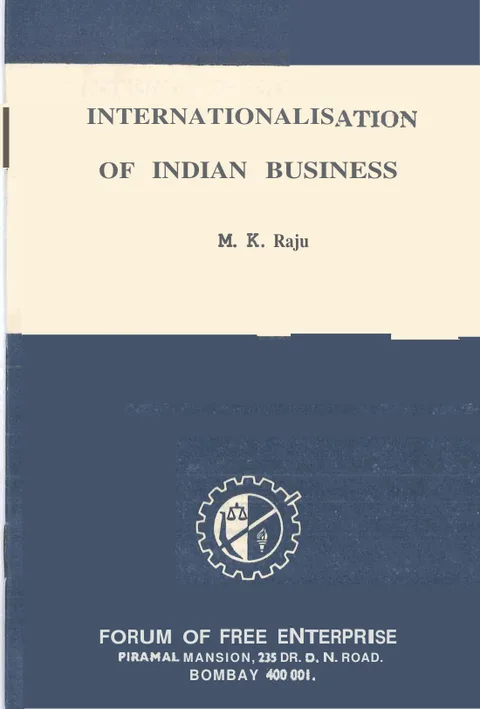
INTERNATIONALISATION OF INDIAN BUSINESS
By M. K. Raju
Published by M. R. PAI for the Forum of Free Enterprise, "Piramal Mansion", 235 Dr. Dadabhai Naoroji Road, Bombay-1, and printed by B. D. Nadirshaw at Bombay Chronicle Press, Sayed Abdulla Brelvi Road, Fort, Bombay-1. · Bombay · 1980
13 pages
Summary
M. K. Raju’s A. D. Shroff Memorial Lecture, delivered in Madras on 27 October 1979 under the auspices of the Forum of Free Enterprise and published as this booklet in January 1980, is a sober post-mortem of India’s first decade of outbound joint ventures. Opening with a tribute to Shroff and his generation’s faith in free enterprise as the engine of national development, Raju shifts quickly from rhetoric to data: of 345 Indian joint ventures approved abroad by December 1978, only 31% were in production, 26% under implementation, and a striking 43% had been abandoned. A closer survey of 23 manufacturing units in a single South-East Asian host country found just 9% profitable and 70% incurring cash losses.
Raju rejects the standard alibis — interest burden, invisible entry barriers, marginal Indian commitment — as inadequate, and instead builds a multi-dimensional diagnosis. Indian joint ventures, he argues, are ‘cash-starved’ from conception, technical-know-how fees and expatriate costs eat up nearly 24% of the equity, debt-equity norms ignore the openness of host-country markets, and Indian parents transferred to overseas operations the same ‘domestic market only’ assumptions that had shaped their import-substitution era at home. Set against Korean, Taiwanese and Japanese firms that built export-oriented industries at world scale from inception, Indian enterprises lacked both the scale and the brand-and-distribution capabilities that define a defensible comparative advantage in a market environment.
The second half of the lecture turns prescriptive. Raju calls on the Government of India and the Reserve Bank to stop treating joint ventures as ‘a foreign exchange generator’ through the export of raw materials and royalties, and to instead build a long-term industrial strategy: liberalised remittances of cash equity, consortium financing through Indian banks, stiff penalties for opportunistic abandonment, and organised takeover of ‘sick units’ by a consortium of Indian firms. The closing turn-around strategy frames the booklet’s central polemic — that ‘strategy must replace opportunism and expediency’ — and ends with a reminder, via a Eugene Black epigraph on the back cover, that private enterprise must be embraced ‘not as a necessary evil, but as an affirmative good.‘
Key points
-
Booklet reproduces the A. D. Shroff Memorial Lecture delivered by management consultant M. K. Raju in Madras on 27 October 1979 under Forum of Free Enterprise auspices.
-
Of 345 Indian joint ventures approved abroad by December 1978, only 31% were in production, 26% under implementation, and 43% were abandoned; in a survey of 23 manufacturing units in one host country, 70% were running cash losses.
-
Raju dismisses the standard ‘interest burden’, ‘invisible barriers to entry’ and ‘marginal commitment’ explanations as insufficient and proposes a multi-dimensional, structural diagnosis.
-
Indian joint ventures are cash-starved from inception: technical fees and expatriate costs cover ~24% of equity, and debt-equity norms safe in protected India become dangerous in open host-country markets.
-
Indian industry’s ‘domestic market only’ import-substitution mindset and reliance on tariff protection do not translate to host markets where Korean, Taiwanese and Japanese firms compete with world-scale, export-oriented operations.
-
GOI’s treatment of joint ventures as a ‘foreign exchange generator’ — and as a vent for idle Indian capacity after the 1969–72 recession — produced the wrong incentive structure and short-term horizon.
-
Reform agenda: GOI/RBI must share long-term financing through a consortium of Indian banks, liberalise equity remittances in cash, impose stiff penalties on opportunistic abandonment, and organise a consortium of Indian industry to take over ‘sick units’.
-
Final exhortation: ‘Strategy must replace opportunism and expediency’ — Indian industrialists must hone business acumen on the concept of strategy if Indian business is to internationalise in a big way.
Metadata and summary are AI-extracted from the source PDF and reviewed for editorial accuracy. The original work is available via the Read PDF tab above (where present); paragraph-level citation inside the PDF is deferred to a future engagement.