pamphlet
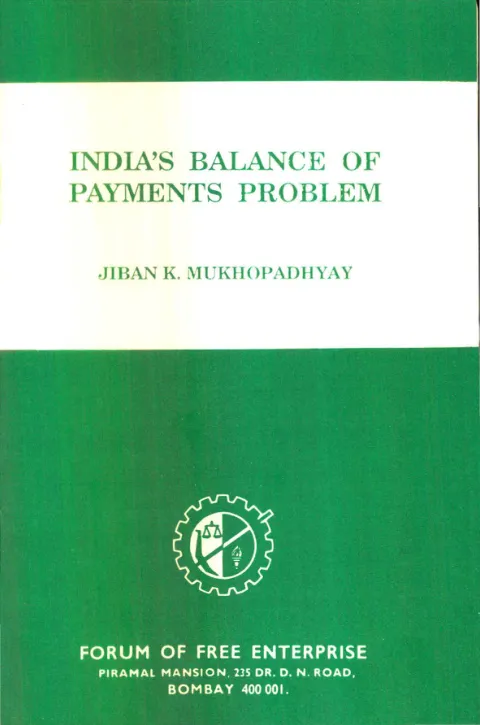
India's Balance of Payments Problem
FORUM OF FREE ENTERPRISE, PIRAMAL MANSION, 235 DR. D. N. ROAD, BOMBAY 400 001. · Bombay · 1989
24 pages
Summary
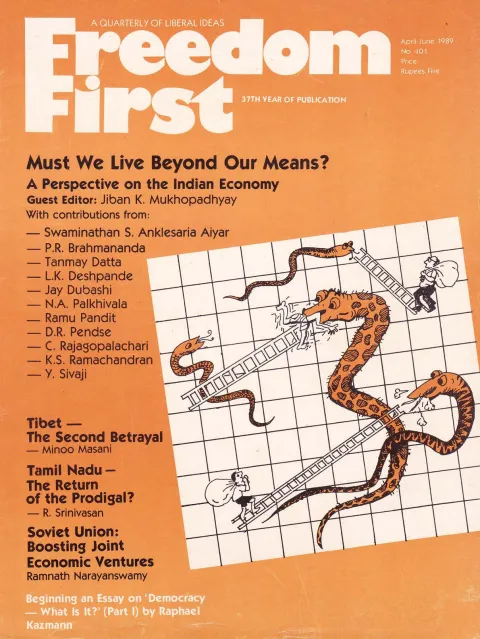
Jiban K. Mukhopadhyay, an economist at Tata Services Ltd., offers a measured diagnosis of India’s persistent balance of payments (BOP) difficulty as of mid-1989. He argues that the strain on the external sector is not a fresh crisis but the cumulative product of nearly four decades of an inward-looking trade regime built around import substitution, soft concessional borrowing, and a residual treatment of exports inside the Five Year Plans. Cheap multilateral finance from the World Bank’s IDA window, he writes, made India complacent in the 1960s — the decade when world demand would have rewarded a serious export drive — and the country “missed the bus”.
The central comparative move in the booklet contrasts India’s stagnating share of world exports (around 0.5 per cent through the late 1970s and 1980s) with the export-led ascent of the “Four Tigers” and China. Mukhopadhyay is careful, however, not to prescribe an export-led growth model wholesale for “a vast poor and unemployment ridden country like India”; following the Abid Hussain Committee (1985) he urges instead that export growth must progressively supplement national economic growth, with production for export treated as an integral part of domestic production rather than a residual.
He then surveys the “pragmatic liberalisation” that began with the 1975-76 import policy and accelerated through the import policies of 1985-88 and 1988-91, alongside a multifaceted export-promotion package (CCS, Duty Drawback, MODVAT, 80 HHC income-tax exemption, eased export credit, and a steady downward adjustment of the rupee). The recent BOP picture, in his reading, is “difficult, but not critical”: exports grew about 23 per cent annually over three years to 1988-89, the export-to-import ratio improved from 55 per cent to 73 per cent, and reserves cover three months of imports. Risks remain — fragile invisibles, NRI deposits that are technically repatriable liabilities, a debt-service ratio that climbed to roughly 26 per cent, and protectionist headwinds from the US’s “Super 301” naming of India and the prospect of a “Fortress Europe” by 1992 — but he concludes that an external debt-trap is not in close sight provided India does not relapse into over-consumption of foreign exchange on projects that do not earn it back.
Key points
-
Frames India’s BOP strain as a chronic, structural problem rooted in four decades of inward-looking trade policy, not a sudden crisis.
-
Argues that cheap IDA concessional finance (US$24bn cumulative 1951-52 to 1986-87, 58% from IDA since 1961) bred export complacency, especially during the high-growth 1960s when ‘we missed the bus’.
-
Documents India’s collapsing share of world exports — from nearly 3% in 1938 to 1.1% in 1960, 0.7% in 1970, and stagnant below 0.5% through the 1980s — against the Four Tigers’ rise from 2% to 7.2% and China’s surge from 0.7% to 1.6% of world exports.
-
Rejects a wholesale export-led growth model for a labour-surplus India but, citing the Abid Hussain Committee, endorses growth-led exports in which export production is integral to domestic production.
-
Tracks the gradual liberalisation of import policy from 1975-76 through the 1988-91 policy, framing it as procedural de-bottlenecking rather than genuine liberalisation, since consumer goods remain banned and a mean nominal tariff above 120% persists.
-
Inventories the post-1985 export-promotion package: action plans on 14 thrust commodities, CCS and Duty Drawback extensions, MODVAT, 100% Section 80 HHC profit exemption, concessional customs duty for export thrust industries, and a steady downward rupee adjustment.
-
Reads current BOP indicators as encouraging — exports up ~23% annually in rupee terms, export-to-import ratio rising 55%→73% (1985-86 to 1988-89), trade deficit barely growing in dollar terms — while flagging that invisibles cover only 36% of the trade deficit versus 72% in 1980-81.
-
Warns that NRI deposits (Rs.13,000 crores by end-1988) cushion reserves but remain repatriable liabilities, the debt-service ratio has climbed to ~26%, and protectionist threats (US ‘Super 301’, ‘Fortress Europe’ by 1992) demand further liberalisation to lift export competitiveness.
Metadata and summary are AI-extracted from the source PDF and reviewed for editorial accuracy. The original work is available via the Read PDF tab above (where present); paragraph-level citation inside the PDF is deferred to a future engagement.