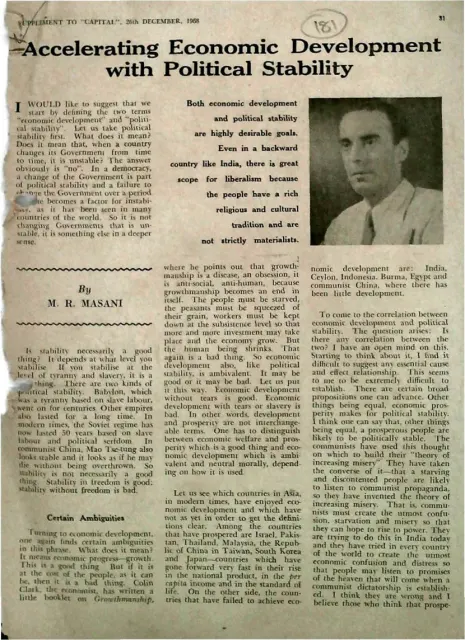
essay
"Growthmanship": Fact and Fallacy
By Colin Clark
Forum of Free Enterprise, Sohrab House, 235, Dr. D. N. Road, Bombay-1 · Bombay · 1965
16 pages
“Growthmanship”: Fact and Fallacy
By COLIN CLARK
Summary
“Growthmanship”: Fact and Fallacy is Colin Clark’s 1965 essay, reprinted from the January 1965 issue of The Intercollegiate Review and issued by Bombay’s Forum of Free Enterprise as a 26-page booklet (Booklet No. 206, dated 11 July 1965) with an introduction by FFE President A. D. Shroff. Clark, then Director of Oxford’s Agricultural Economics Research Institute, coins the term “growthmanship” to describe an excessive preoccupation with economic growth, the advocacy of unduly simple proposals for obtaining it, and the selective use of statistics to flatter one’s preferred political and economic system at the expense of one’s opponents.
The core argument is that the post-war growth models of Sir Roy Harrod, Evsey Domar and Walt Whitman Rostow over-credit capital and under-credit human factors. Drawing on cross-country capital-output ratios, the Norwegian research of Doctor Aukrust, Robert Solow’s American findings and Tibor Barna’s manufacturing comparisons, Clark contends that the marginal capital-output ratio is roughly four or less and often falling, that productivity gains come overwhelmingly from “better knowledge, organisation, skill, effort, education, enterprise”, and that the Communist-era doctrine of a continually rising capital-output ratio — rooted in Eugen von Bohm-Bawerk and fossilised in Soviet planning — is empirically wrong. He dismantles widely-cited international “league tables” purporting to show that high investment drives rapid growth, singling out Governor Nelson Rockefeller’s diagram for the Republicans’ liberal wing, and rejects the Bergson–Nutter–Jasny and CIA-endorsed claim that Soviet productivity was overtaking the United States.
The political payoff is a classical-liberal warning: governments that force the pace through capital-intensive prestige projects can waste real resources and retard rather than accelerate development. Clark cites Nehru’s “comparative religion” reply to a question about building more Indian steel mills, and the wider tendency of “newly developing” countries to crave “a steel mill, a national airline, a six-lane highway and an invitation for the President of the country to address the Washington Press Club”, as emblems of this danger. The summary and conclusions reassert the classical view that land, labour, capital and enterprise must all be present with no factor taking absolute precedence, and that international comparisons designed to show high investment going hand in hand with rapid growth do not survive examination.
Key points
-
Clark coins the polemical term “growthmanship” for an excessive preoccupation with economic growth combined with simplistic policy prescriptions and tendentious selection of statistics.
-
He argues that the post-war Harrod-Domar growth models, designed for a period of capital shortage, are now out of date — capital is created during growth rather than being its principal cause.
-
Empirical capital-output ratios across Argentina, Australia, Canada, West Germany, India, Japan, Norway, the U.K., U.S.A. and U.S.S.R. cluster around 4 or less and often fall as economies advance, contradicting the Communist-era doctrine of an ever-rising ratio.
-
Norwegian research by Doctor Aukrust and parallel American work by Robert Solow show that growth in real national product comes overwhelmingly from human factors — education, skill, organisation and enterprise — rather than from sheer additions to the capital stock.
-
Walt Whitman Rostow’s “take-off into sustained growth” doctrine is dismissed as a “half-truth at best”; Governor Nelson Rockefeller’s diagram correlating high investment with rapid growth collapses when supplemented with a fuller country sample.
-
The Bergson-Nutter-Jasny studies, accepted even by the CIA, have shown that the supposed Soviet “catching up” with U.S. productivity was an artefact of mistaken, selectively-used evidence.
-
Clark ridicules the steel-mill cult — invoking Nehru’s “comparative religion” remark — and warns that newly developing countries who fixate on prestige heavy industry while neglecting other sectors waste capital and retard development.
-
The conclusion is a classical-liberal restatement: land, labour, capital and enterprise must all be present with no factor taking absolute precedence, and government attempts to force the pace are likely to be counter-productive.
Generated by the v1.5 extraction pipeline. Awaiting editorial review.
Metadata and summary are AI-extracted from the source PDF and reviewed for editorial accuracy. The original work is available via the Read PDF tab above (where present); paragraph-level citation inside the PDF is deferred to a future engagement.