speech
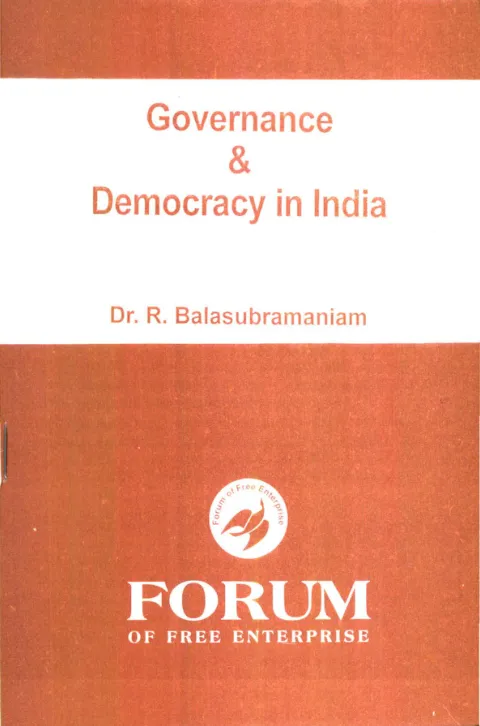
Governance & Democracy in India
Forum of Free Enterprise
36 pages
Governance & Democracy in India
By Dr. R. Balasubramaniam
Summary
Governance & Democracy in India is a Forum of Free Enterprise booklet transcribing Dr. R. Balasubramaniam’s inaugural keynote address delivered in Berlin on 16 January 2019 at an event organised by the Tagore Center, Embassy of India, in association with the Indian Center for Cultural Relations, New Delhi. Speaking as a medical doctor turned grassroots development activist with three decades of work among India’s poorest, Balasubramaniam argues that ‘governance’, ‘democracy’ and ‘citizenship’ cannot be cleanly separated — they are intricately enmeshed and only become legible at the last mile, where a tribal woman in a forest or a small entrepreneur in tier-2 Mysuru actually encounters the state.
The rendered pages develop the booklet’s central diagnosis: India’s deepest transition is not economic but cultural — from ‘subject-hood’ to ‘citizen-hood’, and from an ‘entitlement mindset’ to an ‘empowerment mindset’. Balasubramaniam reads sixty-plus post-independence years as a long habituation to dependence on a paternalist state whose constitution promises food, nutrition and jobs, then narrates the evolution of Indian democracy from one-party Congress hegemony through the 1975 Emergency, the Vajpayee-era coalition experiment, and the post-2014 single-party mandate. He frames the next stage of maturation around three forces: the framing of politically acceptable, administratively feasible and sustainable rules; the building (and dismantling) of democratic institutions; and political leadership willing to ask 1.3 billion people to stop receiving and start participating.
Sunil S. Bhandare’s editorial introduction situates the address inside global anxieties about democratic retreat and signals that the booklet is offered as an ‘honest independent perspective’ from a practitioner rather than an academic — explicitly inviting researchers and students to test his claims about whether recent policy initiatives are ‘conferring the desired benefits to the concerned deserving people’.
Key points
-
Transcript of Balasubramaniam’s inaugural keynote address in Berlin (16 January 2019), published by Forum of Free Enterprise with an editorial introduction by Sunil S. Bhandare and underwritten by the Shailesh Kapadia Memorial Trust.
-
Frames governance, democracy and citizenship as inseparable at the grassroots, drawing on three decades of practitioner work with ‘the poorest of the poor’ in India.
-
Uses an elderly tribal woman’s pension story — and her later access to a bank account via the JAM (Jan Dhan, Aadhaar, Mobile) stack — as a parable for ‘last mile’ good governance.
-
Diagnoses India’s core challenge as a shift from subject-hood to citizen-hood, and from an entitlement mindset to an empowerment mindset across 1.3 billion people.
-
Reads Indian democratic evolution in phases: Congress one-party dominance, the 1975 Emergency, coalition governance under Vajpayee, and a post-2014 single-party mandate seen as growing maturation.
-
Names a ‘bureaucratic challenge’: civil servants accustomed for 65 years to being ‘master’ must internalise the manifesto-stated role of ‘servants of the public’.
-
Lays out three forces shaping governance — rules (politically acceptable, administratively feasible, sustainable), democratic institutions to deliver them, and political leadership to absorb citizen challenge.
Generated by the v1.5 extraction pipeline. Awaiting editorial review.
Metadata and summary are AI-extracted from the source PDF and reviewed for editorial accuracy. The original work is available via the Read PDF tab above (where present); paragraph-level citation inside the PDF is deferred to a future engagement.