speech
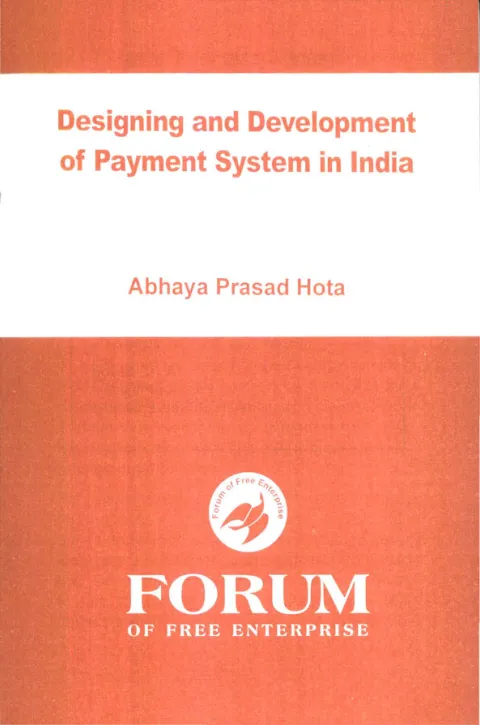
Designing and Development of Payment System in India
Forum of Free Enterprise · 2017
26 pages
Summary
This Forum of Free Enterprise booklet prints the acceptance speech that Abhaya Prasad Hota — former Chief General Manager of the Reserve Bank of India and former MD & CEO of the National Payments Corporation of India (NPCI) — delivered on receiving the Thirteenth M. R. Pai Memorial Award in Mumbai on 21st August 2017. The volume opens with a biographical note on M. R. Pai (1931–2003), the consumer-rights crusader who joined A. D. Shroff at the founding of the Forum of Free Enterprise in 1956 and went on to fight a long series of public-interest battles against telephone departments, banks, Indian Airlines and other monopolies. It is followed by a recorded tribute from Suresh Prabhu, then Union Minister of Commerce and Industry, and an editorial introduction by Sunil S. Bhandare that frames Hota’s career as a continuation of Pai’s consumer-protection mission, this time through the architecture of payment systems rather than the courts.
Hota’s own text — beginning on printed page 11 — traces the institutional design of Indian retail payments across roughly three decades. He outlines five stages: traditional cheque clearing (and its migration through MICR processing to Cheque Truncation, which now clears any cheque in two days); the build-out of real-time inter-bank transfer rails (RTGS, NEFT, IMPS, UPI, BHIM, *99#); the universalisation of card payments through RuPay; the Aadhaar payments platform; and the ECS rebuild after NPCI took it over in 2010. Within the rendered chunk he reaches the start of the Aadhaar section. Throughout, Hota credits regulatory action at the RBI/NPCI level for compressing both time and cost — a Rs.10,000 fee to remit Rs.1 crore in 2004 collapsing to near-zero with widespread RTGS, and India becoming, in 2010, the first country to operate a 24x7 real-time retail payments system through IMPS.
The argumentative thread is that pro-consumer outcomes in finance have come less from market competition alone than from centralised infrastructure decisions that ‘directly impact the ability of the banks to serve their customers better’ — payment standardisation, default RuPay issuance to 225 million Jan Dhan accountholders, BHIM in twelve languages, USSD channels for feature phones. The Forum frames the booklet as a financial-literacy resource for bank depositors, students and researchers, in keeping with its long-standing free-enterprise-with-consumer-voice posture.
Key points
-
Booklet reprints Abhaya Prasad Hota’s acceptance speech for the 13th M. R. Pai Memorial Award (Mumbai, 21 August 2017), jointly hosted by AIBDA and the Forum of Free Enterprise.
-
Front matter establishes the M. R. Pai lineage of consumer activism — his association with A. D. Shroff at the Forum’s 1956 founding, his role with the All-India Bank Depositors’ Association, and tributes from Minister Suresh Prabhu.
-
Hota frames payment-system design as a ‘leveraging’ activity: small interventions at RBI or NPCI level magnify into customer-facing improvements across the banking system.
-
Cheque clearing is presented as the first stage — MICR plus Cheque Truncation cut typical clearing from up to a month (for outstation cheques) to two days regardless of cheque type.
-
Money transfer is the second stage: RTGS, NEFT, IMPS, UPI, BHIM and *99# replaced inter-bank cheques and demand drafts; in 2004 a Rs.1 crore RTGS remittance could cost up to Rs.10,000, since collapsed by RBI pricing intervention.
-
India became, in 2010, the first country to operate a 24x7 real-time retail payments system (IMPS); more than thirty countries have since adopted IMPS-like rails, and BHIM/UPI made money transfer ‘as easy as sending an email’.
-
Card-payment universalisation through RuPay extended access from roughly 55 banks to 800+, and RuPay was issued as the default debit card to 225 million Jan Dhan account holders.
-
Aadhaar Payment platform (the fourth stage, partially rendered) underpins direct benefit transfers, e-KYC, biometric cash-out at business correspondents, and account-credit using Aadhaar as a reference number.
Metadata and summary are AI-extracted from the source PDF and reviewed for editorial accuracy. The original work is available via the Read PDF tab above (where present); paragraph-level citation inside the PDF is deferred to a future engagement.