pamphlet
Golden Jubilee (1956-2006)
An Odyssey
FORUM of Free Enterprise, Peninsula House, 2nd Floor, 235 Dr. D.N. Road, Mumbai 400 001. Email: ffe@vsnl.net. Telefax: 2261 4253. · Mumbai · 2006
8 pages
Golden Jubilee (1956-2006)
Summary
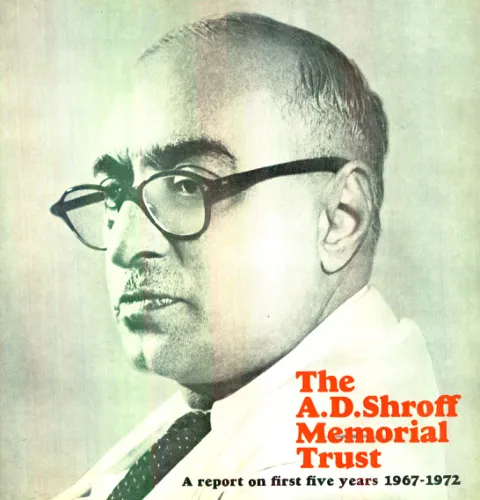
This short institutional retrospective, issued by the Forum of Free Enterprise to mark its golden jubilee, narrates the Forum’s half-century journey from its 1956 founding to 2006. It locates the organisation’s genesis in the “ominous clouds of socialism” of the mid-1950s: the Government’s commitment to a state-directed economy, the nationalisations of coal, civil aviation and life insurance, and a propaganda climate that, in the Forum’s reading, slandered private enterprise. A.D. Shroff and a circle of businessmen-publicists — Murarji Vaidya, M.A. Master, M.A. Sreenivasan and others — concluded that a centralised command economy was incompatible with a pluralist democracy, and built the Forum as a vehicle of economic education to defend the private sector and stem what they saw as drift toward totalitarianism.
The narrative tracks the Forum’s institutional milestones: a 1957 Code of Conduct for business; Nani Palkhivala’s long presidency (1968–2000) and his crusade against confiscatory taxation through the treatise The Highest Taxed Nation; an indictment of the licence-permit regime that, by the booklet’s account, held GDP growth to 3.5% and per-capita income growth to 1.3% between 1951 and 1980; and credit-claiming for the more equitable tax structure that emerged after 1991. It also chronicles the Forum’s cultural footprint — public lectures, booklets, essay and elocution competitions, the A.D. Shroff Memorial Lectures (which hosted Milton Friedman, Peter Bauer and Colin Clark), and the founding of the A.D. Shroff Memorial Trust, the Nani A. Palkhivala Memorial Trust and the M.R. Pai Foundation.
The closing pages perform a tribute function: government recognition of Shroff (commemorative stamp, 1999) and Palkhivala (stamp 2004, Padma Vibhushan, honorary doctorates), and the appearance of the Forum and M.R. Pai in the Friedmans’ autobiography Two Lucky People, alongside George Woods’s encomium to Shroff. The piece ends by announcing a website launch in January 2006 and rededicating the Forum to its mission of objectivity and high standards of governance in public life.
Key points
-
Frames the Forum’s 1956 founding as a direct response to the Nehruvian socialist turn — nationalisation of coal, civil aviation and life insurance, and the official rhetoric against private enterprise.
-
Identifies A.D. Shroff as the founder-leader and names Murarji Vaidya, M.A. Master and M.A. Sreenivasan as fellow signed-article publicists who built early intellectual momentum.
-
Asserts the Forum’s central political thesis: a centralised command economy and a pluralist democratic polity are incompatible, and one-party dominance without organised opposition risks crossing the line into totalitarianism.
-
Claims the Forum produced India’s first comprehensive business Code of Conduct in 1957, framing self-regulation as part of liberal credibility.
-
Indicts the licence-permit-tariff regime with a hard datum: average annual GDP growth of 3.5% and per-capita income growth of 1.3% between 1951 and 1980, one-third of what was planned.
-
Credits Nani Palkhivala (President 1968–2000) and his treatise The Highest Taxed Nation with creating pressure that produced the more equitable post-1991 tax structure.
-
Catalogues an institutional ecology built around three memorial trusts (Shroff, Palkhivala, Pai), the A.D. Shroff Memorial Lectures (Friedman, Bauer, Clark), and decades of youth-oriented essay competitions and leadership camps.
-
Closes with state and international recognition — commemorative stamps for Shroff (1999) and Palkhivala (2004), Padma Vibhushan, and the mention of the Forum and M.R. Pai in the Friedmans’ Two Lucky People.
Generated by the v1.5 extraction pipeline. Awaiting editorial review.
Metadata and summary are AI-extracted from the source PDF and reviewed for editorial accuracy. The original work is available via the Read PDF tab above (where present); paragraph-level citation inside the PDF is deferred to a future engagement.