speech · memorial lecture
Giving is Receiving
Forum of Free Enterprise · 2018
27 pages
No. 30 in Bhogilal Leherchand Memorial Lecture
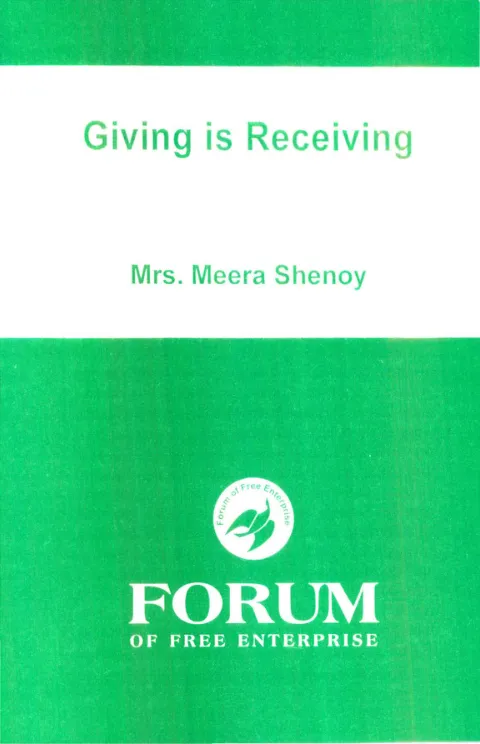
Giving is Receiving
By Mrs. Meera Shenoy
Summary
Giving is Receiving is the printed text of the 30th Bhogilal Leherchand Memorial Lecture, delivered by Meera Shenoy in Mumbai on 5 December 2018 under the auspices of the Bhogilal Leherchand Foundation, the Forum of Free Enterprise, and the A. D. Shroff Memorial Trust. After an editorial introduction by Sunil S. Bhandare framing Shenoy’s work against India’s paradox of “jobless growth” and an unmet “demographic dividend,” Shenoy uses the lecture to recount how, after a decade of skilling rural youth, she founded Youth4Jobs to train youth with disabilities and link them to formal-sector employment.
Shenoy threads the talk with concrete vignettes — parents in villages who first dismissed the idea of jobs for “useless children,” companies that initially asked for trainees who “look like you and me,” and entrepreneurs such as Arvind (a wheelchair-using CEO) and former Yum India president Niren Choudhary, who hired speech- and hearing-impaired staff at KFC. She positions her organisation as advocacy-first (touching 2,75,000 households, villages, schools and societies with the slogan “Ability in Disability”), as a builder of a scalable, replicable training template now operating across twenty-five centres from Guwahati to Trichy and as far as Mauritius, and as the originator of “Not Just Art,” billed as the world’s first portal for disability art.
The second half of the lecture moves from individual stories to system design: MoUs with universities, a CII–DFID sensitisation workshop that landed fifty blind interns at a private-sector bank, “Smart Inclusion Centres” as experiential zones for corporate partners, a government girls’ blind school where teachers are now requesting JAWS and NVDA screen-readers, and a pilot in Chennai that mainstreamed speech- and hearing-impaired cashiers — a single test, she claims, that unlocked the potential of more than 75,000 jobs. The recurring frame is that compassion routed through markets and structured employability is more dignifying than subsidies and doles, and that “if They can, I can,” so too can the reader.
Key points
-
The booklet reproduces Meera Shenoy’s 30th Bhogilal Leherchand Memorial Lecture (Mumbai, 5 December 2018), jointly hosted by the Bhogilal Leherchand Foundation, the Forum of Free Enterprise, and the A. D. Shroff Memorial Trust.
-
Editor Sunil S. Bhandare frames Shenoy’s work against India’s “jobless growth” paradox and reports that Youth4Jobs has trained ~12,500 disabled youth in six years, with 65% placed in the organised sector.
-
Shenoy invokes Gandhi’s choice of Sabarmati as a parable of compassion to explain why Youth4Jobs targets the intersection of poverty and disability rather than poverty alone.
-
She argues that government subsidies and doles, especially around elections, dampen the incentive to work, and that the harder, more dignifying route is linking disabled youth to organised-sector jobs.
-
The model is presented as scalable and replicable: 25 centres from Assam to Tamil Nadu, partnerships with ~550 companies (200 of them first-time hirers), and a first global centre in Mauritius.
-
Shenoy launched “Not Just Art,” pitched as the world’s first portal for Disability Art, with UNESCO signalling interest in becoming its first partner.
-
A Chennai pilot placing speech- and hearing-impaired cashiers — chosen by 97% of surveyed consumers over speaking cashiers — is held up as a market-led unlock of an estimated 75,000+ jobs.
-
Recurring frames include “Ability in Disability,” “if They can, I can,” and the claim that more educated disabled youth are often less placeable because faculty cannot train them and aspirations outrun technical skill.
Generated by the v1.5 extraction pipeline. Awaiting editorial review.
Metadata and summary are AI-extracted from the source PDF and reviewed for editorial accuracy. The original work is available via the Read PDF tab above (where present); paragraph-level citation inside the PDF is deferred to a future engagement.