speech · memorial lecture
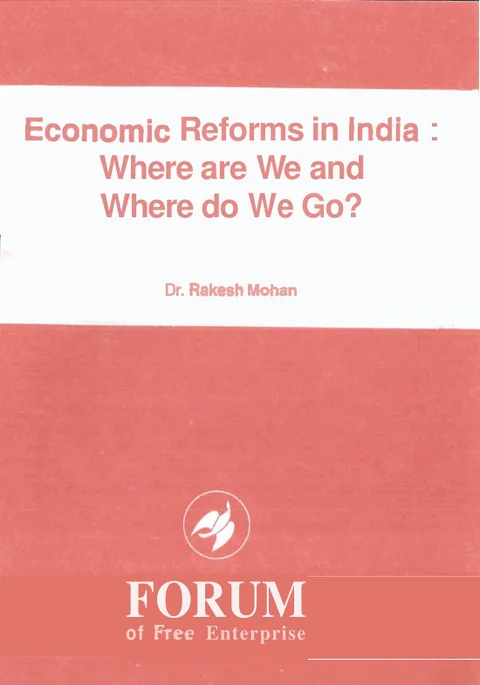
Economic Reforms in India: Where are We and Where do We Go?
Forum of Free Enterprise · Mumbai · 2007
29 pages
Summary
Rakesh Mohan’s 39th A. D. Shroff Memorial Lecture, delivered in Mumbai in December 2005 and published by the Forum of Free Enterprise in 2007, takes stock of fifteen years of economic reform in India and sketches an agenda for the next round. Mohan invokes Malcolm Gladwell’s metaphor of the tipping point to argue that countless small, gradual reforms since 1991 have together released a ‘burst of entrepreneurial energy’, lifting trend growth from around 3–4 per cent for three decades to 6–6.5 per cent, slashing inflation, building comfortable foreign-exchange reserves and pulling poverty down by 23–26 percentage points since independence. He divides the story into macroeconomic reforms — tax simplification (with a central CENVAT rate of 16 per cent, a VAT roll-out, and the Fiscal Responsibility and Budget Management Act of 2004); monetary policy reforms that ended automatic monetisation of fiscal deficits, restored central-bank autonomy and halved average inflation; and external-sector reforms that devalued the rupee in 1991, moved to a managed float, cut peak tariffs from over 400 per cent to 12.5, and opened the current account with limited capital-account convertibility.
Microeconomic reforms — industrial deregulation, infrastructure liberalisation in telecoms, highways, ports and civil aviation, financial-sector strengthening (Basel II, prudential norms, market listing of public-sector banks, SEBI, NSE, abolition of the Controller of Capital Issues, IRDA), and selective agricultural opening — receive a similarly approving review, with telecoms and capital markets singled out as successes and power-sector reform, urban infrastructure and railways flagged as laggards. Mohan documents the turnaround through tables on per-capita income, poverty, literacy, life expectancy, installed power capacity, sectoral growth rates, fiscal indicators, banking NPLs, openness ratios and corporate profitability, dating the corporate-sector revival to 2002–03 after a slowdown around 1997.
Looking forward, Mohan argues that the first generation of reforms freed the private sector but that further acceleration in growth and poverty reduction will be capped by the weakness of public goods and services. He calls for a ‘second generation’ of reforms that empowers the public sector — at central, state and local levels — to deliver agricultural research and extension, urban infrastructure, human-resource development and quality regulation, often through public–private partnerships. Agriculture receives the most extended treatment: he argues that a second green revolution must be disaggregated, regionally tailored and oriented to diversification into dairy, horticulture, fisheries and meat, supported by rejuvenated agricultural universities, NABARD-financed rural infrastructure, and decentralised credit delivery. The rendered pages close on urbanisation, where Mohan notes the puzzle that urban-population growth and net rural–urban migration have slowed during the reform period, with only 21 per cent of urban growth between 1991 and 2001 coming from migration; he traces this to inappropriate small-scale-industry reservations, rigid labour laws and urban land-use restrictions that have suppressed manufacturing-led urbanisation.
Key points
-
Frames fifteen years of Indian reform (1991–2006) as a Gladwellian ‘tipping point’ of many small changes adding up to structural transformation, lifting trend GDP growth from 3–4 per cent to 6–6.5 per cent.
-
Macroeconomic reform agenda traced across fiscal (CENVAT, VAT, FRBM 2004), monetary (end of automatic monetisation, independent RBI, inflation halved to ~5 per cent) and external-sector (1991 devaluation, peak tariff cut from over 400 per cent to 12.5 per cent, managed-float exchange regime) reforms.
-
Microeconomic reform: industrial delicensing in 1991, small-scale reservations cut from 836 to 326 industries, telecom (TRAI), capital markets (SEBI, NSE) and civil aviation cited as successes; power, railways and urban infrastructure flagged as unfinished business.
-
Financial-sector reform produced sharp falls in NPLs, recapitalisation of public-sector banks, listing and Basel II adoption, and entry of private and foreign insurance companies under IRDA after the 1956 nationalisations.
-
Selected indicators: per-capita real income roughly tripled since 1951 to ₹12,414; installed power capacity rose from 1,362 MW in 1951 to over 118,000 MW; life expectancy from 32 to ~65 years; poverty headcount 23–26 per cent in 1999–2000.
-
Argues the binding constraint on the next phase is weak delivery of public goods, not lack of private dynamism, and that the ‘public sector’ must be redefined to span centre, state and local government for delivering agriculture, urban, education and governance services.
-
Diagnoses agricultural deceleration in the 1990s and 2000s and calls for a regionally disaggregated ‘second green revolution’ covering dairy, horticulture, fisheries and poultry, backed by rejuvenated universities, NABARD-financed rural infrastructure, and public–private partnerships in extension.
-
Identifies a paradoxical slowdown in net rural-urban migration during the reform period (only 21 per cent of urban-population growth in 1991–2001), attributing it to small-scale-industry reservations, rigid labour law and constraining urban land policy that suppress manufacturing-led urbanisation.
Metadata and summary are AI-extracted from the source PDF and reviewed for editorial accuracy. The original work is available via the Read PDF tab above (where present); paragraph-level citation inside the PDF is deferred to a future engagement.