edited volume · proceedings
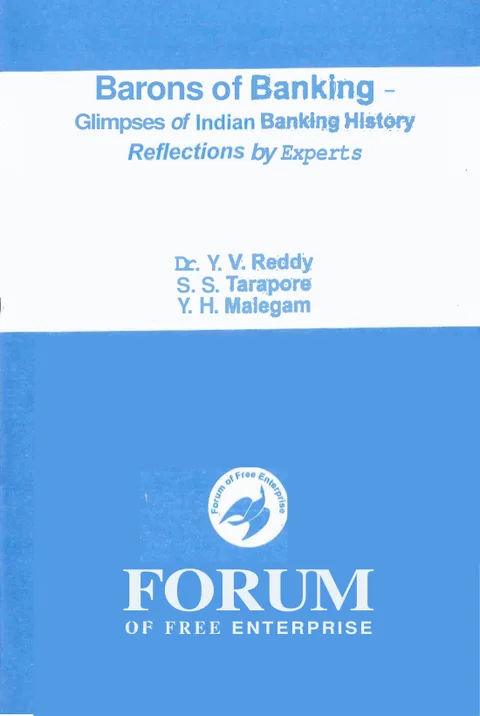
Barons of Banking - Glimpses of Indian Banking History
Reflections by Experts
By Dr. Y. V. Reddy, S. S. Tarapore
Published by S. S. Bhandare for the Forum of Free Enterprise, Peninsula House, 2nd Floor, 235, Dr. D. N. Road, Mumbai 400001, and Printed by S. V. Limaye at India Printing Works, India Printing House, 42 G. D. Ambekar Marg, Wadala, Mumbai 400 031. · Mumbai · 2014
15 pages
Summary
This Forum of Free Enterprise booklet, published on 03/Feb/2014, gathers the remarks delivered on 25 October 2013 at the Mumbai launch of Bakhtiar K. Dadabhoy’s book ‘Barons of Banking — Glimpses of Indian Banking History’, a volume commissioned at the behest of the A. D. Shroff Memorial Trust. After an Introduction by Forum President Minoo R. Shroff, three substantial addresses follow: Dr. Y. V. Reddy (former RBI Governor and Chairman of the 14th Finance Commission), the economist S. S. Tarapore, and the chartered accountant Y. H. Malegam, who is also a Trustee of the A. D. Shroff Memorial Trust. The contributors converge on the book’s framing of six ‘barons’ — Sir Sorabji Pochkhanawalla, Sir Purushottamdas Thakurdas and Sir C. D. Deshmukh from the pre-Independence era, and Raj Kumar Talwar, A. D. Shroff and H. T. Parekh from the post-Independence period — as institution-builders whose dharma shaped the Imperial Bank, the Reserve Bank of India, SBI, ICICI, IDBI and the Unit Trust of India. Across the three reflections, the booklet uses the lives of the barons to argue for central bank accountability and independence, for revisiting the Shroff Committee’s verdict on private-sector discipline, for renewed faith in development banking, and for a future generation of bankers that is younger, more gender-balanced and geographically more diverse. The booklet is sponsored by the Shailesh Kapadia Memorial Trust.
Key points
-
Minoo R. Shroff’s Introduction frames the booklet as a précis of three addresses delivered at the 25 October 2013 Mumbai launch of Bakhtiar Dadabhoy’s book, commissioned by the A. D. Shroff Memorial Trust.
-
The book profiles six ‘barons’ — Sorabji Pochkhanawalla, Purushottamdas Thakurdas and C. D. Deshmukh before independence, and Raj Kumar Talwar, A. D. Shroff and H. T. Parekh after — as institution-builders.
-
Y. V. Reddy reads the book as proof that institutions are creatures of individuals, invoking Pochkhanawalla’s doctrine that thrift-banking is a banker’s highest service to defend household savings over consumer credit.
-
Reddy argues that central bank independence and accountability gained fresh salience after the global financial crisis and questions whether public-sector banks warrant the governance standards applied to private banks, citing the Talwar affair.
-
He calls for a future generation of bankers who are younger, more gender-balanced, geographically diverse and include returnees from global financial centres.
-
S. S. Tarapore predicts the book will become ‘the locus classicus on India’s monetary and banking history’ and singles out Thakurdas’s Note of Dissent against the Hilton Young Commission as still relevant.
-
Tarapore recalls A. D. Shroff’s commendation by Keynes at Bretton Woods and the nationalist sympathies that later cost him the RBI Deputy Governorship.
-
Y. H. Malegam, who conceived the book on the model of Liaquat Ahmed’s ‘Lords of Finance’, insists that history must be critical assessment of the past rather than mere narration.
Essays
Introduction
By Minoo R. Shroff, President, Forum of Free Enterprise
Minoo R. Shroff, President of the Forum of Free Enterprise, opens the booklet by setting the stage for the three reflections that follow. He describes how the book ‘Barons of Banking’ was conceptualised by Y. H. Malegam — modelled on Liaquat Ahmed’s ‘Lords of Finance’ — and how the launch event drew Reddy, Tarapore and Malegam as principal speakers. Shroff summarises each speaker’s argument: Malegam’s insistence that history is critical assessment rather than mere narration, Tarapore’s prediction that the book will become the locus classicus on Indian monetary and banking history, and Reddy’s plea that the private sector adopt self-discipline along the lines of the Shroff Committee’s findings. He records Reddy’s suggestion that a future edition include women bankers and younger figures, and closes with the data point that six thousand copies sold within five weeks of launch.
- Frames the booklet as a precis of three release-event addresses at the launch of Dadabhoy’s ‘Barons of Banking’ on 25 October 2013.
- Argues for history as critical assessment of past events against contemporary norms, not mere narration.
- Records Tarapore’s claim that the book will become ‘the locus classicus on India’s monetary and banking history’.
- Quotes the Shroff Committee on the limits of finance supply absent an improved private-sector investment climate.
- Notes Reddy’s call for a future edition to include women bankers and younger leaders, and reports 6000 copies sold within five weeks.
I. Dr. Y. V. Reddy
By Dr. Y. V. Reddy
Reddy frames Dadabhoy’s volume as a study of how individuals and institutions co-produce one another, arguing that ‘institutions in the ultimate analysis are creatures of individuals’. He moves through the book’s chapters: the pre-RBI debates around the rupee ratio that Sir Purushottamdas Thakurdas’s Note of Dissent crystallised; Sir Sorabji Pochkhanawalla’s Central Bank of India and his doctrine that thrift-banking is the highest service to the public; the rocky founding of the RBI under Osborne Smith; the SBI under Talwar; the contested record of bank nationalisation; the design of public-sector governance compared to the standards expected of private banks (‘the famous Talwar affair?’); the slow build-out of development banking through IDBI, ICICI and UTI; and Shroff Committee findings on the duties of the private sector. Reddy uses the book to defend an independent and accountable RBI, to query the road-map for foreign-bank entry, and to ask why Indian banks have failed where Indian corporates have succeeded as global competitors. He closes with a vision for the next generation of barons — more women, broader geography, more diverse social backgrounds, and returnees with global exposure — and warns that excessive risk-taking is ‘a macho phenomenon’ from which a gender-balanced banking sector would stabilise.
- Reads the book as proof that institutions are ‘creatures of individuals’ and that the six barons embodied dharma within their roles.
- Uses Pochkhanawalla’s doctrine — ‘A banker can render no higher service… than by teaching them thrift’ — to anchor a defence of household savings over consumer credit.
- Argues that central bank independence and accountability has gained renewed salience after the global crisis, and questions whether public-sector banks can be judged by the same governance standards as private banks (the ‘Talwar affair’).
- Defends the Shroff Committee’s verdict that an improved climate for private-sector investment matters more than supply of finance, and presses industry associations to introspect.
- Calls for a future cohort of bankers that is younger, more gender-balanced, more geographically diverse, and includes Indians returning from global financial centres.
II. Mr. S. S. Tarapore
By Mr. S. S. Tarapore
Tarapore offers brief ‘snippets’ on individual barons rather than a continuous reading of the book. He celebrates Sir Sorabji Pochkhanawalla’s single-handed setting up of an Indian bank — the Central Bank of India — against the dominance of the Exchange Banks; restates Sir Purushottamdas Thakurdas’s Note of Dissent against the Hilton Young Commission’s exchange-rate views as still relevant in 2013; recounts A. D. Shroff’s commendation by Keynes at Bretton Woods and the nationalist sympathies that cost him the Deputy Governorship of RBI; recalls H. T. Parekh’s book on the Indian money market as mandatory reading for students of money and banking; and reads the troubled, brief tenure of Sir Osborne Smith as the RBI’s first Governor as the institution’s foundational episode. Tarapore urges the RBI to publish, with external help if required, the work on the Osborne Smith episode and the Taylor Papers, declaring that the RBI should not remain influenced by the British Raj.
- Pochkhanawalla’s ‘single-handed’ founding of the Central Bank of India against Exchange Bank dominance is treated as the epic struggle of pre-Independence Indian banking.
- Thakurdas’s Note of Dissent on the rupee-ratio question is still useful — ‘A rising exchange rate (appreciation) discourages exports and stimulates imports while a depreciation has the opposite effect’.
- Frames A. D. Shroff as the economist commended by Keynes at Bretton Woods whose nationalist sympathies cost him the RBI Deputy Governorship.
- Reads the Osborne Smith episode as crucial to the RBI’s institutional unconscious and calls for the Taylor Papers and the in-house RBI work on Osborne Smith to be published.
- Sees in Yezdi Malegam ‘a modern Sir PT’ sought after by RBI, government and the private sector.
III. Mr. Y. H. Malegam
By Mr. Y. H. Malegam
Y. H. Malegam, Trustee of the A. D. Shroff Memorial Trust, delivers a brief endorsement of Dadabhoy’s volume. He names the six legendary institution-builders the book profiles — Pochkhanawala, Thakurdas and Deshmukh from the pre-Independence era; Raj Kumar Talwar, A. D. Shroff and H. T. Parekh from the post-Independence period — and presents the book as a treatise on institution building that is also a record of personal struggle, recommending it to anyone interested in finance.
- Identifies the book’s six ‘legendary institution builders’ across pre- and post-Independence India.
- Frames the volume as ‘as much a treatise on institution building as about the personal struggles of the individuals contributing to the process’.
- Argues that the contributions of these doyens are ‘hardly known and appreciated’ and that the book is a welcome attempt to bridge the gap.
Metadata and summary are AI-extracted from the source PDF and reviewed for editorial accuracy. The original work is available via the Read PDF tab above (where present); paragraph-level citation inside the PDF is deferred to a future engagement.