pamphlet
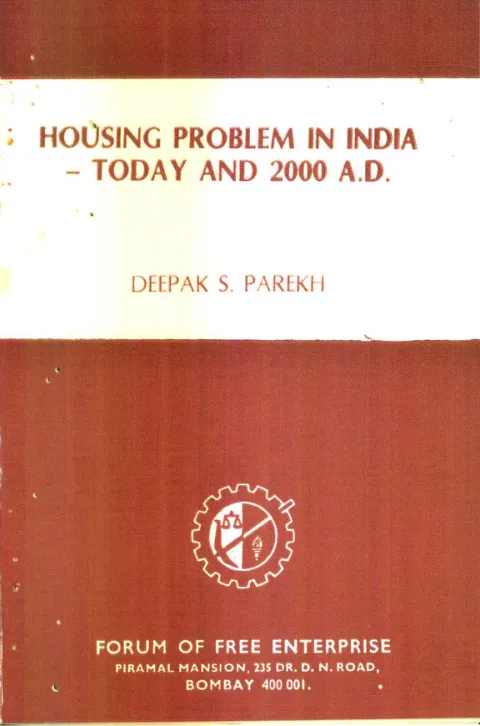
A Solution to the Housing Problem in India
By H. T. Parekh
Published by M. R. PAI for the Forum of Free Enterprise. "Piramal Mansion", 235 Dr. Dadabhai Naoroji Road, Bombay-1, and printed by B. D. Nadirshaw at Bombay Chronicle Press. Sayed Abdulla Brelvi Road, Fort, Bombay-1. · Bombay · 1976
16 pages
Summary
Writing in 1975-76 as Chairman of ICICI, H. T. Parekh opens with a blunt indictment: after twenty-five years and five Five-Year Plans, India has made no significant dent in its housing shortage — roughly four million units in the cities and twelve million more in the villages. Indian planning, he argues, has consistently treated housing as a low-priority sector, allocating only Rs 4,200 crores (under 8 per cent) of the Fifth Plan and just Rs 600 crores from the public sector. Most of whatever has been built has come from private initiative, supplemented by State Housing Boards, LIC and the newly-established HUDCO.
Parekh’s central rebuttal to the “low priority” argument is economic: housing construction is labour-intensive, with a capital-employment ratio of about Rs 5,000 per worker — five to ten times better than industry or transport — and an investment multiplier in which one Rupee of construction outlay yields Rs 10 of income, largely in wages. He cites the United States (two million dwellings a year), the United Kingdom, and Singapore (forty per cent of its population rehoused by government in fifteen years) to argue that house-building doubles as employment policy and welfare policy. He then audits the existing institutional sources of housing finance — HUDCO’s Rs 127 crores of sanctions and 93,000 dwellings, LIC’s Rs 582 crores of cumulative housing contribution, the Delhi Development Authority, Bombay’s stock of 30,000 buildings (20,000 of them over fifty years old) — and concludes that these efforts are “only marginally helping” against demand of this magnitude.
The booklet’s constructive core is a proposal for a new, privately-organised specialised housing finance institution — “The Housing Finance and Development Corporation of India Limited (HFDCI)” — modelled on building societies in Britain and savings-and-loan associations in the United States. It would lend to individuals, cooperative societies and groups in urban and rural areas; finance estate development, shopping centres and major repairs; lend to contractors and builders; and concentrate on low- and middle-income housing. Crucially it would operate on a viable basis at moderate interest rates, take no direct capital, grant or subsidy from government, and instead mobilise household savings while initiating a separate interest-subsidy fund for the poorest borrowers. This is, in effect, the public blueprint for what would become HDFC. The text is followed by three appendices reproducing official sources — the Working Group on Housing for the Fourth Plan (1968), the Middle Class Family Living Survey (1958-9), and the Draft Fifth Five-Year Plan’s housing chapter — which together document the scale of the shortage and the modesty of official ambition.
Key points
-
Twenty-five years of five-year planning have failed to make material progress on housing; urban shortage is around four million units and rural shortage about twelve million.
-
Of the Rs 53,000-crore Fifth Plan, only Rs 4,200 crores (under 8 per cent) is earmarked for housing, and only Rs 600 crores of that from the public sector — most expected investment (Rs 3,600 crores) is private.
-
The standard defence of low housing priority — that scarce resources must go to higher-priority sectors — collapses once housing is reframed as employment generation: construction is labour-intensive, with a capital-employment ratio of Rs 5,000 per worker.
-
Per the Planning Commission, in the Fifth Plan construction generates Rs 10 of income per Rupee invested (against Rs 3.50 economy-wide), mainly as wages.
-
HUDCO, LIC, State Housing Boards and the Delhi Development Authority are doing useful work — HUDCO has sanctioned Rs 127 crores for 93,000 dwellings, LIC has contributed Rs 582 crores cumulatively — but their scale is marginal against demand and HUDCO does not lend directly to individuals.
-
In Bombay, 20,000 of the existing 30,000 buildings are over fifty years old; private builders show enterprise but concentrate on the better-off, while buyers themselves furnish most house finance through instalment payments.
-
Parekh proposes a new privately-organised “Housing Finance and Development Corporation of India Limited (HFDCI)” modelled on UK building societies and US savings-and-loan associations to mobilise individual savings for low- and middle-income housing in urban and rural areas.
-
The proposed corporation will take no government capital, grant or subsidy, will lend at moderate rates on a viable basis, and will separately create a fund to subsidise interest for low-income housing.
Metadata and summary are AI-extracted from the source PDF and reviewed for editorial accuracy. The original work is available via the Read PDF tab above (where present); paragraph-level citation inside the PDF is deferred to a future engagement.