
essay
Wages In Private & Public Sectors
2 pages
Summary
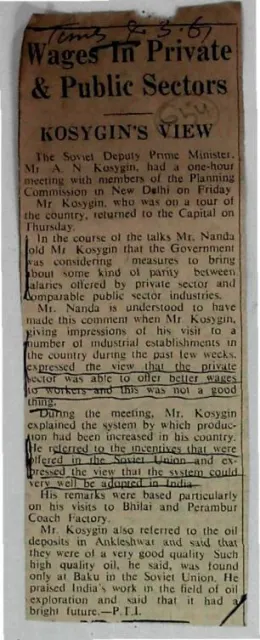
The first clipping, headed “KOSYGIN’S VIEW,” reports on Soviet Deputy Prime Minister A. N. Kosygin’s discussions in New Delhi with members of India’s Planning Commission. It presents Kosygin as describing a system in which producers were offered incentives, while also reporting Mr. Nanda’s observation that the Indian Government was considering measures to create parity between private-sector and comparable public-sector industries. The article highlights Kosygin’s view that private industry could offer better wages, and notes his favorable remarks about Soviet production, oil deposits, and industrial development.
A second, apparently separate clipping is headed “VAST SCOPE FOR EXPORTS TO U.S.” It reports an Indian diplomat’s appeal for expanded exports to the United States, arguing that India had not sufficiently explored the American market. The Consul-General emphasizes the need for better information about U.S. demand, more commercial exchanges, and stronger banking and business contacts. The relationship between this clipping and the Kosygin report is unclear; no publication, author, date, or issue information is visible beyond “CALCUTTA, March 3” in the second article.
Key points
- The first clipping reports A. N. Kosygin’s discussions with India’s Planning Commission in New Delhi.
- It describes a proposed effort to establish parity between private-sector and comparable public-sector industries.
- Kosygin is reported to have said that private industry could provide better wages to workers.
- The article presents Soviet production incentives and industrial development favorably.
- The clipping mentions Kosygin’s visits to Bhilai and Perambur Coach Factory and his comments on Ankleshwar oil deposits.
- The second clipping argues that India had barely accessed the potential of the United States market.
- It calls for improved commercial information, more business exchanges, and stronger banking contacts to expand Indian exports.
Metadata and summary are AI-extracted from the source PDF and reviewed for editorial accuracy. The original work is available via the Read PDF tab above (where present); paragraph-level citation inside the PDF is deferred to a future engagement.
Related across the archive
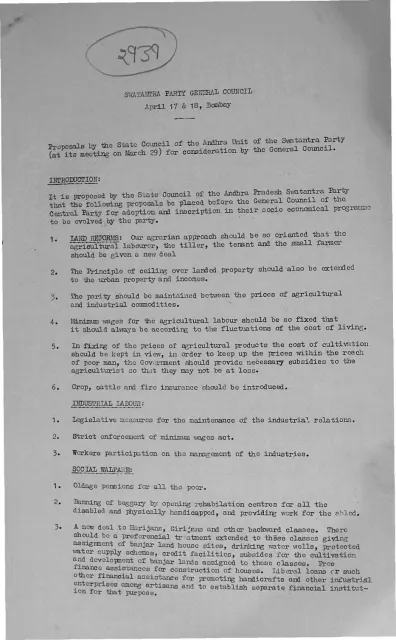 Primary workProposals by the State Council of the Andhra Unit of the Swatantra Party (at its meeting on March 29) for consideration by the General Council.
 Primary workIn Soviet Russia
 ExcerptHas Private Enterprise Failed?
 ThePrintBank nationalisation will be a blow to India’s mixed economy, lead to totalitarianism: Phiroze Shroff