essay
Outside Leadership of Trade Unions
A Bombay Survey
THE ECONOMIC WEEKLY · 1958
6 pages
Summary
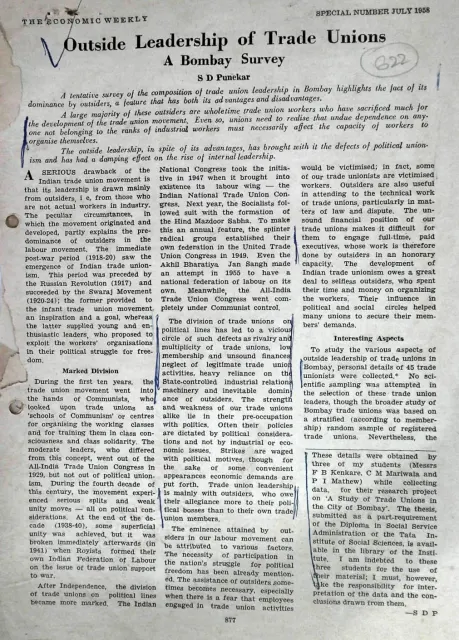
In “Outside Leadership of Trade Unions: A Bombay Survey,” S. D. Punekar examines the predominance of non-worker leaders in Bombay’s trade-union movement. He traces this pattern to the movement’s origins in the post-war period, the influence of the Russian Revolution and Swaraj Movement, and the subsequent division of unions along Communist, Congress, and Socialist political lines. The article argues that outside leaders have provided essential organisational, legal, technical, financial, and political support, but that excessive dependence on them has weakened workers’ capacity to organise themselves and has impeded the growth of internal leadership.
Drawing on a tentative, non-scientific survey of 45 leaders across the AITUC, INTUC, and HMS, Punekar describes their political affiliations, language, caste, age, education, public offices, and union positions. The survey highlights extensive office-holding across multiple unions, overlapping federation activity, political rivalry, and the financial difficulty of maintaining full-time executives. It also records a largely educated, predominantly Brahmin leadership, with most leaders between 31 and 40 years old. The article concludes by calling for a cadre of full-time professional trade unionists who would be accountable to unions rather than political parties. Pages 4–6 of the PDF are an advertisement and two newspaper clippings, not part of the signed article.
Key points
- Bombay’s trade-union leadership is dominated by outsiders who are not actual industrial workers.
- Outside leadership has supplied political, organisational, legal, and technical resources that helped develop the movement.
- Political divisions among unions have produced rivalry, multiplicity, low membership, unsound finances, and neglect of legitimate trade-union activity.
- The survey covers 45 leaders: 12 in the AITUC, 15 in the INTUC, and 18 in the HMS.
- Many leaders hold office in several unions or federations, illustrating an ‘empire-building’ tendency and overlapping organisational activity.
- The surveyed leadership is predominantly Marathi-speaking and Brahmin, and is generally middle-aged and highly educated.
- The article recommends reducing political dependence and developing full-time trade-union professionals accountable to unions rather than political parties.
Metadata and summary are AI-extracted from the source PDF and reviewed for editorial accuracy. The original work is available via the Read PDF tab above (where present); paragraph-level citation inside the PDF is deferred to a future engagement.