essay · working paper
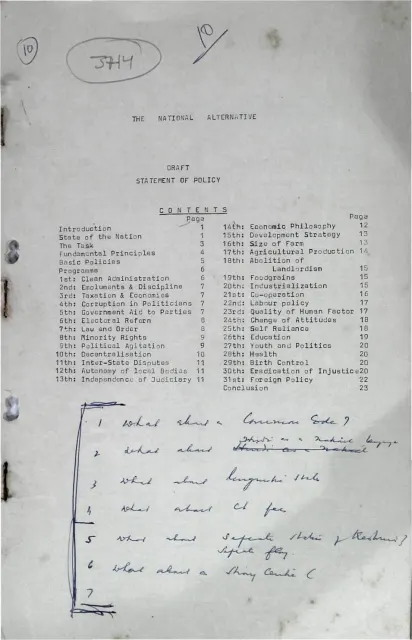
Draft Statement
8 pages
Summary
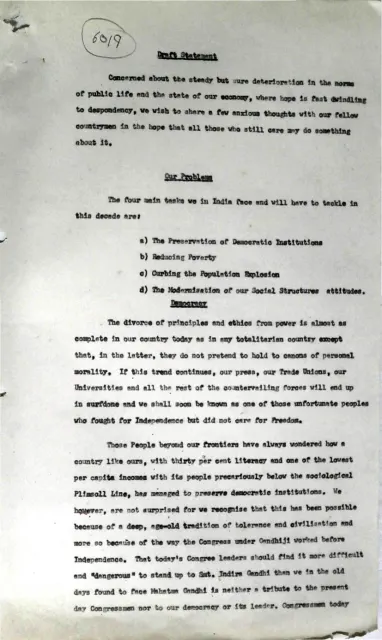
The draft statement opens by warning of the deterioration of public life and the economy, and identifies four tasks for India in the coming decade: preserving democratic institutions, reducing poverty, curbing population growth, and modernising social structures and attitudes. Its discussion of democracy argues that principles and ethics have become dangerously separated from political power, threatening the press, trade unions, universities, and other countervailing forces. It attributes India’s survival as a democracy partly to a long tradition of tolerance and civility and to the pre-Independence working methods of the Congress under Mahatma Gandhi, while warning against the concentration of leadership around Indira Gandhi and the erosion of internal party democracy.
Key points
- The statement frames India’s immediate challenge as a combined crisis of public morality, democratic institutions, poverty, population growth, and social attitudes.
- It argues that the separation of principles and ethics from political power threatens the press, trade unions, universities, and other countervailing institutions.
- It links India’s democratic survival to traditions of tolerance and civility and to the Congress’s pre-Independence organisation under Mahatma Gandhi.
- It criticises the concentration of authority around Indira Gandhi and insists that democracy must be preserved within the Congress Party as well as outside it.
- It rejects populist measures and class conflict as solutions to poverty, warning that they can turn democratic socialism into centralised statism.
- It advocates realistic economic policies based on capital and labour investment, organisation, and fiscal measures that benefit society broadly rather than favoured groups.
- It presents modernisation as dependent not only on policy but also on individual and collective attitudes, including dissent, freedom, social and economic justice, spontaneity, and diversity.
Metadata and summary are AI-extracted from the source PDF and reviewed for editorial accuracy. The original work is available via the Read PDF tab above (where present); paragraph-level citation inside the PDF is deferred to a future engagement.