essay
IN SOVIET RUSSIA
MOSCOW
Moscow · 1927
12 pages
Summary
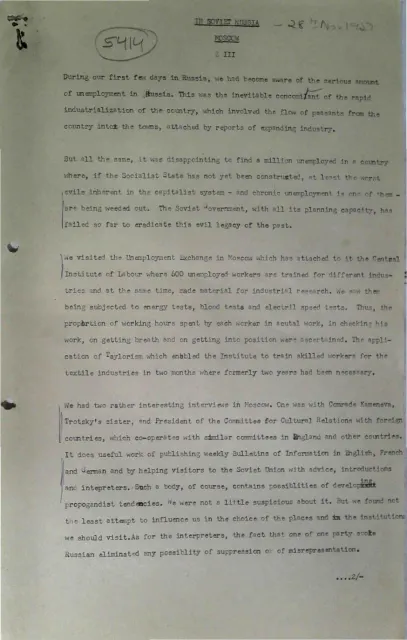
This English-language essay, headed “IN SOVIET RUSSIA” and “MOSCOW,” presents a first-person account of observations in Moscow. It begins with the scale of unemployment accompanying rapid industrialisation and the movement of peasants into towns. The writer is disappointed that Soviet planning has not eliminated chronic unemployment, but describes the Moscow Unemployment Exchange and Central Institute of Labour, where unemployed workers undergo aptitude and physiological tests and receive accelerated industrial training through the application of Taylorism.
The essay then examines women’s civic and political position under Soviet rule, citing expanded voting rights, participation in local and provincial Soviets, and access to professional and public-service roles. Its discussion of elections is more qualified: Soviet representation is described as functional rather than territorial, and the author acknowledges broad participation while noting disfranchisement, public voting by show of hands, and the suppression of rival party elections. The final section records a visit to Lenin’s Mausoleum and reflects on the continuing devotional attachment of Soviet officials and citizens to Lenin and the revolutionary cause. The supplied PDF contains duplicate scans of the same four printed pages.
Key points
- Rapid industrialisation and rural-to-urban migration are presented as contributing to roughly one million unemployed people.
- The Central Institute of Labour uses energy, blood, and “electril speed” tests to study and train workers.
- Taylorist methods are credited with shortening textile-worker training from two years to two months.
- The essay portrays Soviet policy as greatly expanding women’s legal, civic, and political participation.
- Soviet elections use functional representation, including workplace and occupational constituencies, rather than territorial constituencies.
- The author recognises broad participation in Soviet elections but questions disfranchisement, open voting, and the exclusion of rival parties.
- Lenin’s Mausoleum is depicted as a site of continuing political devotion and ritual remembrance.
Metadata and summary are AI-extracted from the source PDF and reviewed for editorial accuracy. The original work is available via the Read PDF tab above (where present); paragraph-level citation inside the PDF is deferred to a future engagement.