essay
SWATANTRA AS ELITE OF POLITICS
2 pages
Summary
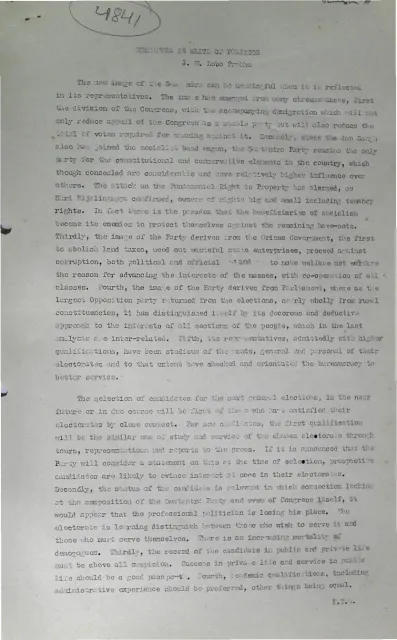
In the rendered pages, J. N. Lobo Prabhu presents the Swatantra Party as an emerging political force whose image rests on opposition to Congress, resistance to socialist policy, and defence of property rights, including tenancy rights. The essay argues that the Party’s reputation is also shaped by the Orissa Government’s administrative record and by the conduct of its parliamentary representatives, whom Prabhu describes as decorous, attentive to sectional interests, and capable of improving bureaucratic service. In the rendered pages, Swatantra is consequently framed as a coalition of constitutional, conservative, and economically liberal elements rather than simply as a party of property-holders.
The second page, continuing the discussion in the rendered pages, sets out criteria for selecting future candidates. Prabhu prioritises close contact with electorates, evidence of study and service, relevant professional and administrative experience, personal integrity, and caution about caste affiliation, political popularity, financial competence, and last-minute candidacies. In the rendered pages, the essay closes with an appeal for the Party to preserve its principles and allow power and public service to follow from democratic organisation rather than treating office as the primary objective.
Key points
- The rendered pages attribute the Swatantra Party’s political image to opposition to Congress and to the socialist turn of the Jan Sangh.
- The essay links Swatantra’s appeal to the defence of property and tenancy rights.
- The Orissa Government is cited in the rendered pages as an example of welfare-oriented, anti-corruption administration.
- Swatantra’s parliamentary representatives are praised for decorum and attention to the interrelated interests of different sections of the population.
- Candidate selection should emphasise electorate contact, study, public and private integrity, and administrative experience.
- The essay warns against relying on caste, popularity, financial spending, or last-minute candidacies as substitutes for political judgment.
- The Party is urged to prefer principle and service to power, while trusting democratic structures to produce office where deserved.
Metadata and summary are AI-extracted from the source PDF and reviewed for editorial accuracy. The original work is available via the Read PDF tab above (where present); paragraph-level citation inside the PDF is deferred to a future engagement.