essay · position paper
GETTING THE FACTS STRAIGHT
1 pages
Summary
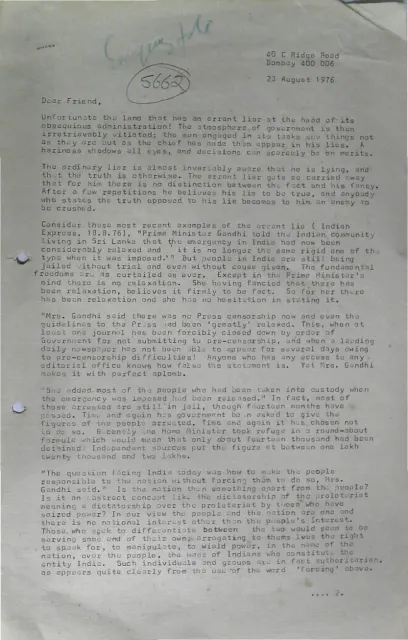
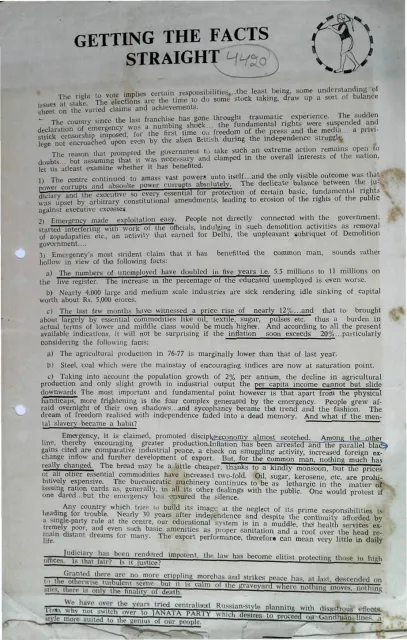
“GETTING THE FACTS STRAIGHT” is a one-page English political position paper assessing the consequences of India’s Emergency. It argues that the Emergency concentrated excessive power in the Centre, weakened the balance between the judiciary and executive, curtailed fundamental rights, imposed press censorship, and enabled interference and exploitation by people connected with government. The paper challenges the claim that the Emergency benefited ordinary citizens by pointing to rising unemployment, industrial sickness, inflation, stagnant agricultural and industrial performance, and declining per-capita income.
The paper also contends that the Emergency’s apparent social calm came at the cost of fear, silence, and the erosion of democratic habits. It criticises an elitist judiciary, argues that basic public services remain inadequate nearly three decades after independence, and rejects centralised “Russian-style” planning in favour of a more decentralised approach. It concludes by urging support for the Janata Party and its proposed continuation along Gandhian lines.
Key points
- The Emergency is presented as an extreme governmental action whose benefits to the nation remain unproven.
- The paper argues that power became concentrated in the Centre and that constitutional amendments weakened protections for fundamental rights.
- Press freedom and freedom of expression were curtailed through censorship.
- The Emergency allegedly facilitated bureaucratic interference and exploitation by people connected with government.
- Economic conditions are described as deteriorating, including doubled unemployment, industrial sickness, inflation, weak agricultural production, and declining per-capita income.
- The paper argues that the Emergency produced silence and fear rather than genuine social or political improvement.
- It criticises an elitist and ineffective judiciary and inadequate public services.
- The conclusion rejects centralised Russian-style planning and endorses the Janata Party’s proposed Gandhian direction.
Metadata and summary are AI-extracted from the source PDF and reviewed for editorial accuracy. The original work is available via the Read PDF tab above (where present); paragraph-level citation inside the PDF is deferred to a future engagement.