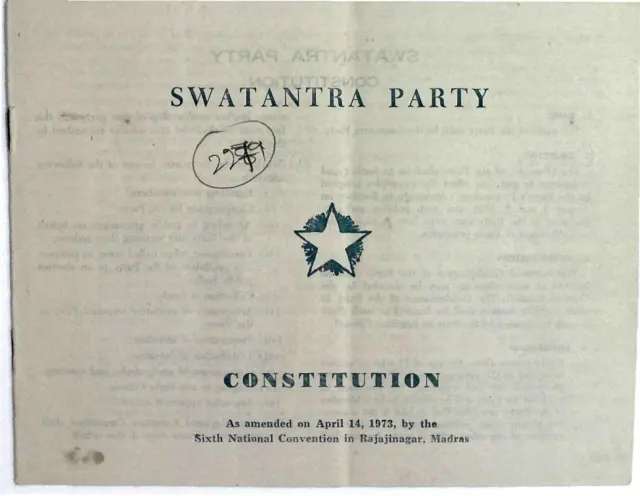
constitution
CONSTITUTION
6 pages

Summary
This six-page scan reproduces the constitution of the Bharatiya Kranti Dal, an English-language political party document with no named author, date, publisher, or place of publication visible. It defines the party’s name and aims, grounding its programme broadly in Mahatma Gandhi’s philosophy while advocating a democratic society free from economic, political, and social exploitation. The stated economic programme combines cooperative small-farm agriculture, decentralized and labour-intensive industry, and State ownership or control of capital-intensive activities required for defence and research. The document also calls for social equality, self-reliance, secularism, nationalism, international cooperation, and peaceful resolution of disputes.
The constitution establishes membership qualifications and ethical requirements, including a minimum age of eighteen, non-membership in other political or designated communal organisations, a clean recent criminal record, abstention from intoxicants for elective officeholders, and prior party service. It then lays out a tiered organisational structure—constituency, district or city, state, and national bodies—with councils, executives, conferences, parliamentary boards, elections by single transferable vote, quorum rules, amendment procedures, and regular meeting requirements. Authority is concentrated in the National Executive, while the constitution also specifies representation, financial distribution of membership fees, disciplinary powers, and procedures for filling vacancies.
Key points
- The Bharatiya Kranti Dal presents itself as a democratic, anti-exploitation party influenced broadly by Mahatma Gandhi.
- Its economic programme combines cooperative smallholder agriculture with decentralized, labour-intensive industry.
- Capital-intensive activities required for defence and research are assigned to State ownership or control.
- The aims include nationalism, secularism, socialism, international fellowship, self-reliance, non-discrimination, and peaceful international dispute resolution.
- Membership is open from age eighteen, subject to political, legal, and organisational conditions.
- Elective office requires additional party service, abstention from intoxicants, and other eligibility requirements.
- The party is organised through constituency, district or city, state, and national councils and executives.
- The constitution regulates elections, finances, meetings, parliamentary boards, amendments, vacancies, discipline, and the authority of the National Executive.
Metadata and summary are AI-extracted from the source PDF and reviewed for editorial accuracy. The original work is available via the Read PDF tab above (where present); paragraph-level citation inside the PDF is deferred to a future engagement.