
essay
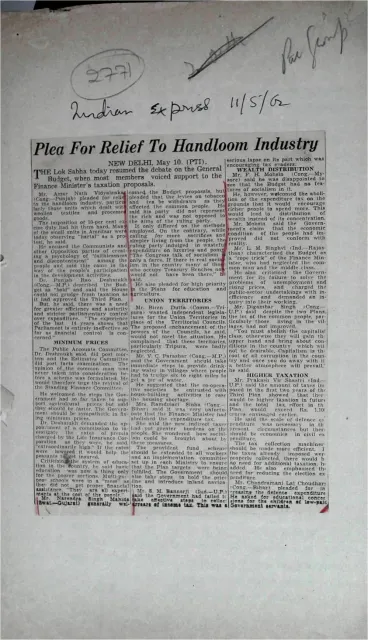
Plea For Relief To Handloom Industry
Indian Express · New Delhi · 1962
1 pages
Summary
This Indian Express report, datelined New Delhi, May 10, covers a Lok Sabha debate on the General Budget. Members from different parties and regions argued that the proposals placed excessive burdens on ordinary people, neglected handloom and agricultural interests, and failed to address rising prices, unemployment, and regional needs. Specific demands included relief for handloom textiles, minimum prices for agricultural produce, review of insurance premiums, improved education spending, and greater attention to Union Territories. In the rendered page, the debate also turns to taxation and the distribution of wealth. Speakers challenge the Government’s claim that its tax proposals would promote socialism, arguing instead that they could discourage investment, leave the middle class under pressure, and fail to produce meaningful redistribution. The report records criticism of higher taxation, inefficient tax collection, administrative waste, and what several members describe as an overly centralised and interventionist economic policy.
Key points
- The Lok Sabha debate records opposition to the Budget’s impact on handloom workers and the textile industry. Members argue that taxation proposals place disproportionate pressure on ordinary people and the middle class. Speakers call for minimum prices for agricultural produce and stronger safeguards for farmers. The report highlights demands for improved education provision, including in poorer regions. Members criticise rising prices, unemployment, administrative inefficiency, and inadequate attention to Union Territories. The Budget’s claim to advance socialism is challenged on the grounds that its tax structure may discourage investment rather than redistribute wealth.
- Several speakers call for lower government expenditure, more efficient tax collection, and reduced taxation.
Metadata and summary are AI-extracted from the source PDF and reviewed for editorial accuracy. The original work is available via the Read PDF tab above (where present); paragraph-level citation inside the PDF is deferred to a future engagement.
Related across the archive
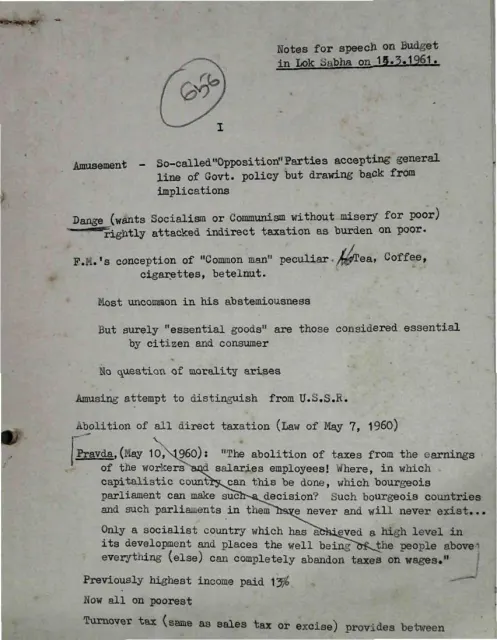 Primary workNotes for speech on Budget in Lok Sabha on 15.3.1961.
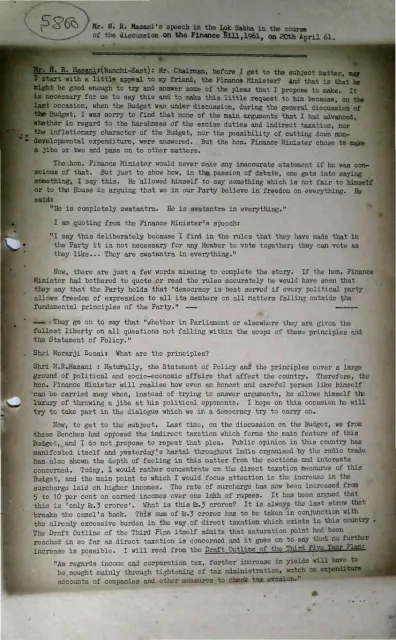 Primary workMr. M. R. Masani's speech in the Lok Sabha in the course of the discussion on the Finance Bill, 1961, on 20th April 61.
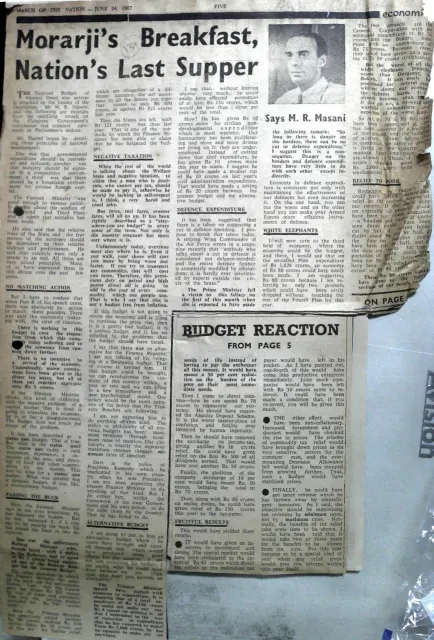 Primary workMorarji’s Breakfast, Nation’s Last Super
 ExcerptFREE MARKET ECONOMY: Key to Economic Progress and Freedoms
 ExcerptThe Liberal Budget: Building an Equitable Society