essay
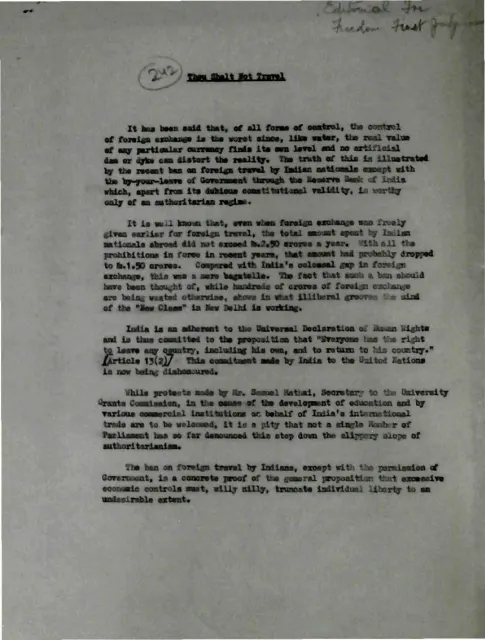
Thou Shalt Not Travel
1 pages
Summary
On the rendered page, “Thou Shalt Not Travel” argues that India’s ban on foreign travel is an unjustified exercise of economic and administrative control. It rejects the claim that foreign-exchange controls can determine the real value of currency, contending that currencies find their own level and that artificial restrictions distort economic reality. The page contrasts the relatively small amount spent by Indian nationals abroad with the much larger colonial-era cost of foreign exchange, presenting the ban as evidence of the “New Class” in New Delhi gaining power.
The argument then shifts from economics to rights. The page invokes India’s commitment to the Universal Declaration of Human Rights and Article 13(2), which protects the right to leave any country, and criticizes Parliament for failing to condemn the restriction. It acknowledges that foreign trade and educational-development measures may be valuable, but concludes that requiring government permission for foreign travel is an excessive economic control that truncates individual liberty.
Key points
- The page challenges foreign-exchange controls as an artificial distortion of currency values.
- It claims that Indian foreign travel expenditure had been reduced to approximately Rs. 1.50 crores annually.
- It contrasts this amount with the colonial-era cost of foreign exchange, described as a much larger sum.
- The foreign-travel ban is presented as evidence of authoritarian tendencies and the rise of a governing “New Class.”
- India’s commitments under the Universal Declaration of Human Rights are invoked against restrictions on leaving the country.
- The text argues that government permission requirements for travel excessively limit individual liberty.
Metadata and summary are AI-extracted from the source PDF and reviewed for editorial accuracy. The original work is available via the Read PDF tab above (where present); paragraph-level citation inside the PDF is deferred to a future engagement.