letter
Letter to Raja
New Delhi · 1963
3 pages
Summary
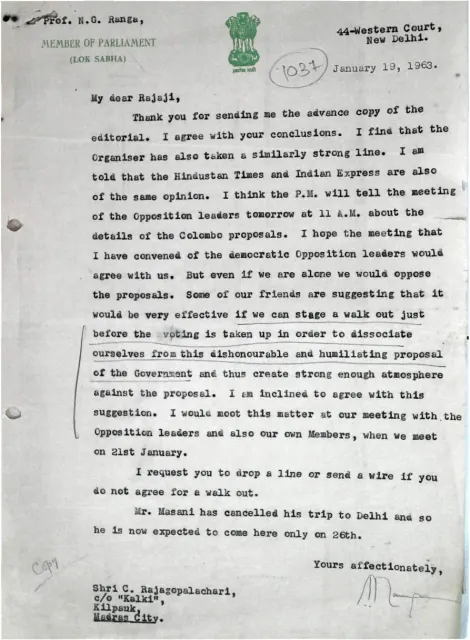
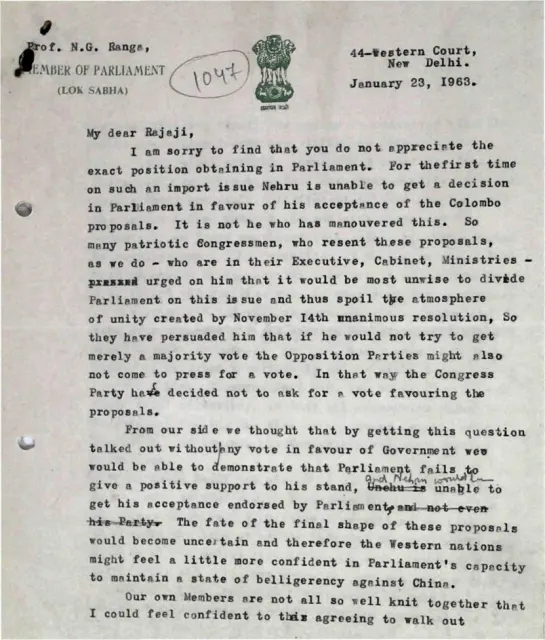
This is a three-page typewritten letter from Prof. N. G. Ranga, MP (Lok Sabha), writing from 44 Western Court, New Delhi on 23 January 1963 to C. Rajagopalachari at Madras. Ranga is defending, at length, the Swatantra-led Opposition’s decision not to force a division in Parliament on the Colombo Proposals for resolving the Sino-Indian border dispute. He tells Rajaji that Nehru, for the first time on a major issue, could not have secured a decision in favour of accepting the proposals, and that patriotic Congressmen from within the Executive, Cabinet and Ministries had themselves urged the Prime Minister not to split Parliament and spoil the unity created by the 14 November unanimous resolution. On that basis the Congress Party undertook not to press for a vote favouring the proposals.
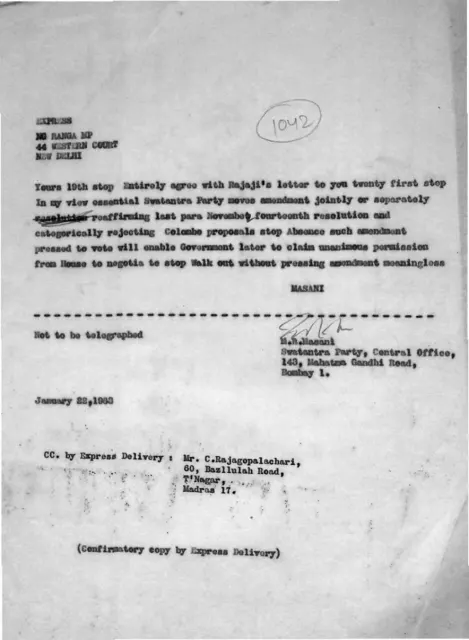
Ranga argues that the Opposition’s counter-strategy, letting the question be talked out without any vote in favour of Government, exposes Nehru’s inability to get parliamentary endorsement and, in his view, strengthens Western confidence in India’s capacity to maintain belligerency against China. He is candid that a walk-out or a lone vote by Swatantra was not tactically safe when Jan Sangh, PSP and other Opposition groups were ready for a softer line, and that his real gain is to have prevented a positive vote for the Prime Minister. He reports that Dhebar himself acknowledged Ranga had rejected the proposals totally, that P. K. Deo would demand total rejection the next day, and that every Opposition leader (excepting the Communists and their fellow travellers) was taking the same strong stand.
The closing section is personal and apologetic. Ranga thanks Rajaji, acknowledges that Shrimati Swami had phoned twice to convey Rajaji’s view, and records that he consulted the Party twice with the advice received from Rajaji and Mr. Masani. He explains that he tried to wriggle out of commitments made with Jan Sangh and PSP but could not, considered an independent amendment, and finally judged it wiser not to break the tenuous understanding being built with the other Opposition Groups, especially since Government itself was not asking Parliament to accept the proposals, leaving Parliament free to decide when its verdict is later sought.
Key points
- Ranga writes to Rajaji on 23 January 1963 to justify why the Opposition did not force a vote against the Colombo Proposals on the Sino-Indian border.
- He states that for the first time on such a major issue Nehru could not secure a parliamentary decision endorsing his acceptance of the Colombo Proposals.
- Congressmen inside the Executive, Cabinet and Ministries privately urged Nehru not to divide Parliament and spoil the unity of the November 14th unanimous resolution.
- The chosen tactic — letting the motion be talked out with no vote in Government’s favour — was, in Ranga’s judgement, the strongest available demonstration that Parliament withholds positive support from Nehru’s stand.
- Ranga was unwilling to walk out or vote alone with Swatantra when Jan Sangh, PSP and other Opposition Groups preferred a softer line, and would not break the tenuous inter-party understanding.
- He reports that Dhebar conceded Ranga had rejected the proposals totally, and that P. K. Deo would demand total rejection the following day; all Opposition leaders except the Communists were taking the same line.
- Shrimati Swami had telephoned twice to convey Rajaji’s viewpoint; Ranga consulted the Party twice on the advice received from Rajaji and Masani, and considered but rejected moving an independent amendment.
- He closes by noting that since Government itself is not asking Parliament to accept the Colombo Proposals, Parliament remains free to decide when its verdict is eventually sought.
Metadata and summary are AI-extracted from the source PDF and reviewed for editorial accuracy. The original work is available via the Read PDF tab above (where present); paragraph-level citation inside the PDF is deferred to a future engagement.