
periodical issue
Khoj : March - April, 2008
By Rajesh Mishra, Trupti Parekh, Parth J. Shah, Sauvik Chakraverti, Rabindranath Tagore, Revatbha Rayjada, Yogendra Mankad, Manjula Dabhi, Asghar Ali Engineer
Pahel — Initiative for Open Society, Vadodara · 2008
44 pages
Summary
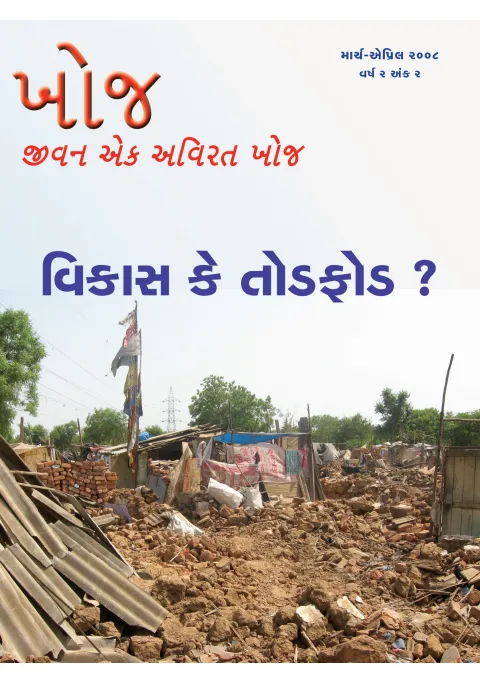
This is the March-April 2008 issue (Year 2, Issue 2) of Khoj (“Search” — tagline: “Life is a ceaseless search”), a Gujarati-language bi-monthly journal edited by Ambrish Mehta and published from Fatehganj, Vadodara, by Action Research in Community Health and Development (ARCH). The cover headline reads ‘Vikas ke Todfod?’ (“Development or Demolition?”), and the issue is built around the human cost of state-led development in Gujarat — the police firing in Vijaynagar that killed two Adivasis, the demolition of roughly 1,300 long-settled poor families on government land in Patnagar (Gandhinagar), the bulldozing of an Adivasi settlement of about 25 families in Indar taluka of Sabarkantha, and the destruction of the Vajepur jungle settlement pictured on the cover.
The editorial by Ambrish Mehta argues that even as the Gujarat government has begun, after the Vijaynagar killings, to implement the 2005 Forest Rights Act in tribal areas, it is simultaneously evicting equally long-settled non-tribal poor from gauchar and government lands without notice or due process. He asks why squatters on forest land are to be regularised but those on other public lands receive bulldozers and severed water connections. The issue’s lead pieces extend this argument: Prasad Chako’s “The face of Vibrant Gujarat’s development” and Trupti Parekh’s “The Adivasis of Mundeti demand justice” document specific displacements; Rajesh Mishra’s reported piece “Give us back our daughters” investigates a state-transport bus that plunged into the Narmada canal killing 44, mostly schoolchildren, and the cover-up by STC and police officials.
The issue also carries a substantial debate on rationalism: a long response by Raman Pathak ‘Vachaspati’ to Jayanti Patel’s earlier essay, arguing that the proper Gujarati equivalent of “rationalism” is vivek-buddhi-vada, not merely vivek, and defending rationalism (after the London Rationalist Association definition) as the supremacy of reason verifiable by experience. Kiran Desai and Anil Patel respond to Mehta’s earlier Nirikshak essay on the 2007 Gujarat election result, debating whether Modi’s mandate can be read as approval of “broad-based development” or as endorsement of communal polarisation and the erosion of rule of law. A long letters section and pieces on science-and-spirituality (Anil Patel; Ashwin N. Karia) round out the issue.
Key points
- The cover story ‘Vikas ke Todfod?’ (Development or Demolition?) frames the issue as a critique of Gujarat’s development model under Narendra Modi, focusing on demolitions of poor and Adivasi settlements.
- Editor Ambrish Mehta’s editorial contrasts the post-Vijaynagar implementation of the 2005 Forest Rights Act in Adivasi areas with simultaneous bulldozing of about 1,300 squatter families in Patnagar (Gandhinagar) and 25 Adivasi families in Indar taluka, Sabarkantha.
- Twelve Vijaynagar villagers remain jailed under IPC 307 after the 13 February police firing at Antarsuba ashram, and the editorial calls for legal aid and proper compensation under the Forest Rights Act.
- Rajesh Mishra’s reported piece ‘Amari dikrio amne pachhi aapo’ investigates a Gujarat State Transport bus that fell into the Narmada canal on 16 April 2008, killing 44 people — mostly schoolchildren from Bamroli and a neighbouring village — and documents the State Transport Corporation’s attempt to blame the driver while suppressing evidence of brake failure and overloading.
- Raman Pathak ‘Vachaspati’ devotes a long essay to defending ‘vivek-buddhi-vada’ (rather than plain ‘vivek’) as the correct Gujarati translation of rationalism, citing Bhartrhari, Shankaracharya’s Vivekachudamani, and the London Rationalist Association definition.
- Kiran Desai’s response ‘Sarvajanhitay Atmakhoj’ challenges Mehta’s reading of the 2007 Gujarat election as a verdict on broad-based development, arguing the result is better explained by communal polarisation and middle-class consolidation around Modi.
- Anil Patel’s follow-up rebuts Kiran Desai, defending Mehta’s analytic approach and warning that the 2002 communal polarisation underpinning Modi’s mandate cannot be wished away, while still insisting on the primacy of Rule of Law.
- The letters column features detailed reader responses from Harshadbhai Vyas (Bhavnagar), Rasik Shah (Ahmedabad), B.A. Pandya (Surat), Rasikbhai Vyas (Bhavnagar), Kunjan Mehta (Bhuj), Babulal Gor (Bhuj) and Mukesh Adenwala (Ahmedabad) responding to the January-February 2008 articles on rationality and the Vijaynagar firing.
Metadata and summary are AI-extracted from the source PDF and reviewed for editorial accuracy. The original work is available via the Read PDF tab above (where present); paragraph-level citation inside the PDF is deferred to a future engagement.