
periodical issue
Khoj : March - April, 2007
By Rajesh Mishra, Trupti Parekh, Parth J. Shah, Sauvik Chakraverti, Rabindranath Tagore, Revatbha Rayjada, Manjula Dabhi, Asghar Ali Engineer, Yogendra Mankad
Pahel — Initiative for Open Society, Vadodara · 2007
48 pages
Summary
This is the March-April 2007 issue (Year 1, Issue 2) of Khoj, a bimonthly Gujarati-language periodical edited by Ambrish Mahetha and published from Vadodara by Action Research in Community Health and Development (ARCH), with an editorial board including Trupti Parekh, Anil Patel, and Rajesh Mishra. The masthead motto is ‘Jivan ek avirat khoj-aavishkar’ (‘Life is a ceaseless seeking and discovery’), and the issue carries a Rig Veda epigraph alongside Xenophanes’ fragment on the limits of human knowledge — signalling the magazine’s blend of Indian liberal civic concern and open-society sensibility.
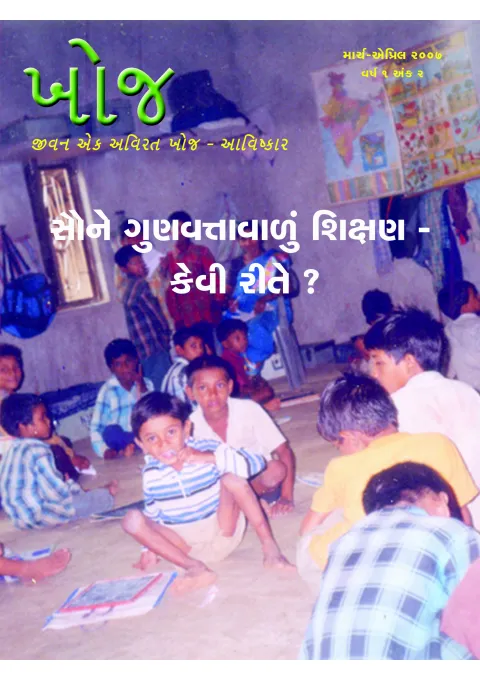
The cover story and lead editorial argue for quality school education for all and seriously propose school vouchers as a market-based remedy: Rajesh Mishra writes on the right of parents and children to choose schools, while Parth Shah (Centre for Civil Society, New Delhi) contributes the keynote piece making the case for education vouchers as a way to deliver quality schooling to poor and rural children whom government schools are failing. Other contents include Trupti Parekh’s investigative field assessment of the National Rural Employment Guarantee Act in 18 villages around Deriapada (Surapaneshwar sanctuary area), which finds the scheme barely functioning — funds undisbursed, talatis unwilling, demanded work refused — and quotes Chidambaram and Manmohan Singh’s ‘outlays are not outcomes’ line back at the government. Revtubha Rayjada writes on protecting the Gir lion habitat after the March 2007 poaching incident in which three lions were killed, and PUCL Gujarat issues a statement defending freedom of expression after Hindutva groups tried to block screenings of the Parzania film about the 2002 Naroda Patiya massacre.
Further articles cover Yogendra Mankad on the Stern Review and IPCC reports on climate change, Manjula Dabhi on the condition of Dalit women, Asghar Ali Engineer on Muslim women, Sauvik Chakraverti’s continuing column ‘Free Your Mind’ on economic liberty, and a Rabindranath Tagore story. The issue also runs a CFore opinion-poll table showing 79% of Indians dislike politicians and 84% feel politicians have brought Indian democracy into disrepute — framing the editor’s broader theme of citizen-society reclaiming ground from a compromised political class.
Key points
- Lead theme is universal quality primary education, with Parth Shah of the Centre for Civil Society arguing for school vouchers as the market-based remedy and Rajesh Mishra defending parental school choice.
- Trupti Parekh’s field investigation of NREGA in 18 villages around Deriapada (Narmada district) documents near-total non-implementation — undisbursed wages, talati obstruction, and refused work demands — turning Chidambaram’s own ‘outlays are not outcomes’ line against the state.
- Revtubha Rayjada’s lead environmental piece responds to the March 2007 Gir poaching in which three lions and one cub were killed, calling for road closures, entry fees, and decentralisation of the Forest Department’s centralised authority over Gir.
- PUCL Gujarat issues a statement defending freedom of expression after Hindutva groups attempted to block screenings of Parzania, the film based on a Parsi family’s experience of the 2002 Naroda Patiya massacre.
- Yogendra Mankad summarises the Stern Review on the Economics of Climate Change and the IPCC’s 2006 report, arguing the era of ‘cautionary environmentalism’ is over and that anthropogenic warming is now scientific consensus.
- A CFore survey of 1,022 urban and rural citizens (Feb 2007) shows 79% dislike politicians, 84% believe politicians ruin trust in government schemes, and 66% would not let their children enter politics.
- Asghar Ali Engineer (Centre for Study of Society and Secularism, Mumbai) writes on the condition of Muslim women, while Manjula Dabhi of Gujarat Vidyapith writes on Dalit women — both pegged to International Women’s Day on 8 March.
- Sauvik Chakraverti continues his serialised column ‘Tamara Manne Mukt Karo’ (‘Free Your Mind’), and the issue closes with Tagore’s parable ‘The Training of the Parrot’.
Metadata and summary are AI-extracted from the source PDF and reviewed for editorial accuracy. The original work is available via the Read PDF tab above (where present); paragraph-level citation inside the PDF is deferred to a future engagement.