
periodical issue
Khoj : March - April, 2006
By Rajesh Mishra, Trupti Parekh, Parth J. Shah, Sauvik Chakraverti, Rabindranath Tagore, Revatbha Rayjada, Yogendra Mankad, Manjula Dabhi, Asghar Ali Engineer
Pahel — Initiative for Open Society, Vadodara · 2006
44 pages
Summary
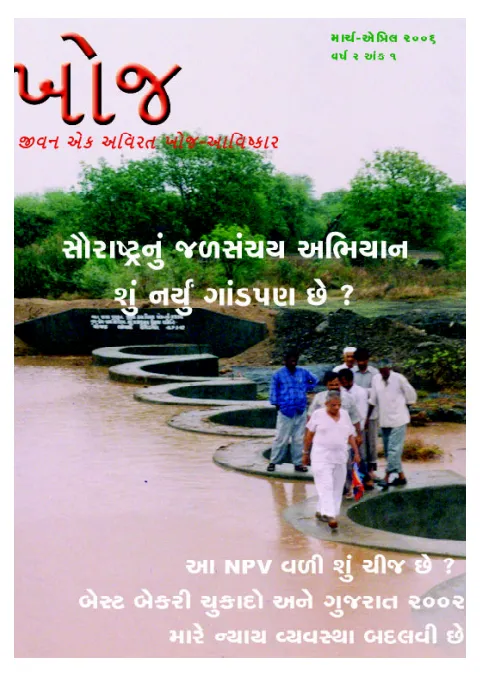
This is the March-April 2006 issue (Volume 2, Issue 1; running issue 7) of Khoj, a Gujarati-language bimonthly journal whose subtitle declares life to be ‘an unceasing search and discovery.’ The issue is edited by Ambrish Mehta and published from the Arya office in Fatehganj, Vadodara, on behalf of the ‘Pahel’ (Initiative for Open Society) centre, with an editorial board including Trupti Parekh, Anil Patel and Rajesh Mishra. Khoj sits squarely in the post-1991 Gujarati liberal tradition: it treats economic openness, the rule of law and individual rights as common ground, while debating their application to Indian conditions through long-form, footnoted essays.
The editorial opens with the Fourth Biennial World Water Forum in Mexico City and contrasts top-down ‘water-for-all’ government schemes with Saurashtra’s grassroots rainwater-harvesting movement, in which farmers built check-dams and recharge structures rather than waiting for the state. A long anchor piece by Ambrish Mehta then asks ‘Is Saurashtra’s water-harvesting campaign sheer madness?’ and weighs critics’ technical objections against measured field gains. Other items engage current liberal-democratic controversies: a piece on Net Present Value (NPV) compensation for forest land following a 2002 Supreme Court ruling; Prof. J.S. Bandukwala on the Best Bakery verdict and Gujarat 2002, urging the Muslim community to rebuild while also bridging Muslim and non-Muslim India; a PUCL summary of the Kalinganagar police firing in Orissa, including the editor’s critique of ‘eminent domain’ powers used to expropriate adivasi land for industry; and Trupti Parekh on Kelo v. New London. Kirit Panvala launches a new series, ‘I want to change the justice system,’ arguing that Indian courts have eroded ordinary people’s hope of justice.
The issue’s flagship serial essay is part 5 of Anil Patel’s ‘Freedom, Knowledge and the Market,’ titled ‘Market Prices: Menger’s Marginal Revolution and its Counter-currents.’ Opening with two Hayek epigraphs, Patel traces how the labour theory of value of Smith, Ricardo and Mill failed to explain relative prices, how Carl Menger’s 1871 Grundsatze grounded value in subjective marginal utility, and how methodological individualism became the philosophical core of the Austrian tradition against German historicism and Fabian rationalist constructivism. A vigorous letters section debates earlier pieces on pesticides, GEAC norms, the Narmada rehabilitation record, and the Jessica Lal verdict.
Key points
- Volume 2, Issue 1 (running issue 7) of the Gujarati bimonthly Khoj, edited by Ambrish Mehta and published by the Pahel (Initiative for Open Society) centre in Fatehganj, Vadodara.
- The editorial frames the Mexico City World Water Forum against Saurashtra’s farmer-led rainwater-harvesting movement, arguing that decentralised initiative outperforms top-down government ‘water for all’ programmes.
- Ambrish Mehta’s long feature ‘Is Saurashtra’s water-harvesting campaign sheer madness?’ answers critics by examining ground-level results of community check-dams.
- Trupti Parekh’s ‘What on earth is this NPV?’ explains the Supreme Court’s 2002 ruling that Net Present Value must be paid when forest land is diverted to non-forest use.
- Prof. J.S. Bandukwala revisits the Best Bakery verdict and Gujarat 2002, calling on Muslims to rebuild economically and to mediate between Muslim and non-Muslim worlds.
- Kirit Panvala launches the series ‘I want to change the justice system,’ citing the Jessica Lal acquittal as proof that procedural failures have throttled public faith in Indian courts.
- The issue carries a PUCL-Orissa report on the Kalinganagar police firing and an editorial critique of ‘eminent domain’ powers used to seize adivasi land for industrial corridors.
- Anil Patel’s serial essay ‘Freedom, Knowledge and the Market’ (part 5) traces the marginal revolution from Smith and Ricardo’s labour theory of value through Carl Menger’s 1871 Grundsatze to Austrian methodological individualism, with Hayek as touchstone.
Metadata and summary are AI-extracted from the source PDF and reviewed for editorial accuracy. The original work is available via the Read PDF tab above (where present); paragraph-level citation inside the PDF is deferred to a future engagement.