
periodical issue
Khoj : March-April, 2005
By Rajesh Mishra, Trupti Parekh, Parth J. Shah, Sauvik Chakraverti, Rabindranath Tagore, Revatbha Rayjada, PUCL Gujaratorganisation, Yogendra Mankad, Manjula Dabhi, Asghar Ali Engineer
Pahel — Initiative for Open Society, Vadodara · 2005
52 pages
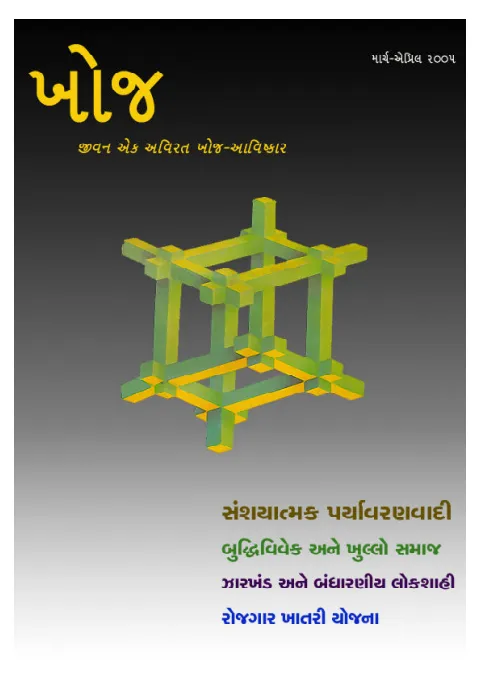
Summary
This is the inaugural issue (Volume 1, Number 1, March-April 2005) of Khoj, a bi-monthly Gujarati periodical published from Vadodara by Arch under the banner of its new initiative ‘Pahel’ (Initiative for Open Society). The editor is Ambrish Mehta, with an editorial board including Trupti Parekh, Anil Patel and Rajesh Mishra and an advisory committee of Gujarati liberal intellectuals and activists (Rashmi Kapadiya, Daksha Patel, Mahendra Chotaliya, Dhruv Bhatt, Sudarshan Iyengar, Kirit Khanawala, Aparna Kadikar, Nimisha Shukla and Parth Shah). Its motto, ‘Jeevan ek avirat khoj-aavishkar’ (Life is an unending search-discovery), and the bilingual epigraphs from the Rig Veda and Xenophanes signal the journal’s intellectual stance: the work of inquiry is permanent and provisional, and its philosophical anchors are explicitly Karl Popper and Friedrich Hayek.
The issue is built as a manifesto for liberal thought in Gujarati. Anil Patel’s lead essay, ‘Khoj sha mate?’ (Why Khoj?), argues that since Amartya Sen’s 1998 Nobel a serious public conversation on poverty, free markets, Darwinian evolutionism and the Nehruvian planning model has been missing from Gujarati periodicals; mainstream papers ignore these debates and the existing socialist consensus has gone unexamined. He traces a long arc from the Gandhi-Nehru divergence through Fabian-influenced Indian economists, the 1991 Rao-Manmohan liberalisation and the persistence of statism inside both Congress and the Sangh Parivar, and lays out the journal’s critique of central planning, bureaucratic licence-permit raj, anti-market populism, and the epistemology of positivism. Trupti Parekh’s companion piece, ‘Khoj na aarambh taane’, reflects on lessons drawn from the J.P.-inspired Total Revolution movement, decades of tribal rehabilitation work around the Sardar Sarovar, the Shoolpaneshwar sanctuary employment-guarantee litigation, the 1984 Delhi anti-Sikh pogrom and the 2002 Gujarat violence, treating constitutional democracy, rule of law and individual liberty as a coherent liberal package.
The rest of the issue previews the recurring sections: ‘Samachar ni bhitarma’ (Inside the news) by Anil Patel covers the National Rural Employment Guarantee Scheme and Jharkhand’s constitutional crisis; Ambrish Mehta launches a series on Bjorn Lomborg’s The Skeptical Environmentalist; a Gujarati translation of a 1972 Karl Popper interview on critical rationalism and the open society follows; Rajesh Mishra revisits the 2002 destruction of Muslim properties in tribal areas of Kavant; and Anil Patel reviews Matt Ridley’s The Origins of Virtue on the evolutionary roots of exchange and cooperation. The issue closes with Walter Lippmann’s 1937 line that in a free society the state administers justice among men who conduct their own affairs.
Key points
- This is the inaugural issue (Vol. 1, No. 1, March-April 2005) of Khoj, a bi-monthly Gujarati liberal periodical published from Vadodara as part of Arch’s ‘Pahel - Initiative for Open Society’.
- Editor Ambrish Mehta and contributors Anil Patel, Trupti Parekh and Rajesh Mishra anchor the journal explicitly in the philosophies of Karl Popper and Friedrich Hayek, framing inquiry as permanent and provisional.
- Anil Patel’s lead essay ‘Khoj sha mate?’ argues that Gujarati periodicals have ignored serious debate on free markets, poverty and Darwinian thought since Amartya Sen’s 1998 Nobel, and that a socialist consensus has gone unexamined.
- The same essay critiques the Nehruvian central-planning and licence-permit framework, traces Fabian socialist influence on Indian economists from the 1930s, and notes that statism survives in both Congress and the Sangh Parivar despite 1991 liberalisation.
- Trupti Parekh’s ‘Khoj na aarambh taane’ draws lessons from J.P. Narayan’s Total Revolution movement, decades of work with Sardar Sarovar oustees, and the Shoolpaneshwar tribal employment-guarantee litigation against the Gujarat state.
- Both editorials treat the 1984 Delhi anti-Sikh pogrom and the 2002 Gujarat anti-Muslim violence as failures of rule of law and as warnings against unbounded majoritarianism, citing Hayek on the limits of unlimited democracy.
- Ambrish Mehta opens a multi-issue series engaging Bjorn Lomborg’s ‘The Skeptical Environmentalist’ (2001) on development, sustainability and environmental claims.
- Anil Patel’s ‘Samachar ni bhitarma’ reviews the new National Rural Employment Guarantee Scheme under Manmohan Singh and Chidambaram and the constitutional crisis around government formation in Jharkhand.
- The issue includes a Gujarati translation of a 1972 Karl Popper interview on critical rationalism and the open society, and a review of Matt Ridley’s ‘The Origins of Virtue’ on the evolutionary basis of trade and cooperation.
- The masthead lists an advisory committee of Gujarati liberal intellectuals including Sudarshan Iyengar, Dhruv Bhatt and Parth Shah, and the issue closes with Walter Lippmann’s 1937 dictum on the state in a free society.
Metadata and summary are AI-extracted from the source PDF and reviewed for editorial accuracy. The original work is available via the Read PDF tab above (where present); paragraph-level citation inside the PDF is deferred to a future engagement.