speech
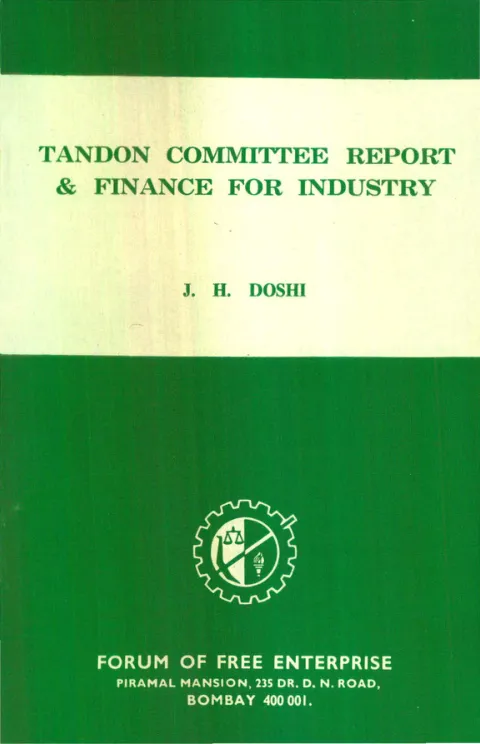
Tandon Committee Report & Finance for Industry
By J. H. Doshi
FORUM OF FREE ENTERPRISE, PIRAMAL MANSION, 235 DR. D. N. ROAD, BOMBAY 400 001. · Bombay · 1975
22 pages
Tandon Committee Report & Finance for Industry
By J. H. Doshi
Summary
This Forum of Free Enterprise booklet reproduces a lecture delivered by industrialist J. H. Doshi in Bombay on 19th December 1975, scrutinising the Tandon Study Group report on bank-credit norms for industry. Doshi traces the report’s origin to the Reserve Bank of India’s anxiety in 1973–early-1974, when oil-shock inflation prompted a sudden ad hoc freeze on cash credit; the Tandon Group (chaired by Prakash Tandon of Punjab National Bank) was constituted to evolve principled norms for inventory holding, working-capital assessment, the debt-equity ratio, and supervision of credit. His central charge is that by the time the final report appeared in August 1975 the cycle had reversed — the economy had slid into recession — yet the recommendations were drafted as if inflationary conditions persisted, and the Committee took no notice of the change.
Doshi works through the report’s two main limbs. On inventory norms he argues that prescribing rigid stock-holding ceilings for 15 industries ignores the disrupted flow of goods in India (transport bottlenecks, import licences, power cuts, strikes) and that comparisons with Japanese or American just-in-time levels are misleading; banks have already begun treating the guidelines as final and the request-for-deviation route is too slow to be useful. On capital structure he warns that Methods One and Two — capping bank finance at 75% and then 75% of total current assets respectively — will force diversion of retained earnings and long-term funds into working capital, starving capital formation precisely when the Planning Commission’s growth targets demand the opposite. He estimates the squeeze would release Rs 600 crores (Method One) or Rs 1,260 crores (Method Two) of credit from medium and large industry, but doubts the released funds will reach productive uses.
Framing the dispute as one of economic philosophy rather than accounting, Doshi accepts the principle of financial discipline but rejects the methods of enforcement, insisting that bank credit is a loan at 16–17 per cent — not a grant — so industry has its own commercial incentive to economise on inventory. He criticises the absence of any Planning Commission member from the Study Group, regrets the bifurcation of the cash-credit limit into a loan and cash-credit component without sufficient flexibility, and welcomes the Reserve Bank’s October press note conceding that flexibility will be needed. The piece closes with two appendices: a sectoral table of gross bank credit deployment as of April 1974 and April 1975, and a worked example illustrating the arithmetic of Methods One, Two and Three on a hypothetical balance sheet.
Key points
-
The Tandon Study Group was conceived under inflationary conditions in 1973–74 but reported in August 1975 when the economy had entered recession, and Doshi argues the Committee never adjusted for the changed cycle.
-
Doshi accepts the broad idea of financial discipline but rejects the methods chosen — fixed inventory norms for 15 industries plus separate caps on bank finance in working capital — as two redundant controls that will choke industrial flexibility.
-
He treats bank credit as a costly loan at 16–17 per cent interest, not a grant, arguing that industry has every reason to economise on inventory without administrative ceilings.
-
Methods One and Two would, on his estimate, release Rs 600 crores and Rs 1,260 crores respectively from credit extended to medium and large industry, but he doubts those funds will reach more productive uses.
-
He warns that forcing industries to substitute retained earnings or long-term funds for working capital will divert resources away from capital formation and slow industrial growth.
-
Doshi notes the capital market’s poor state — paid-up capital raised by non-banking, non-financial private companies rose only about 2 per cent per year in recent years and reached only Rs 99 crores in 1973 against gross investment of Rs 900 crores.
-
He criticises the absence of any Planning Commission member from the Study Group and the failure to test the recommendations against Plan growth targets.
-
The lecture closes by welcoming the Reserve Bank’s October press note on flexibility, treating the bank–client relationship as more than a set of rules, and reproducing appendices on sectoral credit deployment and the Three-Method arithmetic.
Generated by the v1.5 extraction pipeline. Awaiting editorial review.
Metadata and summary are AI-extracted from the source PDF and reviewed for editorial accuracy. The original work is available via the Read PDF tab above (where present); paragraph-level citation inside the PDF is deferred to a future engagement.