edited volume · anthology
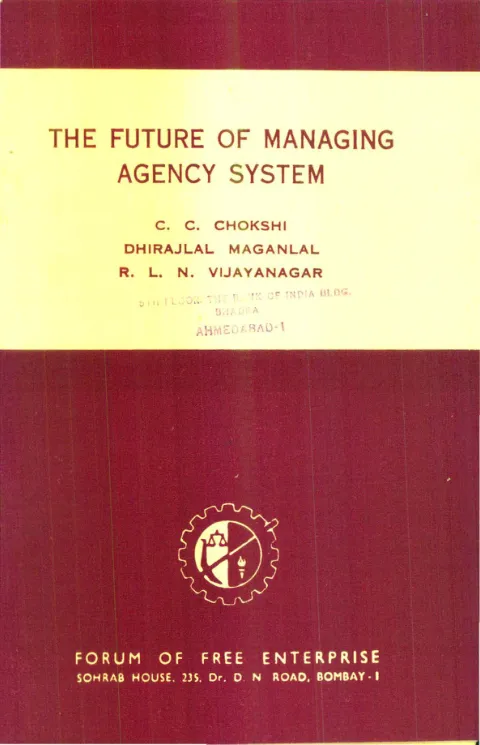
Some Aspects of Corporate Management
By steve-dembicki, c-c-sutaria, krishna-basrur
Published by M. R. Pai for the Forum of Free Enterprise, "Sohrab House", 235 Dr. Dadabhai Naoroji Road, Bombay-1. and printed by H. Narayan Rao at H. R. Mohan & Co. (Press), 9-B, Cawasjee Patel Street, Bombay-1. · Bombay · 1969
20 pages

Some Aspects of Corporate Management
Summary
This July 1969 Forum of Free Enterprise booklet collects three short essays drawn from the Forum’s ‘New Horizons in Corporate Sector’ lecture series, prefaced by an introduction that frames the corporate sector as decisive for India’s industrial development and warns that company law, tax incidence, labour legislation and the general attitude of government and public toward business ‘can impede or accelerate the growth of the corporate sector’. Steve Dembicki (a recently retired ILO Chief of Project) argues that India’s growth gap is fundamentally a management gap and lays out a philosophy of management development; C. C. Sutaria (President of the Institute of Secretaries) makes a sustained defence of the managing agency system against the 1970 abolition, charging that the decision was driven by ‘politics and ideologies rather than economic factors’; and Mrs. Krishna Basrur (Editor of the Consumer Guidance Society Bulletin) sets out the social responsibilities of management toward consumers — safety, honest workmanship, quality standards, continuity of supply — closing with a call for an industrialist’s rather than a financier’s outlook. The volume’s argumentative centre is a Forum-of-Free-Enterprise defence of the corporate sector as the engine of Indian economic development at a moment when government policy was tightening around it.
Key points
-
Steve Dembicki, a recently retired ILO Chief of Project, argues the gap between the United States and Europe is essentially a management gap rather than a technological one, borrowing Servan-Schreiber’s “American Challenge” framing.
-
Dembicki reduces effective management development to three principles: selecting the right people, placing them in the right jobs, and letting them grow for their own benefit as well as the organisation’s.
-
Dembicki appends a list of seventeen recommended management titles by authors including Drucker, Galbraith, Sloan, McClelland, and Carnegie as a study programme for Indian managers.
-
C. C. Sutaria, President of the Institute of Secretaries, defends the managing agency system ahead of its 1970 statutory abolition, charging that the decision rests on “politics and ideologies rather than economic factors.”
-
Sutaria credits the 674 managing agents then operating with financing, promoting, and managing nearly all Indian industry at low cost because their remuneration was tied to profit.
-
Sutaria warns that replacing managing agents with Boards of Directors paid fixed salaries outside Companies Act Sections 198 and 309 will prove costlier, given India’s scarcity of professional managerial talent.
-
Mrs. Krishna Basrur, Editor of the Consumer Guidance Society Bulletin, argues management’s primary responsibility to consumers is safety, citing adulterated foodstuffs, defective electrical appliances, and toxic paint on toys as violations.
-
Basrur cites the free sale of Metanil yellow, a prohibited colouring sold as edible across Bombay and, she says, perhaps all over India, as a concrete example of unsafe practice.
Essays
Management Development
By STEVE DEMBICKI
Steve Dembicki’s short address argues that the gap between the United States and even economically advanced Europe — borrowing Servan-Schreiber’s ‘American Challenge’ framing — is essentially a management gap and not a technological one, and that India’s industrial development hinges on closing it. He insists that ‘ordinary men are capable of being developed to give extraordinary performance’, that authorities and institutions can supply climate and encouragement but learning is ultimately a personal act after formal education ends, and that the discipline rests on three sound principles: selecting the right people, placing them in the right jobs, and allowing them to grow in their own interests as well as the organisation’s. The essay points the reader to a back-of-booklet list of seventeen recommended management titles for further study.
- Frames India’s development challenge as a management gap rather than a technological gap, citing Servan-Schreiber’s ‘The American Challenge’.
- Asserts that ordinary people can be developed into extraordinary performers given the right climate, delegation and learning conditions.
- Distinguishes formal academic training from the more important ‘most important phase’ of learning from actual experience under qualified managers.
- Reduces effective management development to three principles: selecting the right people, placing them in the right jobs, and letting them grow for themselves and the organisation.
- Curates seventeen Anglo-American management titles (Drucker, Galbraith, Sloan, McClelland, Carnegie, Servan-Schreiber and others) as a study list for Indian managers.
Abolition of Managing Agency & Change in the Pattern of Company Management
By C. C. SUTARIA
C. C. Sutaria’s address mounts a defence of the managing agency system on the eve of its statutory abolition in 1970, arguing that the Company Law Committee, the Joint-Stock Committee and the I. G. Patel inquiry committee all recommended mending rather than ending the system, and that 674 managing agents had financed, promoted and day-to-day-managed nearly all Indian industry at low cost because their remuneration was contingent on profit. He concedes some abuses but charges that Government has been ‘guided by politics and ideologies rather than economic factors’ and that the cure — costlier managing-director and consultancy substitutes, paid in fixed salaries outside the purview of Sections 198 and 309 of the Companies Act — ‘will prove worse than the disease’. He warns that with a paucity of professional managerial talent in India, a ‘sudden and hurried step’ will damage industrial development and that the system may quietly return in another form, at greater cost. The essay closes with a short bibliography of company-law references.
- Frames the 1970 abolition of the managing agency system as a politically driven decision against the advice of the Company Law Committee and the I. G. Patel inquiry committee, which urged ‘hastening slowly’.
- Argues the managing agency was uniquely Indian, inexpensive and efficient because remuneration was tied to net profits, giving agents a ‘strong urge to maximise profits by optimum efficiency and economy’.
- Credits managing agents with three functions — pioneering new industries, mobilising idle public capital, and providing day-to-day management — and with delivering returns the public sector has failed to provide.
- Predicts that replacement by Boards of Directors or Managing Directors will be costlier because their fixed salaries fall outside the profit-link discipline and outside government remuneration control under Companies Act Sections 198 & 309.
- Concludes that with a ‘dearth of professional managers’ the changeover risks halting industrial growth and that, history being a guide, the system may return ‘in one form or other’ at greatly increased cost.
Social Responsibilities of Management Towards Consumers
By Mrs. KRISHNA BASRUR
Mrs. Krishna Basrur argues that businessmen’s primary responsibility to consumers is safety — violated whenever foodstuffs are adulterated, electrical appliances are defective, toys carry toxic paint, cigarettes are glamorised to the young, cars are shoddily built or buildings collapse from poor materials — and she cites the free sale of Metanil yellow, a prohibited colouring sold as edible across Bombay and ‘perhaps all over India’, as a concrete example. She extends the duty to honest workmanship and quality control, presses for adoption of National Standards and certification of consumer goods, and rejects the industry argument that certification weakens brand names. She closes with a contrast that is the moral centre of the essay: India needs less of the ‘financier’s outlook’ — quick returns, sellers’ markets, exhausted markets abandoned — and more of the ‘true industrialist’s approach’ who ‘builds for the future’ and ‘works not with money, but with things bearing his name and with people’.
- Defines consumer safety as the primary social responsibility of business and indicts adulteration, defective appliances, toxic toys, shoddy cars and unsafe construction.
- Cites the open sale of Metanil yellow — a prohibited edible colouring — in Bombay as a concrete failure of consumer protection.
- Argues for honest workmanship, strict quality control and adoption of National Standards in consumer goods, dismissing the ‘certification weakens brand names’ objection.
- Calls for a joint consumer-trader body to investigate sharp practices and faults businesses for hoarding-style supply discontinuity that forces consumers into queues.
- Closes with a normative contrast between the short-horizon ‘financier’s outlook’ and the long-horizon ‘true industrialist’s approach’ as the kind of free enterprise worth believing in.
Generated by the v1.5 extraction pipeline. Awaiting editorial review.
Metadata and summary are AI-extracted from the source PDF and reviewed for editorial accuracy. The original work is available via the Read PDF tab above (where present); paragraph-level citation inside the PDF is deferred to a future engagement.