speech
Sales Tax
FORUM OF FREE ENTERPRISE 235, DR. DADABHAI NAOROJI ROAD, BOMBAY 1 · Bombay · 1958
13 pages
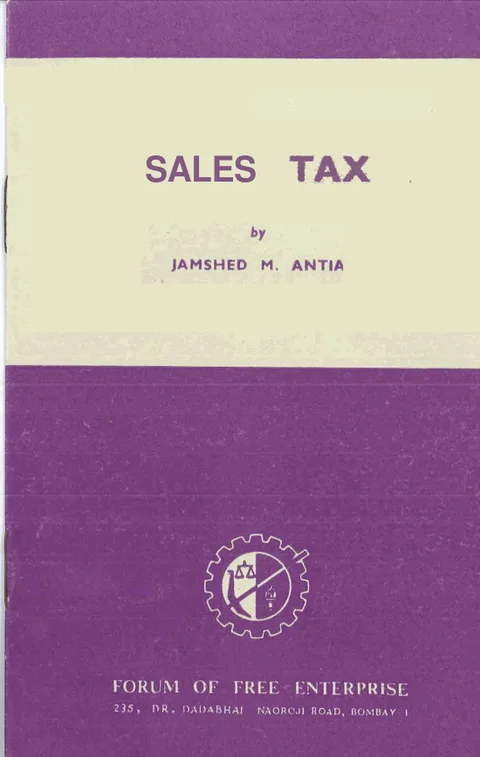
Sales Tax
By JAMSHED M. ANTIA
Summary
Jamshed M. Antia’s lecture, delivered in Bombay on 14 April 1958 under the Forum of Free Enterprise’s series on ‘The New Pattern of Taxation’, is a comprehensive technical and polemical survey of the sales tax in India two decades after its introduction. Antia traces the lineage from the Central Provinces’ 1937 tax on motor spirit and Madras’s pioneering General Sales Tax of 1938 to its emergence by the late 1950s as the mainstay of State finances — revenue having multiplied tenfold from Rs. 8 crores in 1944 to over Rs. 80 crores, rivalling Land Revenue and approaching Central Income-tax in importance.
The lecture surveys the three systems of taxation (multi-point, single-point, and double-point), the constitutional history that led to the 1956 Amendment of Article 286, and the Central Sales Tax Act of 1956 with its categories of intra-State, outside-State, import/export, and inter-State sales. Antia then mounts a sustained critique of the actual effects of sales tax in operation: he argues that despite formal incidence on the seller, the burden ultimately falls on consumer or producer depending on bargaining power, and presents Taxation Inquiry Commission and re-worked Bombay-city figures showing that the burden on the average consumer roughly equals 4.5% of income, becoming heavier than income-tax for incomes below Rs. 700 per month. He documents how multi-point taxes and inter-State rate differences have distorted trade routes, hampered specialisation, encouraged inefficient small-scale production, raised industrial costs, suppressed exports, and inflicted a regressive burden on small dealers and consumers.
The second half turns to administration — recital-pattern penalties, suspicion-driven inspection, corruption, and ‘justice delayed is justice denied’ — and closes with six concrete reform recommendations: making sales tax a Central subject by constitutional amendment, simplifying the structure for the layman, enforcing uniform levy across India, shifting to a single-point tax at the last sale, calibrating rates by economic need (exempting necessaries, taxing luxuries progressively), and compensating States through Finance Commission grants. Antia frames the goal as an integrated tax structure that would let government ‘control the direction of resources without stifling private enterprise’ and create a climate of confidence for free enterprise to play its role in national welfare.
Key points
-
Sales tax revenue in India grew from Rs. 8 crores in 1944 to over Rs. 80 crores by the late 1950s, becoming the mainstay of State finances and rivalling Land Revenue, with the first general tax introduced in Madras in 1938.
-
The constitutional history — Article 286, the Supreme Court’s nullification of inter-State taxation by resident dealers, the 1956 Sixth Amendment, and the Central Sales Tax Act 1956 — created a framework of four sale categories and uniform principles for determining situs of sale.
-
Three systems coexist (multi-point, single-point, double-point); the Centre levies only multi-point inter-State tax while States impose varying rates from less than 1% to 30%.
-
Although nominally assessed on the seller, the tax is ultimately borne by consumer, manufacturer, or trader depending on bargaining position; in Bombay it amounts to roughly 4.5% of income and becomes heavier than income-tax for incomes below Rs. 700/month.
-
Inter-State rate differences distort trade flows, encourage in-State self-sufficiency, hamper specialisation, raise industrial costs, suppress exports, and act as ‘a tax on industrialization’ that depresses the standard of living.
-
Administration is marked by suspicion-driven inspection, secrecy in interpretation, delegated legislation, corruption concerns, and procedural penalties that fall hardest on the small dealer.
-
Antia recommends six reforms: making sales tax a Central subject by constitutional amendment, simplifying the structure, uniform levy across India, single-point at last sale, rates governed by economic need with necessaries exempt and luxuries progressive, and compensating States through Finance Commission formulae.
-
The lecture closes by framing a reformed sales tax as a ‘powerful weapon for controlling the economy in a democratic manner’ compatible with private enterprise and an integrated national tax structure.
Generated by the v1.5 extraction pipeline. Awaiting editorial review.
Metadata and summary are AI-extracted from the source PDF and reviewed for editorial accuracy. The original work is available via the Read PDF tab above (where present); paragraph-level citation inside the PDF is deferred to a future engagement.