pamphlet
PROSPERITY THROUGH FREE ECONOMY — A CASE STUDY OF TAIWAN
By KV Narain
Published by M. R. PAI for Forum of Free Enterprise, "Sohrab House", 235, Dr. Dadabhai Naoroji Road, Bombay 1, and printed by H. NARAYAN RAO at H. R. MOHAN & CO., 9-B, Cawasjee Patel Street, Bombay 1. · Bombay · 1964
2 pages
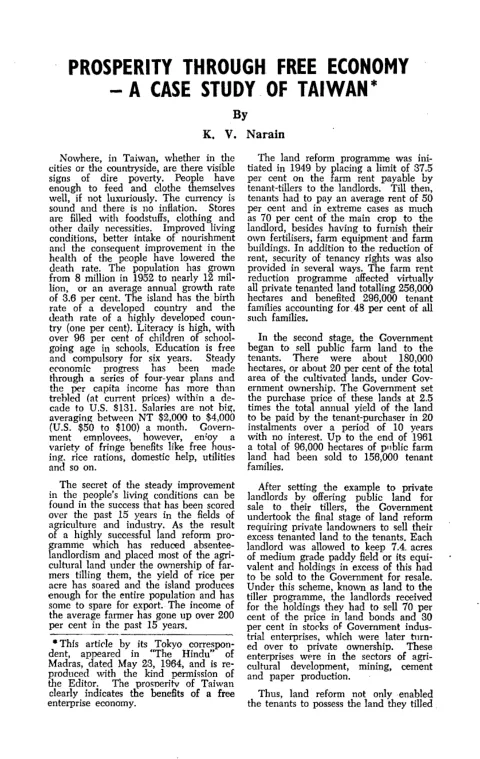
PROSPERITY THROUGH FREE ECONOMY — A CASE STUDY OF TAIWAN
By K. V. Narain
Summary
K. V. Narain’s two-page Forum of Free Enterprise leaflet, reprinted from a Tokyo correspondent’s despatch in The Hindu (Madras, 23 May 1964), uses Taiwan as a worked example of what free-enterprise policy combined with carefully sequenced land reform can deliver. Narain reports an island with no visible dire poverty, sound currency, and the absence of inflation, where stores carry foodstuffs, clothing and consumer goods, where literacy exceeds 96 per cent, and where the average monthly income for permanent employees runs between roughly NT$2,000 and NT$4,000 (about US$50 to US$100). Education is free and compulsory for six years; per-capita income has risen by some 7.5 per cent annually for fifteen years.
The spine of the argument is the land reform programme begun in 1949. Rent was first capped at 37.5 per cent of the farm-rent payable to landlords; the state then sold public land to its tillers; and finally, under the Land-to-the-Tiller scheme, private landowners were required to sell tenanted holdings in excess of 7.5 acres of medium-grade paddy (or equivalent), receiving 70 per cent in land bonds and 30 per cent in stock of government industrial enterprises that were subsequently transferred to private ownership. Narain reports 256,000 hectares redistributed to 298,000 tenant families, with a further 158,000 tenant families brought onto former public land. Rice yields per hectare rose from 3,896 kg in 1948 to 5,216 kg by 1960; production climbed from 6,800 kg of paddy on a 300-kg leasehold to higher owner-cultivated volumes.
The leaflet treats land reform as the platform for industrial take-off rather than its alternative. The four-year plans launched in 1953 emphasised power, fertiliser, petroleum and railways; the second plan added co-ordination of agriculture and industry plus an export drive; the third (1961) consolidated the gains. Industrial output spans chemicals, cement, aluminium, building materials and a widening range of consumer goods including electrical appliances, bicycles and sewing machines. Textiles, processed foods and fertilisers led the export expansion: textile exports rose from US$35 million to US$43 million, and the country’s external accounts swung from a chronic US$80-million annual deficit covered by U.S. aid to a US$20-million favourable trade balance in 1963, with foreign-exchange reserves of US$200 million. The implied moral, signposted in Narain’s editorial footnote, is that Taiwan’s record “clearly indicates the benefits of a free enterprise economy” for Indian readers debating planning and the public sector.
Key points
-
Reprints a Tokyo despatch published in The Hindu (Madras, 23 May 1964); the leaflet’s editorial frame presents Taiwan as a free-enterprise success story for Indian readers.
-
Narain reports no visible dire poverty, sound currency, no inflation, literacy above 96 per cent, and average monthly incomes of NT$2,000-$4,000 (about US$50-$100) for permanent employees.
-
The 1949 land reform capped tenant rent at 37.5 per cent of the farm rent payable to landlords, with the state subsequently selling public land to its tillers.
-
Under the Land-to-the-Tiller scheme, landlords retained up to 7.5 acres of medium-grade paddy (or equivalent); excess holdings were transferred to tenants, with compensation paid 70 per cent in land bonds and 30 per cent in shares of state industrial enterprises that were then privatised.
-
Reported redistribution: 256,000 hectares to 298,000 tenant families, plus 158,000 tenant families brought onto former public land.
-
Per-hectare rice yield rose from 3,896 kg (1948) to 5,216 kg (1960); per-capita income grew about 7.5 per cent annually over fifteen years.
-
Four-year plans from 1953 emphasised power, fertiliser, petroleum, railways and exports; industrial output now spans chemicals, cement, aluminium, electrical appliances, bicycles and sewing machines.
-
Textile exports rose from US$35 million to US$43 million; the trade account swung from a chronic US$80-million annual deficit covered by U.S. aid to a US$20-million surplus in 1963, with US$200 million in foreign-exchange reserves.
Generated by the v1.5 extraction pipeline. Awaiting editorial review.
Metadata and summary are AI-extracted from the source PDF and reviewed for editorial accuracy. The original work is available via the Read PDF tab above (where present); paragraph-level citation inside the PDF is deferred to a future engagement.