speech · memorial lecture
PROSPERITY BEYOND OUR CITIES BY SPREADING ENTERPRISE
Published by S. S. Bhandare for the Forum of Free Enterprise, Peninsula House, 2nd Floor, 235, Dr. D. N. Road, Mumbai 400001, and Printed by S. V. Limaye at India Printing Works, India Printing House, 42 G. D. Ambekar Marg, Wadala, Murnbai 400 031. · Mumbai · 2007
15 pages
No. 41 in A. D. Shroff Memorial Lecture
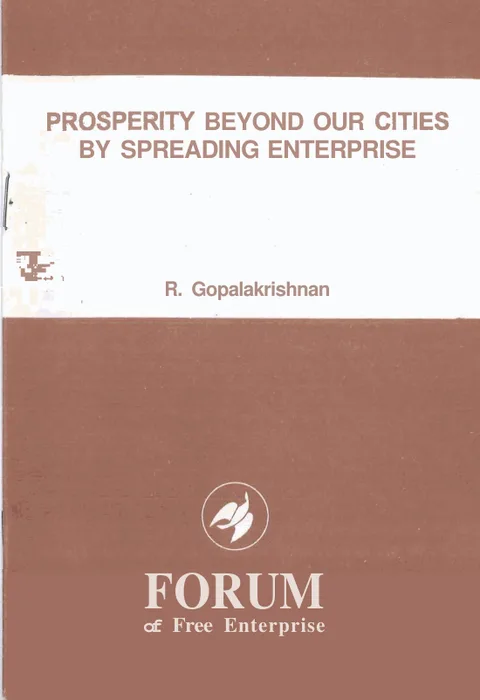
PROSPERITY BEYOND OUR CITIES BY SPREADING ENTERPRISE
By R. Gopalakrishnan
Summary
Delivered as the 41st A. D. Shroff Memorial Lecture in Mumbai on 12 October 2007 and published as a Forum of Free Enterprise booklet, R. Gopalakrishnan’s address argues that India’s much-celebrated macro-economic growth has scarcely reached the roughly sixty per cent of the population living in rural areas and small towns — what he calls ‘Little India’. The remedy he proposes is not another centrally-administered programme but the deliberate liberation of enterprise through decentralization: returning power, finance and decision-making to villages, panchayats and small-town entrepreneurs so that latent energies are released for socio-economic development.
Gopalakrishnan grounds the case historically. He recalls that India was for centuries a ‘no-government condition’ of self-governing village communities, that Indians were prominent in trade and industry between the seventeenth and nineteenth centuries, and that the Indian enterprise gene has survived invasion, colonial rule and partition. He contrasts that inheritance with post-independence centralization, citing C. Rajagopalachari’s image of long intervals between effective governments, Milton Friedman’s taxonomy of spending modes, and a cluster of contemporary indicators — flat rural per-capita income, shrinking rural credit share, unelectrified villages, judicial backlogs of 425–1,165 days for contract enforcement, and lawlessness in 150–165 districts — to show that the Bharat Nirman model of spending other people’s money on other people is not closing the gap.
The speech then turns constructive. Drawing on a Tata Services study of 1,200 entrepreneurs across twelve village clusters, on KVIC, Chetna Gala Sinha’s Mann Deshi Udyogini, Dhriti, Citibank’s micro-entrepreneurship awards, and Tata BP Solar’s rural employment model, Gopalakrishnan sketches a four-driver template — infrastructure, finance and facilitation, rural MBA training, and social capital — that small-town and village enterprise needs. He cites Hernando de Soto on the necessity of functioning markets in land, credit and agro-produce, and argues that markets, panchayat finance and trust in local ‘lords’ are the route to scalability.
The concluding section is openly polemical. Gopalakrishnan warns of six symptoms of a ‘brewing crisis’ in which leaders recognise problems but defer costly fixes, endorses the Bombay Chamber’s proposal to let panchayats raise their own revenue (drawing on a paper that shows land revenue alone could raise Rs 25,000 crores), and insists that the agenda is evolutionary, not the dramatic industrial dismantling of the 1990s. A short biographical postscript and a quotation from Eugene Black — ‘People must come to accept private enterprise not as a necessary evil, but as an affirmative good’ — close the booklet, framing the lecture as an extension of A. D. Shroff’s classical-liberal lineage.
Key points
-
Macro growth of the last five years has mainly served urban ‘Big India’; the 60 per cent of Indians in villages and small towns (‘Little India’) have been bypassed.
-
Gopalakrishnan frames decentralization and enterprise as ‘two sides of the same coin’ — centralized bureaucratic schemes stifle rather than release the natural enterprise of Indians.
-
A historical sweep — Mohenjodaro–Harappa trade, Takshila as the first university, a ‘government-less civilization’ of self-governing village communities — is used to argue that India’s default state has been decentralized and entrepreneurial.
-
Empirical indicators of stagnation in Little India: flat rural per-capita income 1980–2000, rural credit share shrinking from 27% (1994) to 18% (2006), millions in unelectrified villages, contract-enforcement delays of 425–1,165 days, 150–165 districts under Naxal disturbance, land-ownership disputes covering nine-tenths of land.
-
A Tata Services / DES study of 1,200 entrepreneurs identifies four drivers for sparking enterprise in small towns and villages: Infrastructure, Finance & Facilitation, ‘Rural MBA’ training, and Social Capital — mirroring David McClelland’s classic findings.
-
Examples of scalable rural enterprise are surveyed: KVIC, Mann Deshi Udyogini, Sheetalmata Sabzi Mandi at Khamla, Dhriti, Citibank’s 22-state award scheme, KIVA, the ICECD/TCRDS ‘rural MBA’ programme, and Tata BP Solar’s solar-panel manufacturing model.
-
Reform proposals: empower panchayats to raise revenue (per the Bombay Chamber paper, land revenue alone could yield Rs 25,000 crores), accept Hernando de Soto’s argument for functioning markets in land/credit/produce, and move from ‘Stop’ and ‘Slow down’ to ‘Accelerate’ on decentralized governance.
-
The agenda is framed as evolutionary, not dramatic — but urgent, closing with A. D. Shroff’s spirit of urgency and Eugene Black’s defence of private enterprise as ‘an affirmative good’.
Generated by the v1.5 extraction pipeline. Awaiting editorial review.
Metadata and summary are AI-extracted from the source PDF and reviewed for editorial accuracy. The original work is available via the Read PDF tab above (where present); paragraph-level citation inside the PDF is deferred to a future engagement.