speech
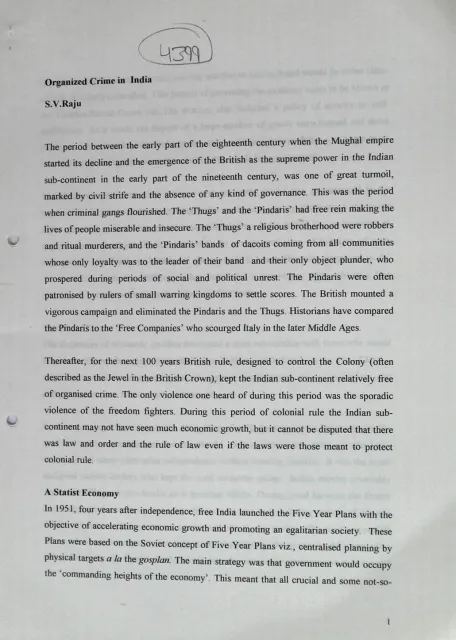
Organised Crime and Economic Development in India
By Anand Sinha
FORUM OF FREE ENTERPRISE, PENINSULA HOUSE, 235, Dr. D. N. Road, MUMBAI 400 001. · Mumbai
24 pages
Organised Crime and Economic Development in India
By Dr. Ajit Kumar Sinha
Summary
Dr. Ajit Kumar Sinha, then immediate past president of the Indian Economic Association, uses his 1999 Presidential address (reproduced by the Forum of Free Enterprise) to argue that organised crime — not just slow reform or weak institutions — has become the binding constraint on India’s market transition. Writing at the close of the first decade of post-1991 liberalisation, he concedes that successive governments have held to a common economic agenda, but observes that headline indicators (HDI rank of 132/174, per-capita GNP rank of 165/210, FDI absorption a fraction of China’s) lag behind expectations. The reason, he insists, is that markets cannot function without effective property rights, predictable law and protection of life and property — and crime syndicates have steadily eroded all three.
The pamphlet then walks through the evidence trail: the 1993 Vohra Committee’s account of an entrenched nexus between criminals, politicians, bureaucracy and police; the Supreme Court’s 1997 directive that produced a follow-up high-level committee under N. N. Vohra with B. G. Deshmukh and S. V. Giri; confirmatory reports from the Centre for Policy Research, the Bihar police, and a Bihar Legislative Council house committee; and the National Crime Record Bureau’s own preface to Crimes in India 1997. Sinha treats organised crime as a global economic actor (estimated at $1.5 trillion a year) that now rivals multinational corporations in scale and uses information technology to dissolve state borders.
Most of the second half reports Sinha’s own questionnaire-based survey of 206 economists across 16 non-special-category states, six special-category states and Chandigarh. The numbers are striking: 93% report rising crime, 38% confirm ‘Rangdari’ (protection) tax as a precondition for opening or running a business, 80% see a nexus between criminals and police, 74% accept a four-way nexus across mafia, police, bureaucracy and politicians, and 47% confirm that mafia dons have been elected as representatives in their areas. A rank correlation of 0.94 between rise in ‘anti-development crime’ and capital flight, and 0.71 for rural militant organisations’ impact on the rural investment climate, anchor his case quantitatively.
The through-line is a classical-liberal one with empirical reinforcement: free entry and free exit — the basic preconditions of a market — are being foreclosed by syndicates that levy Rangdari tax on entrepreneurs, Firauti (ransom) tax on industrialists, and ‘greasing/speed money’ on every interaction with the state. When mafia figures themselves graduate to ministerial office and Lok Sabha and Rajya Sabha seats, Sinha argues, the criminal economy stops being a deviation from the political economy and becomes its dominant logic, and reform without restoring rule of law is a self-defeating exercise.
Key points
-
Frames organised crime as the principal limiting factor on India’s post-1991 reforms, not the more commonly cited political instability, communal tension or tax structure.
-
Anchors the diagnosis in property rights, free entry/exit and rule of law — markets cannot function without protection of life and property from criminal acts.
-
Summarises the Vohra Committee (1993, tabled 1995) and the Supreme Court-mandated 1997 follow-up under N. N. Vohra, B. G. Deshmukh and S. V. Giri to establish official confirmation of the criminal-political-bureaucratic nexus.
-
Reports the global scale of organised crime ($1.5 trillion/year), arguing syndicates have become economic powers rivalling multinational corporations and now exploit information technology to bypass state borders.
-
Presents an original 206-respondent survey of economists across 22 states/UTs to verify ground realities the official statistics do not capture, including the prevalence of Rangdari (protection) tax and Firauti (ransom) tax.
-
Documents the mainstreaming of mafia figures into elected office (Mukhiya, MLA/MLC, Lok Sabha, Rajya Sabha) and into ministerial positions in several states.
-
Quantifies the linkage between crime and economic performance via rank correlations — 0.94 between anti-development crime and capital flight, 0.71 between rural militant organisations’ nexus and the rural investment climate.
-
Treats ‘greasing/speed money’ as having moved beyond ordinary file-pushing into a syndicate-mediated tariff on doing business, making reform without enforcement infeasible.
Generated by the v1.5 extraction pipeline. Awaiting editorial review.
Metadata and summary are AI-extracted from the source PDF and reviewed for editorial accuracy. The original work is available via the Read PDF tab above (where present); paragraph-level citation inside the PDF is deferred to a future engagement.