speech
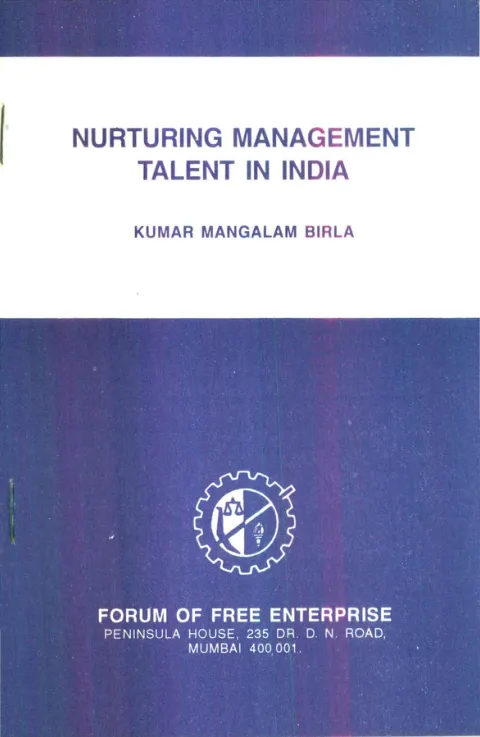
Nurturing Management Talent in India
Published by M. R. Pai for the Forum of Free Enterprise, "Peninsula House", 235, Dr. D. N. Road, Mumbai 400 001, and printed by S. V. Limaye at India Printing Works, India Printing House, 42 G. D. Ambekar Marg, Wadala, Mumbai 400 031. · Mumbai · 2000
16 pages
Summary
Kumar Mangalam Birla’s pamphlet — based on his acceptance speech for the Bombay Management Association’s “Management Man of the Year” Award (26 May 2000) — argues that talent, rather than capital, scale, technology, or labour in the conventional sense, has become the dominant strategic resource of contemporary business. Borrowing John Gardner’s typology of “pathfinders and path preservers,” Birla redefines managerial talent as a composite of intellectual range, emotional intelligence, creativity, willingness to learn, and the ability to straddle functional, cultural, and geographic boundaries. He attributes the present urgency to a global supply-demand imbalance for such people, a generational appetite for entrepreneurial autonomy, the diffusion of decision-making to every level of complex organisations, and rising business complexity that places a premium on integrated, non-linear thinking.
Birla then turns to India’s specific position. He treats English-language facility, numerical aptitude, an innate capacity to adapt, and an intensely competitive culture (from nursery-school interviews to the Civil Service) as endowments that have already produced a globalised cohort of Indian professionals in IT, engineering, and finance. Against this he places three retarding forces: a social stigma around failure that suppresses experimentation, a conformist culture in which “the nail that sticks out invariably gets hammered down,” and an educational system that is rote-driven, narrow, and “memory-centric.”
The final stretch reads as a practitioner’s checklist for Indian organisations. Birla identifies three live issues — keeping talented people perpetually challenged through fast-tracking and cross-functional exposure; integrating talent without letting mediocrity drive it out or letting it harden into an ivory tower; and managing the widening compensation divergence between high-performers and the rest in an era of stock options and performance-linked pay. Citing Ernest Shackleton’s 1900 Antarctic recruitment advertisement, he ends on the claim that the real challenge is striking a balance between material rewards and a larger sense of mission, and that making India genuinely talent-friendly requires macro-level action on quality-of-life and human-development indicators so that the brain drain can be reversed.
Key points
-
Talent — not capital, scale, technology, or conventional labour — is framed as the single dominant strategic resource of contemporary business; Birla calls the resulting paradigm “People Power.”
-
The definition of managerial talent is widened beyond functional expertise to include emotional intelligence, creativity, team orientation, entrepreneurial drive, and cross-cultural mobility.
-
Four drivers are offered for the talent crunch: a global supply-demand imbalance, the desire to “be one’s own boss,” the need to spread decision-making to every organisational level, and rising business complexity.
-
India’s enabling endowments are listed as English fluency, numerical aptitude, an adaptive temperament, and a hyper-competitive culture exemplified by nursery-school interviews and Civil Service ratios.
-
Three retarding forces are diagnosed: an indelible social stigma around failure, a conformist culture hostile to dissent, and an educational system that is rote-based and “memory-centric.”
-
Three live organisational issues are flagged: keeping talented people challenged through fast-tracking and overseas secondments, integrating talent without letting mediocrity drive it out, and managing widening compensation differentials and stock-option pressure.
-
Birla invokes Ernest Shackleton’s 1900 Antarctic recruitment notice to argue that mission and meaning, not material rewards alone, mobilise talent.
-
The conclusion shifts to a macro register: nurturing and retaining talent in India requires fixing quality-of-life, human-development, and infrastructure deficits — “attracting brains is a lot more difficult than attracting FDI.”
Metadata and summary are AI-extracted from the source PDF and reviewed for editorial accuracy. The original work is available via the Read PDF tab above (where present); paragraph-level citation inside the PDF is deferred to a future engagement.