speech
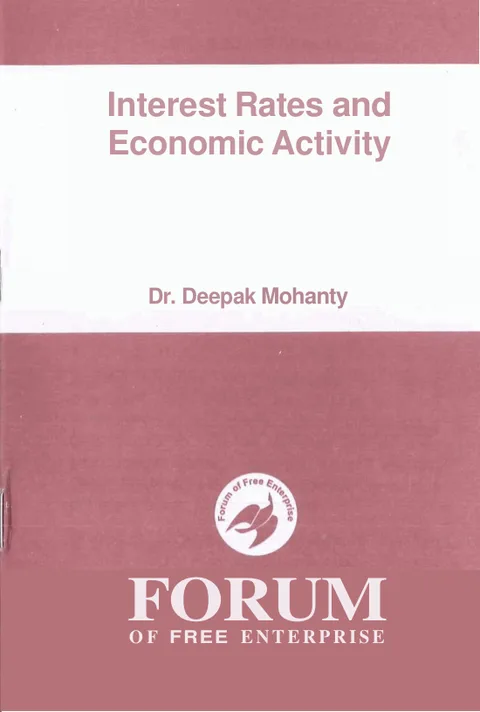
Interest Rates and Economic Activity
Published by S. S. Bhandare for the Forum of Free Enterprise, Peninsula House, 2nd Floor, 235, Dr. D. N. Road, Mumbai 400001, and Printed by S. V. Limaye at India Printing Works, India Printing House, 42 G. D. Ambekar Marg, Wadala, Mumbai 400 031. · Mumbai · 2014
13 pages
Summary
Dr. Deepak Mohanty, Executive Director of the Reserve Bank of India, uses this 2014 Forum of Free Enterprise booklet (based on a talk delivered at the Association of Financial Professionals of India in Pune in August 2013) to probe whether monetary policy alone can revive India’s flagging growth. Reviewing the decade 2003-04 through 2012-13, he divides the Reserve Bank’s stance into four growth-inflation phases — the boom of 2003-08, the global-crisis response of 2008-10, the inflation-fighting tightening of 2010-12, and the cautious easing of 2012-14 — and asks whether interest-rate movements actually transmitted into market lending rates and real economic activity.
His answer is sceptical of the easy view that cheaper credit will restart investment. Empirical evidence cited from Reserve Bank and IMF working papers shows that policy rate changes do affect output and inflation, but transmission is asymmetric: banks raise lending rates quickly during tightening and adjust them more sluggishly during easing, because fixed-rate deposit liabilities and the apprehension of losing deposits constrain them. Mohanty unpacks the Fisher decomposition to argue that nominal rather than real rates have shaped recent investment, and presents firm-level data showing the interest cost-to-sales ratio rose from 2.6 per cent to 3.8 per cent while sales growth collapsed from 20.9 per cent to 9.5 per cent — a squeeze driven less by RBI policy than by sluggish demand, supply bottlenecks, and a declining marginal efficiency of capital.
The booklet’s argumentative centre, set up by Minoo R. Shroff’s foreword and reaffirmed in Mohanty’s conclusion, is that India’s investment slowdown is structural rather than monetary. Price stability and exchange-rate stability, he insists, are necessary preconditions for sustainable high growth; when non-monetary factors — corporate over-leverage, supply-side bottlenecks, weak global demand — are doing the damage, lowering interest rates is no panacea. Charts and tables tracking repo and CRR moves, weighted average lending rates, the incremental capital-output ratio, and the marginal productivity of capital are mustered to support the case for monetary caution over premature easing.
Key points
-
The booklet covers the Reserve Bank of India’s monetary stance from 2003-04 through 2012-13, partitioned into four growth-inflation phases.
-
Mohanty argues that monetary policy transmission in India is asymmetric — faster from policy rate to market rates during tightening than during easing.
-
He attributes the post-crisis investment slump primarily to non-monetary factors: supply bottlenecks, sluggish demand, and corporate deleveraging.
-
The Fisher equation framework is used to distinguish nominal and real interest rate effects on investment decisions.
-
Firm-level evidence shows interest cost-to-sales ratio rose from 2.6 per cent (2003-08) to 3.8 per cent (2012-13) as sales growth collapsed from 20.9 per cent to 9.5 per cent.
-
The incremental capital-output ratio (ICOR) has been rising and the marginal productivity of capital (MPC) declining since 2008-09.
-
Mohanty’s central policy conclusion is that lower interest rates alone cannot stimulate growth when non-monetary headwinds dominate; price and exchange-rate stability are prerequisites for sustainable growth.
-
The booklet appears in the Forum of Free Enterprise series dedicated to the Shailesh Kapadia Memorial Trust, with a foreword by Forum President Minoo R. Shroff.
Metadata and summary are AI-extracted from the source PDF and reviewed for editorial accuracy. The original work is available via the Read PDF tab above (where present); paragraph-level citation inside the PDF is deferred to a future engagement.