
speech
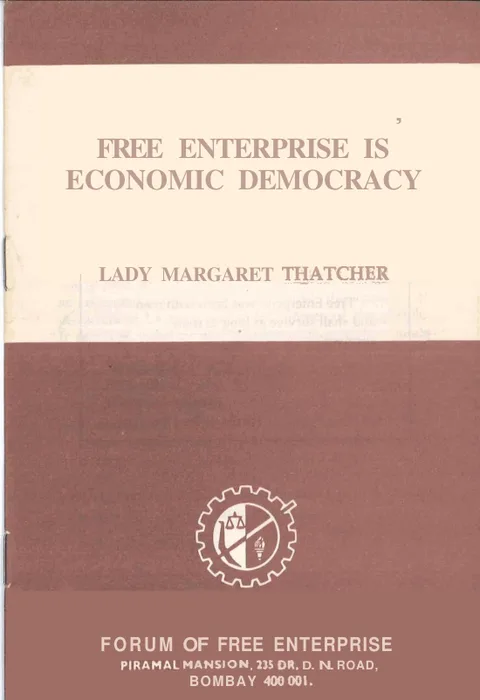
Free Enterprise is Economic Democracy
Published by M.R. Pai for the Forum of Free Enterprise, "Piramal Mansion", 235, Dr. D.N. Road, Bombay 400 001. · Bombay · 1995
9 pages
Summary
This Forum of Free Enterprise booklet collects two excerpts from Lady Margaret Thatcher: a keynote address delivered in Bombay on 9 September 1994 under the Citibank Leadership Speaker Series (“Free Enterprise is Economic Democracy”), and a lecture titled “The New World Order” given at the Fraser Institute’s 20th Anniversary luncheon in Vancouver in 1994. Together they amount to a compressed manifesto of Thatcherism reframed for an Indian audience on the cusp of liberalisation.
In the first piece Thatcher argues that economic freedom is itself a form of freedom, that free enterprise is best understood as ‘economic democracy,’ and that the state’s role should be limited but strong — sound on currency and finance, restrained on industry. She praises Asia’s growth miracle, urges India to use its democratic openness and middle-class capacity to consolidate reform, and presents privatisation as the mechanism that ‘shrinks the powers of the state and enlarges the power of the people.’
The second piece is autobiographical: Thatcher recounts the four things her 1979 government did ‘pretty well immediately’ — cutting income tax rates from a top of 83 percent down to 40 percent, dismantling price/incomes/exchange/development controls, rewriting trade-union law to restore the secret ballot and curb collective bullying, and privatising 46 nationalised industries. She frames the project as a moral one: capitalism, not socialism, carries the moral quality because it depends on voluntary cooperation, the rule of law, and the responsible exercise of freedom. The closing reflection insists that politicians must seek power by ‘getting their convictions right,’ rooted in the best traditions of their country.
Key points
-
Thatcher reframes free enterprise as ‘economic democracy’ — power dispersed to the people through ownership and the market, parallel to political democracy through the vote.
-
The state should be ‘limited but strong’: sound finance and a stable currency are core duties, while industry and management belong with private owners.
-
Privatisation is treated as both an economic and a political instrument — it shrinks state power and converts ordinary wage-earners into shareholders and homeowners.
-
India is addressed directly: its established parliamentary democracy and large entrepreneurial middle class are presented as competitive advantages over China and post-Soviet Russia.
-
The 1979 UK reform programme is summarised as four immediate moves — cut income-tax rates (top rate from 83% to 40%), abolish prices/incomes/exchange/Development controls, reform trade-union law (secret ballot, end of the closed shop), and privatise 46 nationalised industries.
-
Lower tax rates produced higher revenues: the top 5 percent of earners contributed a bigger share of tax at 40 percent than they had at 83 percent — Thatcher’s headline ‘power of incentives’ claim.
-
Capitalism is defended in explicitly moral terms — it requires voluntary joint action, the rule of law, and serving others through the market — while socialism is cast as ‘the planning by the few over the lives of the many.’
-
Political leadership is figured as conviction politics against ‘the art of the possible’: the task in 1979 was to make the impossible happen by refusing pragmatism untethered from values.
Notable passages
"Thatcher argues that economic freedom is itself a form of freedom, that free enterprise is best understood as 'economic democracy,' and that the state's role should be limited but strong"
"Privatisation is treated as both an economic and a political instrument — it shrinks state power and converts ordinary wage-earners into shareholders and homeowners."
"The 1979 UK reform programme is summarised as four immediate moves — cut income-tax rates (top rate from 83% to 40%), abolish prices/incomes/exchange/Development controls, reform trade-union law (secret ballot, end of the closed shop), and privatise 46 nationalised industries."
Metadata and summary are AI-extracted from the source PDF and reviewed for editorial accuracy. The original work is available via the Read PDF tab above (where present); paragraph-level citation inside the PDF is deferred to a future engagement.
People in this work
Related across the archive
 ExcerptFree Enterprise is Economic Democracy
 Primary workSWATANTRA PARTY MANIFESTO
 ExcerptIs There A Middle Way? - Dr F. A. Mehta
- Primary workBR Shenoy Memorial Lecture 2021 | Montek Singh Ahluwalia
- Primary work2nd Indian Liberals Annual Lecture | The Scope for Political Liberalism in India by Dr. JP Narayan