speech
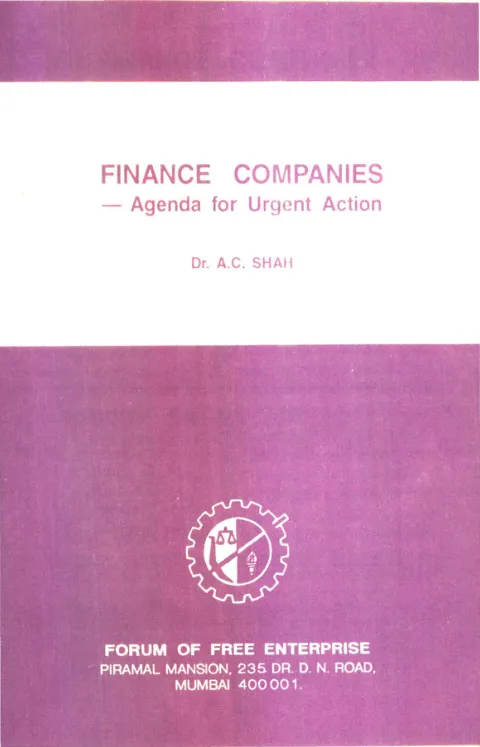
Finance Companies
Agenda for Urgent Action
By DR AC Shah
Published by M. R. Pai for the Forum of Free Enterprise, "Piramal Mansion", 235, Dr. D. N. Road, Mumbai 400 001, and Printed by S. V. Limaye at India Printing Works, India Printing House, 42 G. D. Ambekar Marg, Wadala, Mumbai 400 031. · Mumbai · 1997
20 pages
Summary
Delivered as a talk at the Forum of Free Enterprise in Mumbai on 24th July 1997 and published as a booklet on 15 July 1997, Dr. A. C. Shah’s address takes stock of India’s Non-Banking Financial Companies (NBFCs) in the aftermath of the CRB scam and the sweeping 1997 amendment to the Reserve Bank of India Act. Speaking as a former Chairman and Managing Director of Bank of Baroda and Chairman of the RBI Committee on NBFCs, Shah argues that the industry — although the youngest member of India’s financial sector, with an asset base of over Rs.50,000 crores and a deposit base of about Rs.18,000 crores — is being unfairly tarred by the misconduct of a single firm and is now under severe liquidity stress as deposits dry up, withdrawals accelerate, and banks adopt a ‘wait and watch’ posture.
Shah’s central plea is that the process of deregulation initiated over the previous four years not be reversed: RBI should tighten and clarify entry norms (the new Net Owned Funds threshold of Rs.25 lakhs is endorsed) while protecting well-managed NBFCs from collective punishment. He proposes a graded regime — only NBFCs with NOFs of Rs.5 crores and above, rated and prudentially compliant, should access unrestricted public deposits; smaller companies should be given a three-year window to scale up or exit; sub-Rs.1–2 crore firms should be barred from accepting public deposits altogether and possibly brought under a revised Money Lenders Act. He urges RBI to operationalise the P. R. Khanna Expert Group’s 1996 recommendations on supervision, to advance a deposit insurance scheme on the lines of UK and USA models, and to use the recent SLR hike to fund a stand-by refinance facility for registered NBFCs.
The second half of the talk turns to the industry’s own duties: build a Self-Regulatory Organisation (SRO) with a federal structure and binding code of conduct, set up shared infrastructure for credit information and registry of leased assets, invest in training at the Bankers Training College and National Institute of Bank Management, and project a clearer public image. Shah anticipates a wave of mergers and acquisitions producing a small number of dominant players surrounded by specialist satellites, and closes with a quotation from RBI Governor Dr. C. Rangarajan affirming the NBFC role in deepening capital markets and offering wider choice to investors. The booklet’s bookends — an A. D. Shroff epigraph on free enterprise and a Eugene Black epigraph on private enterprise as ‘an affirmative good’ — frame the address squarely within the Forum of Free Enterprise’s classical-liberal tradition.
Key points
-
The CRB scam and the 1997 amendment to the RBI Act mark a turning point: RBI now has ‘wide ranging and sweeping’ powers over NBFCs and has relaxed credit and deposit access for rated, prudentially compliant companies.
-
The NBFC industry holds an asset base of over Rs.50,000 crores and roughly Rs.18,000 crores in deposits, but faces an acute liquidity squeeze as deposits vanish and banks freeze sanctioned credit.
-
Shah opposes collective punishment of NBFCs for one firm’s fraud, citing the Bank of England’s handling of Baring Bros and Lord Dingham’s BCCI report (‘the player is always few steps ahead of the regulator’).
-
Proposes a tiered NOF-based regime: free deposit-raising only for NBFCs with NOFs of Rs.5 crores and above; a three-year transition for Rs.1–5 crore firms; outright ban for sub-Rs.1–2 crore firms.
-
Calls on RBI to urgently operationalise the P. R. Khanna Expert Group (April 1996) supervisory scheme, launch deposit insurance for NBFCs, and use the SLR increase to underwrite stand-by refinance.
-
Argues the industry must form a federally structured Self-Regulatory Organisation (SRO) with a binding code of conduct, common credit-information pool, and leased-asset registry.
-
Expects consolidation through mergers and acquisitions to leave ‘only a small number of dominant players’ surrounded by specialised satellite firms over the next five to ten years.
-
Closes with RBI Governor Dr. C. Rangarajan’s observation that NBFCs’ success ultimately depends on ‘management capabilities, observance of financial discipline and effective deployment of funds.’
Metadata and summary are AI-extracted from the source PDF and reviewed for editorial accuracy. The original work is available via the Read PDF tab above (where present); paragraph-level citation inside the PDF is deferred to a future engagement.