speech
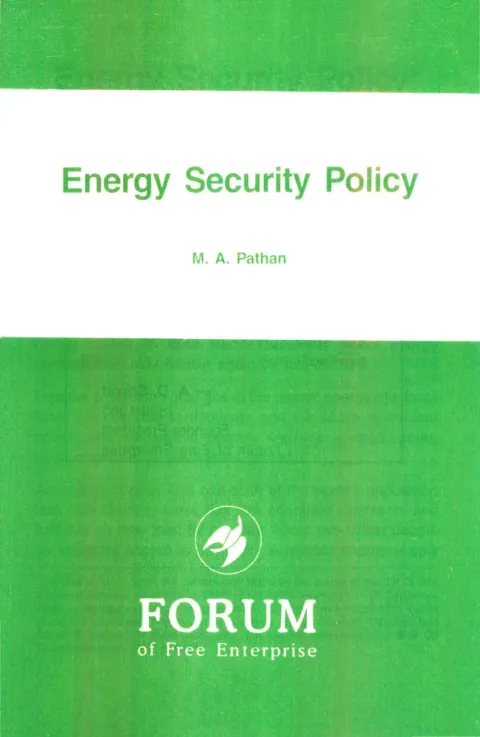
Energy Security Policy
By MA Pathan
Published by S. S. Bhandare for the Forum of Free Enterprise, "Peninsula House", 235, Dr. D. N. Road, Mumbai 400 001, and Printed by S. V. Limaye at India Printing Works, India Printing House, 42 G. D. Ambekar Marg, Wadala, Mumbai 400 031. · Mumbai · 2006
17 pages
Summary
M. A. Pathan’s Energy Security Policy is a Forum of Free Enterprise booklet adapted from his 10 December 2005 presentation at the J. R. D. Tata Memorial Seminar (organised in Mumbai by the Leslie Sawhny Endowment). Pathan, then Group Resident Director of Tata Services and formerly Chairman of Indian Oil Corporation (1997-2002), surveys the global energy outlook — worldwide consumption nearly doubled over the previous 35-40 years, fossil fuels will continue to dominate the mix, and demand from emerging economies (especially India, where GDP was growing above 8%) is set to balloon. Citing the International Energy Outlook 2005, he projects world energy use rising from 412 quadrillion Btu in 2002 to 645 quadrillion Btu in 2025, with oil prices climbing from US $10.29/barrel in 1998 to over US $65/barrel in 2005 and the International Energy Agency estimating that $17,000 billion of investment is required globally by 2030.
The booklet’s argumentative spine is that energy security must rest on two principles: minimising the energy needed to deliver services, and securing diverse access to supply and technology. India, with 17% of the world’s population but only 0.8% of known oil and gas, imports over 70% of its crude and is acutely exposed — a US $10 rise in oil price knocks roughly 1% off GDP and adds 2.6 percentage points to inflation. Pathan calls for an Energy Vision 2050 building on the existing Hydrocarbon Vision 2025, the consolidation of oil, gas, coal, power, renewables and nuclear under a comprehensive Ministry of Energy, the creation of strategic reserves, a separate Asian benchmark crude, and aggressive equity-oil investment abroad (citing ONGC Videsh, GAIL, OIL and the new ONGC-Mittal company).
On the demand side he is unambiguously a price-and-incentives liberal: subsidised and free power to agriculture is condemned as “large scale wastages” that lull users into profligacy, while fiscal incentives, standards-and-labelling, benchmarking, building codes and time-of-day metering are urged to drive efficiency. India’s energy intensity, he notes, is 2.88 times that of rich countries. On supply, he advocates coal gasification with carbon sequestration, coal-bed methane, gas-to-liquid technology, thorium-based nuclear reactors, biomass and bagasse co-generation, Jatropha-based bio-diesel on India’s 30 million hectares of available wasteland, ethanol blending, and the National Hydrogen Energy Roadmap (then just presented by Ratan Tata, chairman of the Steering Group on Hydrogen Energy). The closing pages tie energy security to tariff design, an Oil Price Stabilisation Fund, defence postures protecting maritime routes and foreign policy — and insist that national energy policy must be “depoliticized” if it is to deliver in the long term.
Key points
-
Pathan frames energy security around two principles: minimising energy needed to deliver services, and securing diverse, affordable, sustainable access to supply and technology.
-
India’s exposure is structural — 17% of world population but 0.8% of known oil and gas, with crude imports already above 70% of requirement and projected to exceed 85% within two decades.
-
A $10/barrel oil price increase cuts Indian GDP by roughly 1% and adds about 2.6 percentage points to inflation, anchoring the booklet’s macroeconomic case for energy security.
-
He calls for an Energy Vision 2050 extending the Hydrocarbon Vision 2025, a comprehensive Ministry of Energy unifying oil, gas, coal, power, renewables and nuclear, and a strategic petroleum reserve.
-
Subsidised and free power — especially to agriculture — is sharply criticised as encouraging profligacy; market-aligned tariffs, time-of-day pricing, standards-and-labelling, and fiscal incentives are urged in its place.
-
Supply-side diversification is multi-pronged: coal gasification with carbon sequestration, coal-bed methane, gas-to-liquid, thorium reactors and fusion R&D, Jatropha bio-diesel on 30 million hectares of wasteland, ethanol blending, and the National Hydrogen Energy Roadmap.
-
Regional integration is central — Asian benchmark crude, gas pipelines from Myanmar/Bangladesh/Turkmenistan/Iran, diesel exports to Pakistan, equity stakes in Sri Lanka, and overseas equity-oil acquisitions by ONGC Videsh, GAIL, OIL and the new ONGC-Mittal vehicle.
-
Energy security must reshape adjacent policy domains — tariff and tax structure, defence (maritime route protection), foreign policy, and an Oil Price Stabilisation Fund — and must be ‘depoliticized’ for durable effect.
Metadata and summary are AI-extracted from the source PDF and reviewed for editorial accuracy. The original work is available via the Read PDF tab above (where present); paragraph-level citation inside the PDF is deferred to a future engagement.