speech · memorial lecture
Education and India's Poverty
By V. V. John
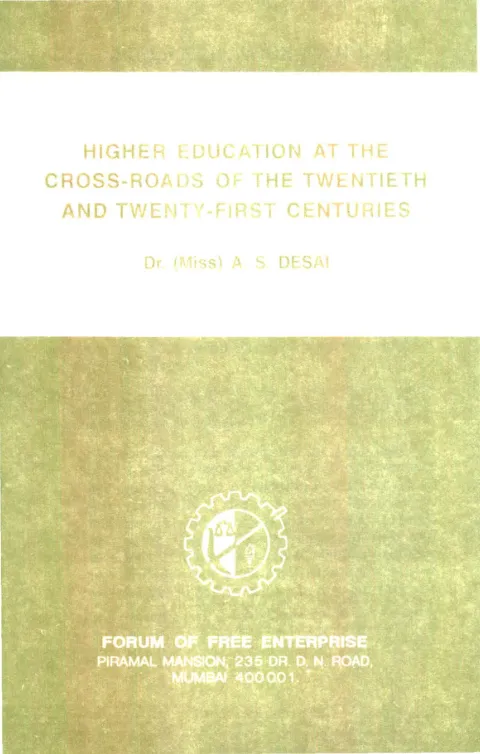
FORUM OF FREE ENTERPRISE, PIRAMAL MANSION, 235 DR. D. N. ROAD, BOMBAY 400 001. · Bombay · 1975
21 pages
No. 10 in A. D. Shroff Memorial Lecture
Summary
Delivered as the tenth A. D. Shroff Memorial Lecture under the auspices of the Forum of Free Enterprise in Bombay on 27 October 1975, V. V. John’s address argues that India’s poverty is at root an educational problem and that the country’s universities and colleges have failed in their duty to the poor. John, a former Vice-Chancellor of Jodhpur University, opens by saluting the scholarly studies of poverty by Dandekar and Rath, Fonseca, and Dantwala for moving the debate beyond sentimental generalities, but insists that poverty is ultimately a moral problem whose solution requires the active engagement of the intellectual class. With more than 250 million Indians, including 100 million children, going to bed hungry, he argues, compassion cannot be allowed to retreat into either economic technicality or the convenient fatalism he sees creeping into developed-country attitudes towards the Third World.
The heart of the lecture is an indictment of Indian higher education as a “scandalous pyramid of privileges” subsidised by public funds for an academically privileged minority that returns little of value to the society that paid for its training. John mocks the brain drain debate as a “clever hoax,” derides teachers’ “relay hunger strikes” for higher emoluments in a country of literal hunger, and laments that the dream of every educated Indian is “a full-time salary for part-time work.” The expansion of enrolments since the Kothari Commission has, in his telling, produced an illusion of opportunity rather than meaningful qualifications, while a privileged sector at the top consumes per-capita expenditure ten or fifteen times higher than the rest.
John then turns to the politics of property and land reform, criticising progressives who would strip the right to property from the Constitution without distinguishing widely distributed small ownership from plutocratic concentration; drawing on Chesterton’s debate with Yeats and on Henry George’s Progress and Poverty, he defends small property as a safeguard of liberty against both private and state power. He rejects the GNP-first economics that asks the poor to wait for trickle-down, attacks the cult of “selective” quality education that screens out the children of the poor, and dismisses the equality preached by Coleman and Jencks as a narrow income-equality that education cannot deliver. Education’s task, he concludes, is not to flatten differences but to enable every person’s full self-development; commitment to a social order that disperses both economic and political power is, in his closing words, “a necessary postulate to any system of education aiming at the full development of human resources.”
Key points
-
Frames poverty as ultimately a moral and educational problem, not merely an economic one, and assigns educationists a primary share of responsibility for tackling it.
-
Cites a conservative reckoning that over 250 million Indians, including 100 million children, go to bed hungry every night, to anchor the lecture’s stakes.
-
Indicts Indian universities and colleges as a ‘scandalous pyramid of privileges’ funded by public money but yielding little public return.
-
Dismisses the brain-drain lament as a ‘clever hoax’ staged by entrenched experts to inflate their own scarcity value.
-
Defends widely distributed small property — citing Chesterton’s debate with Yeats — as a bulwark against both private plutocracy and state bureaucracy, and warns against abolishing the right to property without distinguishing kinds of ownership.
-
Attacks GNP-maximising economists who ask the poor to wait for redistribution and criticises ‘selective’ quality education that excludes children of the poor.
-
Disputes the sociological notion of equality drawn from Coleman, Jencks, Jensen and Eysenck, arguing that genuine equality is moral and spiritual, realised through self-fulfilment rather than equalised incomes.
-
Concludes that the right kind of education and a just social order — one that prevents concentration of wealth or power in either private hands or the state — are mutually constitutive.
Metadata and summary are AI-extracted from the source PDF and reviewed for editorial accuracy. The original work is available via the Read PDF tab above (where present); paragraph-level citation inside the PDF is deferred to a future engagement.