speech
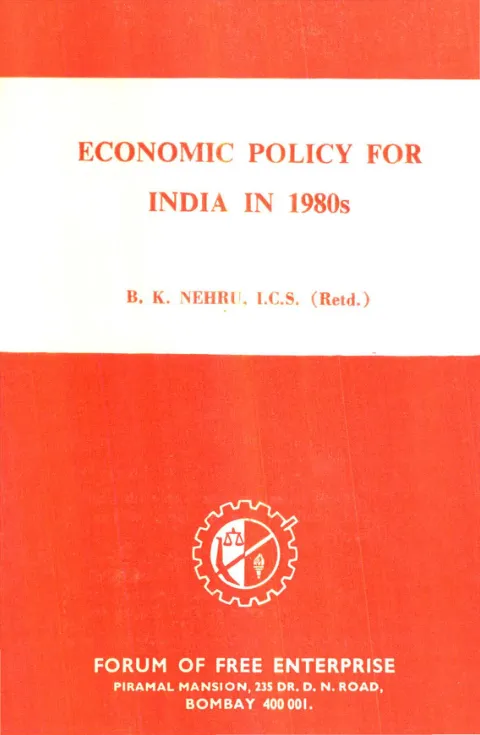
ECONOMIC POLICY FOR INDIA IN 1980s
By BK Nehru
FORUM OF FREE ENTERPRISE, PIRAMAL MANSION, 235 DR. D. N. ROAD, BOMBAY 400 001. · Bombay · 1983
15 pages
Summary
Delivered as a lecture at the Leslie Sawhny Programme in New Delhi on 17 March 1983 and published as a booklet by the Forum of Free Enterprise, this essay by B. K. Nehru — former civil servant, distinguished economist, and then Governor of Jammu and Kashmir — offers a candid retrospective on India’s first thirty-five years of economic policy and a forward-looking case for liberalising the economy in the 1980s. Nehru redefines the conventional label ‘mixed economy’ for India, arguing that what India actually runs is a command economy with a small residual market — production, distribution, pricing, and technology choices are all directed by government regardless of ownership.
He traces the genesis of this system to the wartime controls inherited at Independence, the post-Depression fashion for socialism that captured Indian students in 1930s Britain (himself included), Jawaharlal Nehru’s powerful Fabian leanings and admiration for the Soviet Union, and the objective shortages of capital, foreign exchange, industry and entrepreneurial talent that made directive policy seem necessary. He grants real achievements — the build-out of physical infrastructure, the development of basic industries, the breakthrough in agriculture, and the creation of a large cadre of managers, scientists, engineers and entrepreneurs that India now exports. But he is unsparing about the failures: a miserly 3.5% average growth rate, demographic growth of 2.15% leaving per-capita gains at 1.35%, 48% of the population below the subsistence-level poverty line, 5.6% compounded inflation over 35 years, a bloated and unproductive public sector, and the cancer of corruption that has, in his view, virtually collapsed the administration.
From this diagnosis Nehru argues that the objective conditions which once justified controls have changed: India now saves over 20% of GNP, has built creditworthiness in international markets, and possesses a surplus of trained manpower. He prescribes a five-part programme — move decisively from a command economy to a regulated market economy; reform the loss-making public sector and shed accretions kept alive only to provide jobs for MLAs; rebuild the administration; restructure the borrowed British-style trade union framework; and index money to deal with permanent inflation that is distorting depreciation, taxation, and wage differentials. He closes by naming the three vested interests — politicians, bureaucrats and established industrialists — that profit from the present system at the expense of the common man and therefore block reform.
Key points
-
Nehru argues India does not have a true ‘mixed economy’ but a command economy with a small market residue — government dictates what is produced, by whom, with what technology, for whom, and at what price, regardless of ownership.
-
He traces the system’s origins to wartime controls, the 1930s fashion for socialism in British universities, Jawaharlal Nehru’s Fabian and pro-Soviet leanings, and objective shortages of capital, foreign exchange, industry and entrepreneurs at Independence.
-
Successes credited to the system include the build-out of infrastructure (roads, railways, power, steel, cement, fertilisers), basic-goods industries, agricultural development, and a deep stock of managers, technicians and entrepreneurs.
-
Failures itemised: 3.5% average growth on a tiny base, population growth of 2.15% leaving per-capita gains of only 1.35%, 48% of Indians below the poverty line, 5.6% compounded inflation over 35 years, a wasteful public sector, and endemic corruption.
-
The ‘objective conditions’ have inverted — India now saves over 20% of GNP, has international creditworthiness, and a surplus of trained manpower — so the rationale for controls is gone.
-
Reform programme: shift from a command economy to a regulated market economy, fix the public sector and shed jobs-for-MLAs accretions, revamp administration, restructure UK-borrowed trade unions, and index money against permanent inflation.
-
Three resistances stand in the way of change: ideological loyalty to a 1947 vintage of socialism that the rest of the world has abandoned; and the vested interests of politicians, bureaucrats and established industrialists who benefit from the status quo — the present system ‘harms only the common man.’
Metadata and summary are AI-extracted from the source PDF and reviewed for editorial accuracy. The original work is available via the Read PDF tab above (where present); paragraph-level citation inside the PDF is deferred to a future engagement.